
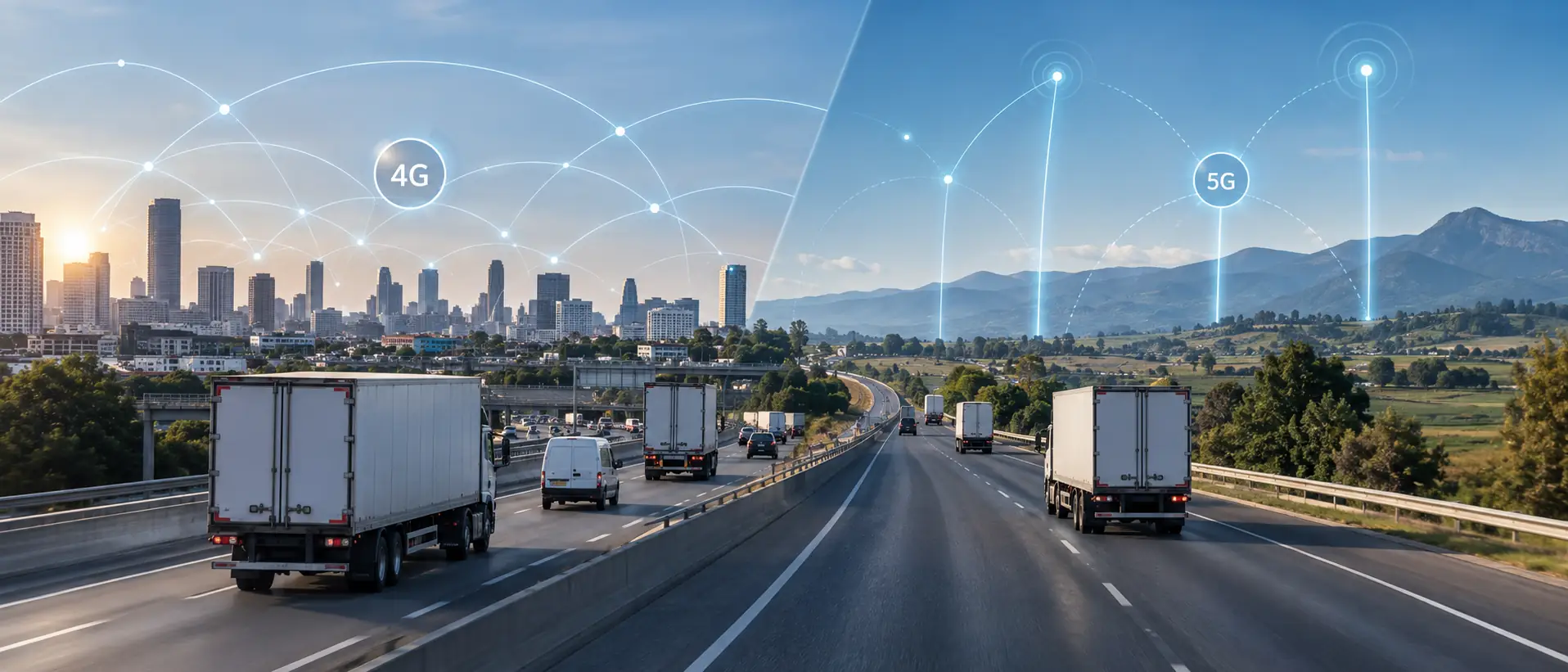
The real-world gap between 5G and 4G dash cams in fleet environments is far smaller than it is on smartphones. 5G is theoretically 100x faster than 4G, but for in-vehicle video monitoring, 4G already satisfies more than 95% of needs. Meanwhile, 5G hardware costs at least 50–80% more, and data-plan expenses can double or triple.
Many buyers see “5G” and assume it’s the future—and worry they’ll fall behind if they don’t buy in. But for B2B fleet scenarios, technology decisions can’t be driven by marketing hype. They have to be driven by ROI: does the extra money deliver equivalent value?
- For now (2025–2026), 4G is the optimal choice for fleet dash cams—mature technology, broad coverage, reasonable cost, and enough performance for the vast majority of use cases.
- The “killer app” for 5G in fleet dash cams hasn’t arrived yet. Today’s main advantages are speed and latency, but those deliver diminishing returns for vehicle video monitoring.
- 5G’s biggest problem right now isn’t the technology—it’s coverage. Highways and remote areas still have large 5G gaps, so long-haul fleets often can’t use it at all.
- The cost gap is significant: 5G devices are 50–100% more expensive, data plans are 2–3x more expensive, and the efficiency gains are limited—so the payback period is long.
- Recommended strategy: Deploy 4G now, and revisit 5G in 2–3 years when coverage is broader, device costs have dropped, and truly 5G-dependent applications exist.
If you’re currently comparing 5G and 4G vehicle recorders, finish this article first. Understand the real gap between 5G and 4G in fleet scenarios before making a decision—after all, you’re buying dozens or hundreds of units, and the wrong choice is costly.
The Hype vs. Reality of 5G for Fleet Dash Cams
5G has been heavily marketed in recent years—IoT, autonomous driving, remote surgery, all kinds of high-concept buzzwords. Many people hear “5G” and assume it must be powerful and future-proof. But in the specific case of fleet dash cams, what does 5G actually deliver? Is it genuinely useful, or mostly marketing?
What 5G Actually Promises vs. What Delivers Today
5G isn’t a single technology. it’s a set of standards with three main application scenarios:
- eMBB (Enhanced Mobile Broadband):Higher speeds, up to ~10 Gbps download and ~1 Gbps upload. This is the easiest to understand and the most mature 5G application today.
- uRLLC (Ultra-Reliable Low-Latency Communications):Latency as low as 1 ms with 99.999% reliability. Used for industrial control, autonomous driving, and other real-time-critical scenarios. But the standards and commercialization for this are still evolving.
- mMTC (Massive Machine-Type Communications):Supports millions of devices per square kilometer. Used for smart cities and large-scale IoT sensor networks.
For in-vehicle video monitoring, the only directly relevant 5G benefit is eMBB—faster upload speeds. The other two scenarios matter little for dash cams:
- Vehicle video monitoring only needs second-level latency. 4G’s 2–5 second latency is more than enough.1 ms ultra-low latency is unnecessary.
- A typical fleet vehicle has one device per vehicle, so there’s no massive-connection problem—mMTC isn’t needed.
The most practical improvement 5G offers dash cams is faster uploads and clearer video. But 4G can already stream 1080p and even 4K video—so how much faster is actually necessary?
Why Fleet Dash Cams Are Different from Consumer 5G Use Cases
Why smartphone experience doesn’t translate to fleet devices
Many buyers apply their smartphone experience to in-vehicle devices: 5G phones feel much faster than 4G phones, so 5G dash cams must be far better too. But in-vehicle and smartphone use cases are fundamentally different:
- Usage pattern:Smartphones are used by people actively consuming content, consuming high bandwidth continuously. Dash cams only upload video when an event is triggered.most of the time data volume is very low. Peak bandwidth matters far less for a recorder.
- Usage environment:Smartphones are mainly used in cities and indoors, where 5G coverage is strongest. Vehicles go everywhere—highways, suburbs, mountains, rural areas—where 5G coverage is often weak or nonexistent.
- Cost sensitivity:A smartphone is a personal purchase.a few hundred RMB more may not matter. Fleet purchasing is bulk buying—dozens or hundreds of units. A few hundred RMB per device becomes tens or hundreds of thousands in total, plus ongoing data costs.
- Lifecycle:Smartphones are replaced every 1–2 years, so rapid technology turnover is fine. Fleet devices are used for 3–5 years or longer, so technology choices must prioritize maturity and long-term stability.
Here’s the simplest example: buying a 5G phone for use mostly in the city, where 5G signal is strong, delivers a great experience. But a 5G recorder installed in a truck that spends every day on highways and long-haul routes will constantly lose 5G signal and fall back to 4G—so where is the 5G value?
GreatWill has discussed this topic with many fleet customers. Most conclude the same thing after hearing the analysis: 5G is good technology, but now is not the right time. Start with 4G, and upgrade later when 5G coverage improves, prices drop, and there are real 5G-dependent applications.
Speed and Bandwidth: How Much Difference Does 5G Make?
Speed: 5G’s most intuitive advantage.
Theoretical vs. Real-World Speeds
Speed is 5G’s most intuitive advantage. 5G’s peak downlink reaches 10 Gbps with 1 Gbps uplink. 4G LTE’s peak downlink is around 1 Gbps with 50–100 Mbps uplink. But note: these are “peak” and “theoretical” figures. Real-world usage is nothing like that:
- 4G real-world experience:Under normal network conditions, 4G uplink typically runs 5–30 Mbps. That’s more than enough for 1080p 30fps video, and can even handle 4K (which needs about 10–20 Mbps).
- 5G real-world experience:In well-covered urban areas, 5G uplink reaches 50–200 Mbps—genuinely much faster than 4G. But in suburbs and on highways, where 5G coverage is weak, speeds can fall below 4G.
- Speed in motion:At high vehicle speeds, 5G degrades more severely than 4G—because 5G uses higher frequency bands, has smaller cell coverage, and hands off more frequently. On the highway, 5G’s real-world experience can be about the same as 4G, or even worse.
For in-vehicle video monitoring, uplink speed is the key—because the main traffic is uploading video. Let’s do the math:
- 1080p 30fps live streaming:Needs 2–4 Mbps uplink → 4G is fully sufficient.
- 4K 30fps live streaming:Needs 10–20 Mbps uplink → 4G can support it where signal is good.
- Multi-channel simultaneous streaming:E.g., 3 channels of 1080p at once need 6–12 Mbps → 4G handles this too.
See? Even 4K live streaming is within 4G’s capabilities. So what’s the point of 5G’s higher speed? Honestly, for current applications, not much—because 4G is already enough.
When Higher Bandwidth Actually Matters for Fleets
That’s not to say 5G bandwidth is completely useless. In specific scenarios, higher bandwidth does add value:
- Multi-channel 4K streaming:If a vehicle carries 4–6 cameras all streaming 4K simultaneously, 4G may struggle and 5G handles it more comfortably. But this is rare—most fleets need 2–3 channels, and not necessarily 4K.
- Fast large-file download:When you need to pull a full recording remotely (e.g., complete accident footage), 5G transfers faster. But this need is infrequent, and a delay of a few dozen seconds doesn’t matter.
- Remote AI model updates:If on-device AI models need frequent over-the-air upgrades and the files are large, 5G completes them faster. But AI model updates are infrequent—maybe every few months—so slower is fine.
- Multi-vehicle aggregation:If dozens of vehicles parked at the same depot upload data at once, 5G’s capacity advantage shows. But this is a special case, not a daily norm.
These scenarios exist, but they’re niche. For 90%+ of fleets, 4G bandwidth is fully sufficient. The speed gain 5G brings does not justify its much higher cost.
In GreatWill’s commercial 4G dash cam wholesale projects, almost no customer has asked to move to 5G because “4G speed isn’t enough”—because it truly is. Many customers initially worried about speed, but were reassured after real-world testing.
Latency: Does 5G’s Low Latency Matter for Dash Cams?
Low latency is 5G’s other core selling point—1 ms ultra-low latency sounds impressive. But for dash cams, does low latency actually matter?
What Latency Actually Means for Fleet Monitoring
What is latency? Latency is the time gap between “the event happens” and “you see the picture.”
- 4G live-stream latency:Typically 2–5 seconds,well-optimized solutions reach 1–2 seconds.
- 5G live-stream latency:Theoretically under 100 ms,real commercial use is around 500 ms to 1 second.
5G latency is indeed lower. But the question is: for fleet monitoring, is there an essential difference between 2-second and 0.5-second latency? Let’s walk through the main fleet monitoring scenarios:
- Accident emergency response:A collision happens, the system auto-uploads video, and you see it in the office. Does a 1–2 second gap affect your decision? Not at all—you file the insurance claim, you call for rescue,those one or two seconds don’t matter.
- Real-time dispatch:Dispatchers watch live footage to understand road conditions. Does seeing it one or two seconds later affect dispatch decisions? No.
- Remote driver intercom:Real-time voice through the device. A 2-second-latency call is already good—like a normal phone call. 0.5-second is slightly better, but barely perceptible.
- Remote vehicle control:This genuinely needs low latency, but current regulations don’t allow remote vehicle control, and won’t in the near term.
In fleet monitoring, 5G’s low latency is a “nice to have, but not having it doesn’t affect usage at all” feature.
The Real Bottleneck Isn’t Network Latency
End-to-end latency isn’t just network latency—it also includes encoding, decoding, and processing latency. The network is only one link:
- Encoding latency:The camera captures and compresses the image, which takes time. H.264/H.265 encoding adds several to a dozen-plus frames of latency—tens to hundreds of milliseconds.
- Network latency:Data travels from device to cloud to user—this is the 4G/5G latency difference.
- Decoding latency:The user’s end decodes and plays—also takes time.
- Cloud processing latency:If video goes through AI analysis, transcoding, etc., that adds latency too.
For fleet management, the real latency bottleneck isn’t the network—it’s human decision-making speed. After you see the video, you must assess the situation, make a decision, and take action—a process that takes at least seconds, even tens of seconds. Compared to that, a one- or two-second network difference is nothing.
Selling dash cams on 5G low latency is essentially charging a premium for a feature customers don’t need.
Network Coverage: The Biggest Practical Gap
If the gap in speed and latency is a question of “is it useful,” then the coverage gap is a question of “can you even use it.” 5G’s biggest hard weakness right now is coverage—especially on the highways and remote areas fleets routinely travel.
Urban vs. Highway and Rural Coverage
The root of 5G’s coverage problem is its frequency bands. 5G uses much higher frequencies than 4G (Sub-6 GHz, even millimeter wave). The higher the frequency, the shorter the wavelength, the worse the penetration, and the smaller the coverage area.
- Urban coverage:5G coverage in city cores is already fairly good—high base-station density enables near-continuous coverage. This is why many people think 5G is great: they use it in the city, where the signal really is solid.
- Highway coverage:Highway 5G coverage is much worse. Highways are long with relatively low traffic, so carriers have little incentive to build stations. Many highway stretches still have only 4G.
- Suburbs and rural areas:Coverage here is even weaker,many places don’t even have full 4G bars, let alone 5G.
- Remote areas:Mountains, deserts, borders—if 4G reaches these at all, that’s already a win,5G simply can’t.
For fleets, this is a very real problem. Your vehicles don’t only run inside cities—long-haul transport, intercity delivery, rural routes are all routine fleet operations. In these scenarios, a 5G device is often just a 4G device—because there’s no 5G signal.
So you paid 5G prices for equipment that spends most of its time on the 4G network. Was that money well spent?
Why This Matters More for Commercial Fleets
Why coverage hurts commercial fleets far more than individual users
Coverage matters far more to commercial fleets than to personal users, for several reasons:
- Wide operating range:Individual users spend most of their time in a fixed city,fleet vehicles go everywhere—nationwide, even cross-border. The wider the operating range, the more obvious 5G’s coverage gaps become.
- High reliability requirement:Fleet equipment is a production tool, not an entertainment device. If video can’t upload or location can’t report, it can directly affect accident handling and operations management. The device must work stably in any scenario.
- High consistency requirement:Fleet management needs uniform standards and experience. You can’t have HD live streaming in the city but nothing transmits in the suburbs—that makes management chaotic.
- Long payback period:Fleet equipment is used 3–5 years. If you pay a premium for 5G now but wait 2–3 years for coverage to catch up, the first few years of that money are wasted.
Among GreatWill’s customers, some do urban delivery and some run long-haul trunk routes. Urban-delivery customers are somewhat interested in 5G—city coverage is decent, after all. Long-haul customers almost uniformly choose 4G—because they know full well that 5G is unusable on the road.
GreatWill’s 4G truck dash cam is optimized for long-haul trunk routes and heavy trucks—full-network 4G, strong signal reception, low-power design, stable work anywhere in the country. For long-haul fleets, stability and reliability matter more than anything.
The 5G Coverage Build-Out Timeline
“5G coverage is bad now, but it’ll improve—won’t 2–3 years fix it?”
That’s true, but you have to look at the timeline. Based on common industry forecasts:
- Urban 5G coverage:2025–2026 will basically complete continuous coverage of major cities—this is already nearly done.
- Highway 5G coverage:Major highway trunk routes aren’t expected to have good 5G coverage until 2027–2028.
- National/provincial road 5G coverage:Possibly 2029–2030 or later.
- Rural and remote 5G coverage:No timetable—may never happen, because carriers also calculate ROI,building 5G where few people are isn’t cost-effective.
If you buy 5G equipment now, you may wait 2–3 years before using 5G on most operating routes. So for those 2–3 years, isn’t the extra money wasted? And 2–3 years from now, 5G hardware prices will definitely drop a lot—upgrading then offers far better value.
Cost Comparison: 5G’s Price Premium vs. Value
How much more is 5G, and does the extra money buy equivalent value?
Hardware Cost Difference
Start with hardware procurement. 5G modules cost significantly more than 4G modules—the most direct cost difference:
- 4G modules:Mainstream commercial-grade 4G modules cost roughly tens to a bit over a hundred RMB, varying by brand and spec.
- 5G modules:Mainstream 5G modules cost roughly 200–400 RMB—about 2–3x the 4G price.
The module is only part of the cost. Other 5G device components are also more expensive:
- Main chip:Supporting 5G’s high speeds demands more computing power, so the chip itself costs more.
- PCB design:High-frequency signals require higher PCB standards—more layers, more complex processes.
- Antenna:5G antenna design is more complex and needs more antenna elements, raising cost.
- Thermal management:5G modules consume more power, so thermal design must keep up—otherwise they throttle or even crash.
A 5G dash cam’s hardware cost runs 50–100% or more above a comparable 4G unit. This gap will narrow as 5G spreads, but won’t disappear short-term.
Data Plan and Subscription Costs
Hardware cost is one-time,data fees are ongoing. How much more are 5G data plans?
- 4G IoT plans:Roughly 1–3 RMB per GB, cheaper on monthly packages. A vehicle at 5 GB/month is about 10–20 RMB.
- 5G IoT plans:Roughly 3–8 RMB per GB—about 2–3x 4G. The same 5 GB is about 20–50 RMB.
Why is 5G data more expensive? Because 5G network buildout costs are high and carriers must recoup investment. Also, 5G is fast, so users unconsciously consume more data—like moving from narrowband to broadband: faster speeds mean more usage.
Total Cost of Ownership (TCO) Analysis
Combining hardware and data, here’s a simple TCO (total cost of ownership) comparison:
Example for comparison,specific numbers require contacting GreatWill.
Assumptions: fleet size 100 vehicles,usage period 5 years.
- 4G plan:Hardware 1,500 RMB/unit, data 15 RMB/month → hardware 150,000 + data 90,000 = 240,000 RMB.
- 5G plan:Hardware 2,500 RMB/unit, data 35 RMB/month → hardware 250,000 + data 210,000 = 460,000 RMB.
The 5G plan’s total cost is nearly double the 4G plan. So what value does the extra 220,000 RMB buy?
- Faster upload? But 4G is already enough.
- Lower latency? But 2-second latency is already good.
- Better coverage? Actually 5G coverage is worse.
- More features? Currently no 5G-exclusive killer feature.
ROI is clear once calculated: the 4G plan pays back in about 1–2 years (through lower accident rates, reduced claims, and improved management efficiency), while the 5G plan may take 3–4 years or longer. For pragmatic fleet managers, the choice is obvious. For details, see GreatWill’s 4G dash cams for fleet operating cost.
Use Cases Where 5G Might Actually Make Sense
Urban Delivery and Last-Mile Fleets
Why does this scenario suit 5G? Because the vehicles run inside cities, where 5G coverage is good. And urban-delivery vehicles typically operate during the day and return to depot at night, so the operating pattern is concentrated.
- Good 5G coverage:City cores have continuous 5G coverage, so devices mostly run on the 5G network.
- Frequent dispatch:Urban-delivery fleets are large, routes are complex, and dispatch is frequent—so real-time video and location data are more valuable.
- More AI use:Complex city traffic drives stronger demand for AI-assisted driving and driver monitoring, and 5G better supports cloud-based AI analysis.
But even in this scenario, 5G isn’t “mandatory”—4G works just as well, only with a slightly worse experience. Whether the experience difference justifies paying double comes down to the fleet’s budget and needs.
Specialty Vehicles with High-Bandwidth Needs
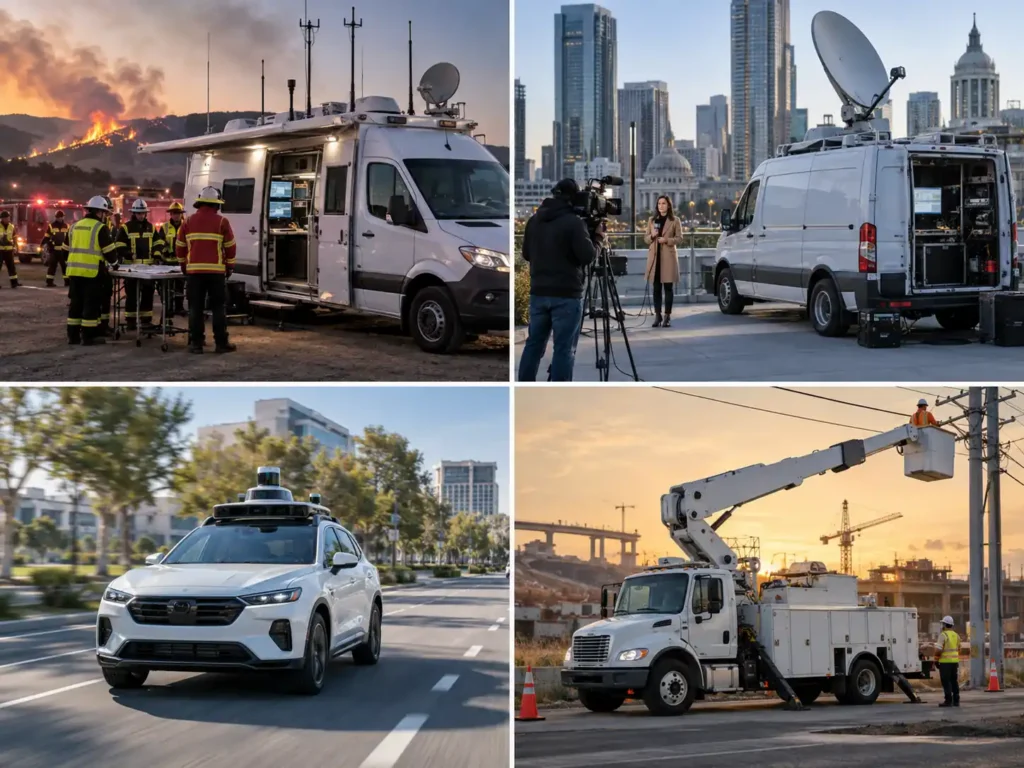
For example:
- Emergency command vehicles:Need multiple HD video streams back to the command center in real time—high bandwidth demand.
- News live-broadcast vehicles:Needless to say, they require HD live streaming.
- Autonomous-driving test vehicles:Need to send large volumes of sensor data to the cloud in real time—very high bandwidth demand.
- Special engineering vehicles:Remote control and remote diagnostics need high bandwidth and low latency.
In these scenarios, 5G’s high bandwidth and low latency genuinely deliver. But these are very niche, special-purpose cases—not mainstream fleet needs. Most fleets just do transport and don’t need that much bandwidth.
Fleets Planning for Long-Term Infrastructure
Some large enterprises or logistics companies plan 5–10 years out. When they procure equipment now, they look not only at today’s needs but also at future extensibility.
- Long device lifecycle:If equipment is used 5–7 years, then once 5G coverage is complete it can be used—without being retired too early due to obsolescence.
- Ample budget:Large enterprises have relatively generous budgets and can absorb the 5G premium as a bet on the future.
- Tech-exploration needs:They have dedicated teams for technology exploration and pilots, and are willing to invest in new tech.
GreatWill’s fleet-management 4G dash cam solution also supports customer 5G pilots—contact GreatWill for customization, though a MOQ (minimum order quantity) applies. If you genuinely want to see how 5G performs in your fleet, get a few 5G sample units from us and test them. Let the data speak, then decide whether to go all-in.
Why 4G Is the Sweet Spot for Most Fleets Right Now
After all those 5G scenarios, you’ll notice one thing—over 90% of fleets don’t fall into those special cases. For the vast majority, 4G is the best choice right now.
Mature Technology and Proven Reliability
4G technology is already extremely mature—network, modules, devices, and applications, the whole supply chain is mature.
- Mature network:4G coverage is already very complete,even remote areas basically have 4G signal. For fleets, working stably comes first.
- Mature modules:After more than a decade of iteration, 4G modules have well-polished stability, power consumption, and compatibility. Failure rates are low, so you can use them with confidence.
- Mature devices:4G dash cams have evolved for years,solution design, manufacturing process, and quality control are all mature. Every pitfall has been hit and fixed, so the products are stable.
- Mature platform:4G in-vehicle video platforms have developed for many years—complete features, and the user experience is well-validated.
That means low failure rates, low O&M cost, and peace of mind. For fleets, equipment is a production tool—stability and reliability matter more than any new feature.
GreatWill has built 4G in-vehicle devices for years, our products are validated by hundreds of thousands of vehicles across markets (Brazil / Latin America / Africa). We know what problems arise in what scenarios and how to solve them—welcome to consult! Mature products, complete solutions, top-tier technology—GreatWill’s premium 4G dash cams are here for you.
Optimal Cost-Performance Ratio
4G offers the best value for money
- Reasonable hardware cost:4G recorder prices have dropped to a sensible level that most fleets can afford.
- Controllable data cost:4G plans are cheap, daily data usage stays low, and fleet budgets are easy to manage.
- Low O&M cost:Stable devices, low failure rates, and low after-sales and O&M costs.
- Short ROI period:The investment is modest but the value is clear—lower accident rates, reduced claims costs, improved management efficiency—typically paying back in 1–2 years.
Upgrade Path: How to Plan for the 5G Transition
Pilot First, Scale Later
- Pick a small subset of vehicles (say 5–10 units), deploy 5G devices, and run them for 3–6 months.
- Focus on observation: actual 5G coverage on your operating routes, speed performance, and stability.
- Measure cost: what’s the actual data consumption? How much more does 5G cost vs 4G?
- Evaluate value: does the experience gain justify the extra spend? What real help does it bring your business?
- Based on pilot results, decide whether to scale up—go all-5G, stick with 4G, or deploy 5G on select routes.
GreatWill supports flexible cooperation models—sample-unit testing, small-batch pilots, and per-project collaboration all work.
Choosing a Forward-Compatible Platform
A platform ready for future 5G upgrades
What does this mean? You use 4G devices now, but the platform is the same—when you later want to upgrade to 5G, you only swap the devices, the platform stays, data is preserved, and accounts don’t need rebuilding. A smooth transition.
- Unified platform:Both 4G and 5G devices connect to the same management platform—same UI, same logic, same data format.
- Connected data:Historical data is retained,new-device data flows in automatically, with no data gap.
- Unchanged accounts:Admin and driver account permissions don’t need reconfiguration.
- Compatible APIs:If you’ve done system integration, the interfaces don’t change—new devices connect automatically.
GreatWill’s cloud SaaS platform supports both 4G and 5G devices on a unified architecture. Later, you can move smoothly from 4G to 5G via software upgrades or other operations. Specific technical details require consultation.
Frequently Asked Questions
How much faster is a 5G dash cam than 4G, really? Is the difference big in practice?
Where 5G signal is good, 5G upload speed is roughly 2–5x 4G—genuinely faster. But note two caveats. First, this gap only appears where 5G coverage is good, on long-haul or suburban routes, 5G signal comes and goes and most of the time it falls back to 4G. Second, faster isn’t the same as better experience—because 4G already streams 1080p and even 4K smoothly, so 5G’s extra speed is barely perceptible day to day. It’s like home broadband: 100 Mbps and 1000 Mbps both feel equally smooth for video and web browsing, the difference only shows when downloading large files.
Will buying 4G now become obsolete soon? How long will 4G networks last?
No need to worry about 4G obsolescence. First, 4G networks will operate for at least 10+ more years—just as 2G still runs in many places even after 4G became mainstream, carriers won’t decommission them easily. Second, in-vehicle device lifecycles are 3–5 years, buying 4G now easily lasts to 2029–2030, when 5G will be mature and it’ll be the right time to upgrade. Third, full 5G coverage (especially highways and remote areas) is at least 3–5 years away, buy 5G now and you’ll spend the first few years mostly on 4G anyway—the premium isn’t worth it.
Do 5G devices work on 4G, or only on 5G networks?
All 5G devices are backward-compatible with 4G and 3G, and auto-switch to 4G when there’s no 5G signal. So you won’t be stuck unable to use a 5G device where 5G is absent—it works, but you paid 5G prices for a 4G experience, which isn’t great value. If your fleet mainly runs routes with poor 5G coverage, 5G devices are even less worth it.
How much more expensive is 5G data than 4G? How much more per month for a fleet?
5G IoT plan unit prices are roughly 2–3x 4G. At 5 GB/month, 4G is about 10–20 RMB/unit and 5G about 25–50 RMB/unit. For a 100-vehicle fleet, 5G data alone costs 18,000–36,000 RMB more per year, and over 5 years that’s over 100,000 RMB. Actual costs depend on carrier, plan, and real usage—this is just a rough reference. We suggest testing sample units for 1–2 months to see your fleet’s actual consumption before estimating cost.
When is it worth going 5G now?
A few cases justify 5G now: first, fleets operating mainly in city cores with excellent 5G coverage and very high real-time video-clarity demands, second, special high-bandwidth needs 4G genuinely can’t handle, like multi-channel 4K streaming or large real-time data returns, third, large enterprises building long-term tech reserves with ample budgets who want to pre-position for the future. Apart from those, we recommend 4G now for 90%+ of fleets—best value, and upgrading in 2–3 years when 5G matures is no problem. GreatWill has done in-vehicle video for years and seen too many customers chase the new and hit trouble—paying several times more for a feature they can’t use, ending up with unstable devices and high O&M costs, and losing out in the end.
Ready to Make the Right Choice for Your Fleet?
Choose products by your real needs, don’t overpay for needs you might have in the future. If 4G is enough, go 4G, move to 5G when you truly need it. Technology is for solving problems, not for keeping up with the Joneses.
If you’re evaluating a fleet dash cam solution and aren’t sure whether to choose 4G or 5G, contact our team to discuss:
- Whether your fleet scenario fits 4G or 5G—we’ll give you an objective analysis.
- Detailed cost comparison and ROI calculation for 4G vs 5G plans.
- Sample-unit testing and pilot cooperation—test before you buy, let the data speak.
- A path plan for smoothly upgrading from 4G to 5G.
GreatWill have factories in Huizhou and Shenzhen, a mature 4G product line, and 5G R&D and pilot capability. As a professional custom fleet 4G dash cam manufacturer, we won’t push 5G just to make more money—we recommend whatever fits you best. B2B business runs on reputation, clients stick with you long-term because you’re straight with them.
Related Article Recommendations
If you’re interested in 4G dash cams and fleet technology selection, the following articles may help you:
4G Dash Cam TCO Analysis: Total Cost of Ownership for Fleets


Responses
Discussion
0 responses
No responses yet
Start the discussion with a practical question or field note related to this article.