

Every fleet spends money — but not every dollar spent actually saves money. A 4G dash cam belongs to the latter category. Unlike tires and fuel, it is not a consumable that depletes over time. It is a cost-transfer tool — converting money you’re already losing (accidents, fraud, inefficient driving, asset loss) into lower premiums, fewer disputes, and more fuel-efficient driving habits.
Key Highlights
Accident-related costs account for 15%–25% of fleet operating expenditure, a 4G dash cam can reduce accident rates by 20%–40%.
Insurers typically offer 5%–20% premium discounts for fleets equipped with 4G dash cams.
Fuel savings from improved driving behavior can reach 5%–10%, translating to tens of thousands of dollars annually for a mid-size fleet.
Remote real-time monitoring replaces manual inspections, eliminating 1–2 dedicated dispatcher positions per 100 vehicles.
A complete 4G dash cam system (hardware + platform + data) typically delivers a payback period of 6–12 months.
The Real Cost of Operating a Fleet Without 4G Dash Cams
Fleets generate costs every single day — but not every cost is clearly visible. Accident-related expenditures are scattered across repair bills, insurance renewal notices, legal consulting invoices, and downtime loss records. Fuel wasted by inefficient driving is buried within monthly fuel totals. Losses from cargo damage and vehicle misuse are often written off as “normal wear and tear.” Without surfacing these hidden costs, ROI analysis is impossible — because if you don’t know what you’re losing money on, you can’t determine what investment will stop the bleeding.
Accident-Related Costs: Claims, Lawsuits, and Hidden Losses
A moderate-severity accident carries a surface cost of $3,000 to $15,000 in repairs. But that’s not the full picture:
Insurance Premium Increases: Every claim on record drives up premiums for the next 3–5 years, with average increases of 20%–40%.
Downtime Revenue Loss: While the vehicle is in the shop, revenue stops. For a mid-size truck generating 800USD/day in revenue, two weeks of downtime equals $11,200 in direct income loss.
Legal Costs And Settlements: If the accident involves personal injury, legal fees and settlement amounts typically start at $25,000 with no upper limit.
When fault is unclear — for example, both parties at an intersection claiming right-of-way — the party without video evidence almost inevitably bears a higher share of liability. According to the American Transportation Research Institute (ATRI), fleets lose an average of 22% of total accident costs annually due to an inability to prove innocence.
How 4G dash cams change the equation: They don’t change the probability of an accident occurring — they change the efficiency of liability determination and the scale of economic loss after an accident happens.
Fuel Inefficiency: The Cost of Poor Driving Habits
Hard acceleration, hard braking, speeding, and prolonged idling have a far greater impact on fuel consumption than intuition suggests. U.S. Department of Energy testing data shows:
For a long-haul truck covering 80,000 miles per year at 4/gallon, aggressive driving burns an extra $4,000–$6,000 in fuel annually.
The value of 4G dash cams: They make these behaviors visible. Without data, driving behavior is a vague “feeling” — you suspect a driver might be aggressive, but you have no proof. With AI-powered driving behavior analysis, every hard brake, every speeding event, every anomalous acceleration comes with a timestamp and location record. This isn’t about punishing drivers — it’s about training and improvement. And every gallon of fuel saved through better driving shows up directly on the income statement.
Asset Loss: Theft, Cargo Damage, and Unauthorized Vehicle Use
Cargo theft costs the global transportation industry over $30 billion annually. For fleets carrying high-value goods (electronics, pharmaceuticals, luxury items), a single theft incident can exceed the entire annual investment in dash cam systems for the whole fleet.
A more insidious loss is unauthorized vehicle use — drivers running personal jobs after hours, with the extra mileage, fuel, and risk entirely borne by the fleet.
4G Dash Cam Capabilities:
Real-time GPS positioning and geofencing trigger instant alerts for any deviation from planned routes.
Video evidence serves directly as material for insurance claims and police reports, dramatically shortening claims cycles.
Asset security may not be the primary function of a 4G dash cam — but for certain fleet types, it may deliver the highest ROI of all.
Direct Cost Reductions: Where 4G Dash Cams Deliver Hard Savings
Accident costs and fuel waste are “possible” losses — frequency varies by fleet, and financial impact is hard to predict precisely. Direct cost savings, however, are “guaranteed” returns — the moment you deploy the system, these savings are in effect. This is the easiest ROI component to quantify and the most compelling argument when presenting an investment case to management.
Insurance Premium Reduction: Leveraging Video Data in Negotiations
Insurance discounts are the ROI source fleet operators look forward to most — but they don’t activate automatically. You need to proactively bring data to the negotiating table.
Fleets equipped with 4G dash cams typically receive 5%–20% premium discounts, depending on three factors:
Historical Accident Data — how much evidence you can show of safety improvements post-deployment (monthly/quarterly before-and-after comparisons).
Active Safety Features — whether your dash cam system includes ADAS collision warning, DMS fatigue monitoring, and other proactive safety capabilities.
Insurer Familiarity — whether your insurance partner is experienced with fleet technology discount policies.
Negotiation strategy matters. The most effective approach isn’t asking “I have dash cams, can I get a discount?” — it’s presenting three types of data:
Accident rate trend curves (pre- vs. post-deployment)
Driving behavior improvement curves (frequency decline in hard braking / speeding events)
Key exonerating video evidence from actual incidents
For a mid-size fleet with $500,000 in annual premiums, a 15% discount equals $75,000 per year — a figure that typically covers the entire annual cost of the dash cam system.
Accident Dispute Resolution: Evidence That Eliminates Ambiguity
Deliberately staging accidents or exaggerating injuries to extort compensation is far more prevalent in the commercial vehicle sector than most people realize. A classic scenario: a car “sideswipes” a truck during a lane change, then claims whiplash and demands compensation. Without video evidence, insurers typically settle rather than litigate — settlement amounts usually range from 20,000 per incident.
Fleets with dual-channel (front + rear) or even 3-channel 4G dash cams possess complete multi-angle data to reconstruct accidents. Genuine fraud attempts can result in zero payout.
From an ROI perspective: for a 50-vehicle mid-size fleet, avoiding just one crash-for-cash incident through video evidence recovers the entire deployment cost of the system.
Driver Behavior Improvement: Turning Video into Coaching
Direct cost savings are the starting point for break-even. But what makes ROI truly compelling is the sustained operational efficiency improvement that accumulates after deploying 4G dash cams.
Driver Behavior Improvement: Turning Video into Coaching
Viewing dash cams purely as “monitoring whether drivers misbehave” is the lowest-ROI usage. The high-ROI approach is turning video data into a driver training tool.
Best Practice: Each week, select 3–5 representative driving event clips — one well-handled emergency avoidance, one unnecessary hard brake, one efficient route choice — and review them in safety meetings.
Positive cases set the standard: “This is the level we expect.”
Risk cases provide scenario-based teaching: “If you encounter this situation again, what’s the correct response?”
This real-video-based training is far more effective than verbal lectures — drivers are watching their own colleagues’ actual operations, not abstract safety manuals.
Impact Data: Fleets implementing video-assisted training typically observe within 3–6 months:
15%–30% reduction in hard acceleration / hard braking events
5%–10% fuel consumption improvement
Measurable extension of wear-part replacement cycles
Remote Fleet Visibility: Fewer Inspections, Faster Dispatch
Traditional fleet management has an invisible inefficiency loop: vehicle in the field → dispatcher doesn’t know the vehicle’s exact location and status → requires manual inspections or frequent phone calls → information lag leads to slow dispatch decisions.
4G dash cam real-time streaming and GPS capability compresses this loop into a single action: open the management platform or mobile app, and all vehicles’ location, speed, heading, and live in-cab/exterior views are visible at a glance. A dispatcher can determine in seconds which vehicle is closest to the next pickup, whether a driver is fatigued, and whether any abnormal stops warrant investigation.
For a 100-vehicle fleet, remote monitoring replacing manual inspection can free up 2,000–3,000 work hours per year in dispatch and management time.
Calculating Fleet Dash Cam ROI: A Practical Framework
Payback Period = Total Investment ÷ Annual Savings
Break-Even Analysis: Plug In Your Numbers
Investment Side (Per Vehicle)
Savings Side (Annual, Per Vehicle)
Typical Payback Periods
Total Cost of Ownership: Hardware, Connectivity, and Platform
A 4G dash cam is not a “buy it and forget it” expense. It generates ongoing costs throughout its lifecycle. Understanding this cost structure is a prerequisite for accurate ROI analysis.
3-Year TCO Reference:
Approximately 200–1,800 per vehicle (including hardware + installation + data + platform). Compared to what a fleet spends annually on accidents, insurance, and fuel, this figure is typically just a fraction.
Explore the full 4G dash cam product lineup and hardware cost ranges across different models.
Learn about the long-term cost structure differences between 4G and WiFi-based solutions.
Non-Financial Returns: Compliance, Reputation, and Competitive Edge
Some ROI doesn’t show up on the income statement, but is equally important to a fleet’s long-term survival and growth. If your investment analysis for management only talks about how much money is saved while ignoring dimensions like compliance protection and customer trust, the argument is incomplete.
Regulatory data requirements for the transportation industry are tightening. The EU’s Mobility Package requires commercial vehicles to record driving time and route data. Under the U.S. FMCSA’s CSA scoring system, accident records directly impact a carrier’s safety rating. China’s requirements for dynamic monitoring of “two-passenger-one-hazardous” vehicles (commercial passenger transport, tourist transport, and hazardous goods transport) are also being continuously upgraded.
Fleets equipped with full 4G recording and cloud storage don’t need to spend weeks assembling paper driving logs and scattered onboard data when responding to regulatory inspections. 90-day cloud trajectory replay, digitally signed and time-stamped video evidence, exportable driving behavior reports — these aren’t capabilities reserved for accident response; they are the most direct foundation of confidence during annual inspections, safety audits, and major-client compliance reviews. The cost of a single compliance violation (fines + remediation + business suspension) far exceeds the deployment cost of an entire system.
Winning More Contracts: Why Fleet Buyers Prefer Monitored Carriers
In the carrier qualification assessments of large shippers and 3PL platforms, “whether real-time vehicle monitoring capability is in place” has become an increasingly important screening criterion. Fleets with dash cams demonstrate control and transparency when bidding — shippers can see real-time location and status during cargo transport. Without it, the message is simply “trust us, but you have no proof.”
This is not a theoretical inference. A growing number of logistics bidding documents explicitly list in-vehicle video monitoring as either a bonus item or a hard requirement under the “Safety and Monitoring Capability” section. A $500,000 annual transport contract won because of monitoring capability represents an ROI calculation on an entirely different order of magnitude.
Implementation Strategy for Maximum ROI
The ROI of a 4G dash cam depends on how you deploy it. Rolling out across the entire fleet at once maximizes upfront cost pressure, while prioritizing the wrong vehicles or routes may produce underwhelming early return data that undermines momentum for broader rollout.
Phased Deployment: Start Small, Scale with Data
Recommended Three-Phase Deployment
Phase 1 — Pilot (1–2 months): Select 5–10 vehicles with higher accident rates or riskier routes for priority deployment. The goal is to quickly generate comparable data — accident rate changes, driving behavior improvements, dispute resolution efficiency — which serves as hard evidence to justify fleet-wide expansion.
Phase 2 — Expansion (2–4 months): Compile the pilot vehicles’ data into an ROI report and extend coverage to the remaining 80% of the fleet. This phase focuses on optimizing the installation process and device configuration (you may discover that certain vehicle models only need a single-channel setup rather than dual-channel).
Phase 3 — Full Fleet + Optimization (Ongoing): Once the entire fleet is online, the ROI focus shifts from “cost savings” to “efficiency gains” — leveraging accumulated driving data to optimize route planning, driver scheduling, and vehicle maintenance cycles. The richer the data, the greater the optimization potential.
Fleet-specific 4G dash cam solutions— deployment plans tailored to different fleet sizes and industries.
Integrating with Your Existing Fleet Management Stack
If you’re already using a Transportation Management System (TMS) or fleet management software, your 4G dash cam should not become another standalone data silo. Choosing a dash cam platform with open API support allows vehicle location, driving behavior, video events, and alerts to be pushed directly into your existing management interface.
This means your dispatchers don’t need to switch between multiple platforms, and your data reports don’t require manual aggregation. One of the key conclusions of any ROI evaluation should be “can this device integrate into my existing system?” — not just “is this device good on its own.”
Further Reading
For a Comparison Of 4G Dash Cam Technical Solutions
For a Dedicated Analysis Of Freight Truck Fleets
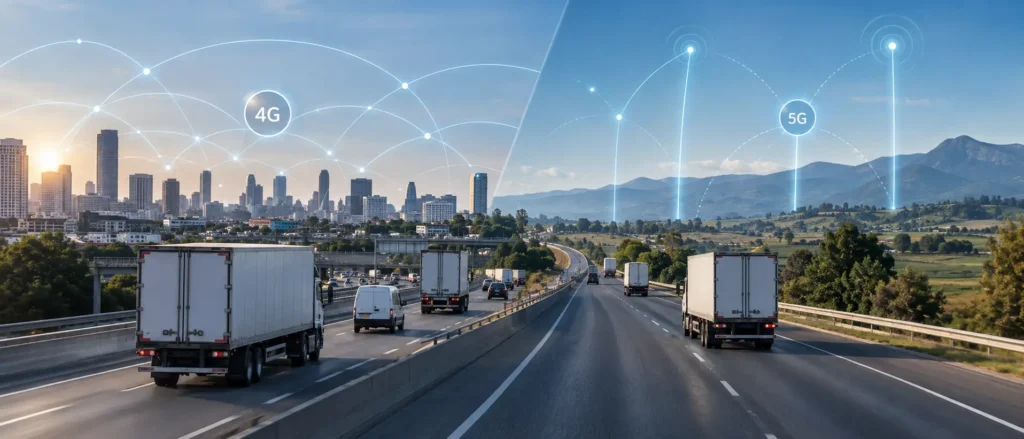
For 4G Vs. 5G Technology Selection
FAQ
Will installing a dash cam definitely lower my insurance premiums?
Insurance discounts depend on whether your insurer offers fleet technology discounts and what kind of safety improvement data you can provide. We recommend communicating with your insurance broker before deployment to confirm which data points (accident video, driving behavior scores, mileage records) are key factors in premium assessment. After 6–12 months of deployment, use the accumulated data to initiate renewal negotiations — this typically yields more favorable rates.
Is the ROI for small fleets (under 10 vehicles) the same as for large fleets?
Per-vehicle hardware and platform costs are similar, but economies of scale differ significantly. Small fleets primarily recoup their investment through accident handling and insurance discounts, with lower marginal value from efficiency gains. However, even with just 5 vehicles, avoiding a single wrongful accident or crash-for-cash incident already generates a positive return. Payback periods typically run 10–18 months — longer than for large fleets, but the return remains positive.
Is live streaming really necessary? Will data costs be too high?
Live streaming doesn’t need to run 24/7. Most fleets use an “event-triggered upload” mode — short video clips are automatically uploaded only when abnormal events occur (collisions, hard braking, geofence breaches). Under this mode, a standard 10GB/month data plan is usually sufficient. Additional data is consumed only when active remote inspection is needed (e.g., a dispatcher checking a vehicle’s real-time location and camera feed). Total data expenditure typically accounts for 10%–15% of TCO.
Will drivers resent being monitored?
The key is positioning: define the dash cam as “a tool that protects drivers” rather than “a tool that supervises drivers.” Proving innocence in accidents, reducing dispute resolution time, and securing lower insurance rates — these are benefits drivers directly experience. We recommend holding a driver communication meeting before deployment to clearly explain the scope of video data usage (no monitoring during off-duty hours, no use for purely punitive purposes) and the data protection policy.
How many years will a system last?
Hardware design life is typically 3–5 years, depending on operating environment (lifespan is shorter in regions with extreme heat and sun exposure). SD storage cards should be replaced every 2–3 years. Platform and firmware updates are delivered continuously via OTA — there’s no “system obsolescence” issue.
What is the biggest ROI trap?
Buying but not installing. Installing but not reviewing. Reviewing but not acting. Hardware deployment is only the first phase of ROI — the real savings come from continuous data analysis and behavior improvement, which requires fleet management to invest effort and establish processes. Fleets that purchase equipment without implementing management practices typically see ROI 40%–60% lower than peers who drive comprehensive adoption.



Responses
Discussion
0 responses
No responses yet
Start the discussion with a practical question or field note related to this article.