
Multi-channel 4G dash cams have become the standard for commercial fleets. A single-lens camera only sees the road ahead, yet over 80% of accidents and disputes involving commercial vehicles occur in blind spots: right-side turns, rear-end collisions, in-cab violations, and loading/unloading disputes. Without multi-channel video coverage, these risks remain invisible, indefensible, and unaffordable.
This is not simply “adding more cameras.” It is an upgrade to the fleet’s entire safety protection and evidence system—from single-point monitoring to full 360-degree scene coverage, and from “finding evidence after an incident” to “having evidence from every angle.” Blind-spot accident rates, claim costs, and driver violation rates can all decrease at the same time.
Key Takeaways
- Over 70% of commercial fleet accidents involve blind spots, while a single-lens camera covers less than 30% of risk scenarios. Multi-channel systems are a necessity, not an option.
- Dual-channel (front + in-cab) suits small fleets and urban delivery vehicles. Three-channel (front + in-cab + right blind spot) is the mainstream configuration for medium and heavy trucks. Four-channel and above are ideal for special-purpose vehicles.
- The key to a multi-channel system is not the number of cameras, but integration. Split-system wiring is complex and failure-prone, while integrated host solutions are more reliable.
- Simultaneous multi-channel recording and uploading test device computing power, storage capacity, and 4G bandwidth. Poor system design can multiply costs.
- When selecting a system, consider: channel configuration, recording resolution, AI capabilities, platform-side multi-channel viewing, and installation convenience. More cameras are not always better, the right, well-matched configuration is what matters.
If you are evaluating a multi-channel 4G dash cam solution, we recommend starting with this article to understand each configuration’s use cases and true costs before engaging a supplier for a tailored match. That way, you avoid overspending.
The Blind Spot Problem: Why Single-Camera Dash Cams Aren’t Enough
Let me start with a question: What share of a fleet’s accidents and disputes do you think happen directly in front of the vehicle?
Most people’s first reaction is “probably most of them”—after all, head-on collisions are the most visible type of crash. But the actual data tells a completely different story.
According to statistics from the FMCSA (U.S. Federal Motor Carrier Safety Administration), among large truck accidents:
- Frontal collisions account for only about 20%
- Side collisions (especially right-side blind spots) account for about 30%
- Rear-end collisions (being struck from behind) account for about 20%
- Backing-up and loading/unloading accidents account for about 15%
- In-cab incidents caused by driver violations, fatigue, or improper operation account for about 15%
In other words, 80% of accidents and disputes—if you only have a forward-facing camera—will either not be captured at all or be captured too unclearly to be of use. The evidence is incomplete, liability is impossible to establish, and when it comes to claims, you are simply left holding the bag.
A 2025 report from ATRI (American Transportation Research Institute) makes the point even more directly: trucks equipped with multi-channel cameras saw a 45% reduction in blind-spot accidents, a 60% reduction in right-turn accidents, and a 50% reduction in backing accidents. This level of improvement is simply impossible with a single-lens camera.
Why? Because a single-lens camera can only capture one direction. Trucks have large blind spots, long bodies, and wide turning radii, the right side and rear are natural visual dead zones—invisible in the driver’s mirrors, and equally invisible to a single forward-facing camera.
Cost of Blind Spot Accidents for Fleets
What is the cost of blind-spot accidents?
First, direct losses:
- Vehicle repair costs: Truck blind-spot accidents typically involve the sides or rear of the vehicle, and repair costs often run into thousands or even tens of thousands of dollars.
- Cargo damage: In rear-end collisions or turning scrapes, cargo can be damaged—especially high-value or fragile goods.
- Injuries and fatalities: Right-side blind-spot accidents easily involve pedestrians and cyclists; once someone is injured, compensation can be extremely high.
- Insurance claims: More accidents drive up premiums, and the claims process is time-consuming and labor-intensive.
Second, indirect losses—something many fleets never calculate, but which are actually more expensive:
- Downtime losses: A damaged truck needs repairs, anywhere from a few days to several weeks. Daily downtime losses can exceed the repair cost itself.
- Customer losses: Late or damaged deliveries leave customers dissatisfied and can cost you orders.
- Management costs: Handling accidents, processing insurance, and arguing with the other party—the time of safety supervisors and fleet managers is also a cost.
- Compliance risk: If injuries or a serious accident are involved, you may also face regulatory penalties and impacts on operating qualifications.
According to Cambridge Mobile Telematics, the average total cost of a single blind-spot accident for a commercial fleet (including repairs, claims, downtime, and management) is about $35,000. Note that this is the “average”—the cost of a serious accident is far higher.
A three-channel 4G dash cam system, by contrast, may cost only two to three hundred dollars per vehicle, plus a modest annual platform fee. The comparison makes it clear—even avoiding just one blind-spot accident a year pays back the investment.
Beyond Accidents: Other Blind Spot Headaches
Blind spots bring more than just accidents; they bring many other headaches. Each one seems minor on its own, but they add up—and they are also costs.
Scenario 1: Cargo disputes.
At unloading, the customer says the cargo is damaged or short and claims your transport caused it. You say it was fine when loaded. Who has the evidence? Without a cargo-area camera or loading/unloading footage, it is impossible to tell—and in the end the fleet usually takes the loss, because you have no proof.
Scenario 2: Driver violations.
Drivers talking on the phone, smoking, driving fatigued, or not wearing seat belts—all are safety hazards. But without an in-cab camera, you have no idea, and only find out after an incident. Moreover, many accidents are rooted in driver violations; without in-cab video, you cannot even identify the cause.
Scenario 3: Passenger/escort disputes.
If there is an escort, accompanying staff, or passenger on board, who gets the final say in a dispute without in-cab video?
Scenario 4: Backing and loading/unloading damage.
When backing up, hitting a wall, a pole, or the loading dock—without a rear camera, the driver relies entirely on feel, and scrapes and bumps are a daily occurrence.During loading/unloading, a forklift operator damages the interior of the cargo box through mishandling—without an in-cab/cargo camera, you won’t even know when it happened.
Scenario 5: Cargo theft.
A truck parked at a depot or rest stop gets its cargo stolen. Without external and cargo cameras, you won’t even know when it was stolen or what the thief looked like—reporting it to the police is useless.
Each of these issues may seem minor on its own, but together they significantly impact fleet operating costs and management efficiency. A multi-channel camera system is the solution that addresses all of them at once.
We at GreatWill have spent years in vehicle video and talked with many fleets—nearly every customer who upgraded from single- to multi-channel says the same thing: “If I’d known how useful multi-channel is, I’d never have bought single-channel in the first place.” Because the pitfalls of blind spots only truly hurt once you’ve fallen into them.
Common Multi-Camera Configurations and Their Use Cases
Multi-channel camera systems come in many configurations—dual-, three-, four-, even eight-channel and beyond. More is not always better; the best choice is the one that fits your fleet’s specific scenarios.
Dual-Lens (Front + Interior): The Entry-Level Multi-Cam Setup
The most basic multi-channel configuration: dual-channel—front + in-cab/rear.
Its characteristic: only a modest cost increase (30%–50% more than single-channel), but it covers a much larger set of scenarios—in-cab and rear.
What does an in-cab camera solve?
Driver behavior monitoring: fatigued driving, distracted phone use, smoking, not wearing a seat belt—all can be captured.
DMS (Driver Monitoring System) AI function: only with an in-cab camera can you enable AI driver-state monitoring with automatic alerts.
In-cab disputes: disputes between the driver and escorts or passengers are backed by video evidence.
Cabin security: unauthorized entry into the cab can be recorded.
What does a rear camera solve?
Reversing and blind-spot safety: large trucks and buses have significant rear blind spots; when reversing, hitting pedestrians, low posts, steps, or loading docks can be avoided with a real-time rear view.
Rear-end liability: when hit from behind, rear footage directly proves your vehicle is not at fault and the other party is fully liable—solid evidence for claims and fault determination.
Evidence against cutting-in and staged crashes: rear-end “crash-for-cash” scams, malicious cutting-in, or forced lane intrusion by the following vehicle—the rear view is the most direct evidence.
Rear cargo/trailer monitoring: trucks and trailers can monitor whether cargo at the rear is loose, spilling, or falling, and whether the coupling status is normal.
Which fleets is a dual-channel solution suitable for?
Small vans and urban delivery vehicles: compact body, relatively small blind spots; the main risk is driver operation.
Taxis, ride-hailing, and ride-hailing freight: need to record driver–passenger interactions.
Fleets with limited budgets but wanting basic safety coverage: dual-channel is the most cost-effective entry-level choice.
Limitations of dual-channel: it only covers front and in-cab; the right blind spot, rear, and cargo area remain unseen. For medium/heavy trucks and semi-trailers, dual-channel is not enough.
3-Channel (Front + Interior + Right Side): The Fleet Standard
Three-channel configuration: front + in-cab + right blind-spot—this is currently the mainstream configuration for commercial fleets and the most cost-effective option.
Why the right blind spot rather than the left? Because the driver can see the left blind spot via the left mirror, and the left side is the overtaking lane, which carries relatively lower risk. The right blind spot, however, is the truck’s largest visual dead zone—during right turns, cyclists, pedestrians, and cars are easily caught, making it one of the highest-casualty scenarios in truck accidents.
Core scenarios covered by the three-channel solution:
- Front: frontal collisions, leading-vehicle conditions, road conditions.
- In-cab: driver state, violations, DMS AI analysis.
- Right blind spot: right-turn accidents, right-side overtaking, cyclist/pedestrian protection, right-side loading/unloading.
Why is three-channel the “golden configuration”? Because:
- Covers over 80% of high-risk scenarios: front + driver + right blind spot essentially covers the truck’s most problem-prone areas.
- Controllable cost: three-channel is more expensive than dual, but far cheaper than four- or eight-channel, offering the best value.
- Relatively simple installation: three cameras, wiring is not overly complex; construction time and cost are within acceptable ranges.
- Moderate pressure on bandwidth and storage: three channels recording simultaneously means three times the capacity and data of a single channel, but still within reasonable limits.
The three-channel solution suits the vast majority of medium/heavy truck fleets, especially those in logistics, freight, and construction. GreatWill’s wholesale three-channel 4G dash cam solution is our most-selected configuration—because it strikes the best balance between coverage, cost, and reliability.
4-Channel and 8-Channel Systems: For Specialized Vehicles
Four-channel and above configurations are professional-grade—suitable for vehicles with special requirements.
Common extended channels and their uses:
- Fourth channel (rear cam): tail camera, mainly for reversing assistance and rear-end evidence. Suitable for vehicles that reverse frequently, such as engineering vehicles, sanitation trucks, and delivery vehicles.
- Fourth channel (left blind spot): left-side camera, symmetrical to the right blind spot. If the fleet frequently runs on multi-lane highways with many left-lane changes, consider adding a left blind-spot camera.
- Cargo-area camera: dedicated to filming the interior of the cargo box, monitoring cargo status, loading/unloading processes, and theft prevention. Suitable for high-value cargo transport, cold-chain transport, and dangerous-goods transport.
- Five channels and above: special-purpose vehicles, such as tankers, concrete mixers, large engineering vehicles, RVs, and buses. They require all-around, dead-zone-free coverage—typically front, rear, left, right + in-cab + cargo + blind spots, with cameras at every angle.
The advantages of high-channel-count solutions are clear—full coverage with virtually no dead zones. But several issues need attention:
- High cost: more cameras mean higher equipment cost. A five-channel system’s equipment cost may be more than double that of a three-channel system.
- Complex installation: more cameras mean more complicated wiring, mounting, and calibration; longer installation time and higher labor costs.
- High storage and bandwidth pressure: multiple channels recording 1080p simultaneously consume several times the storage and upload data of a single channel. If everything is transmitted over 4G, data costs become staggering.
- Reliability risk: more cameras mean more potential failure points. Any single camera failing may affect the overall system.
So, more channels are not always better—choose a “just enough” configuration based on your vehicle type and operating scenarios. For most logistics fleets, three channels are sufficient. For special-purpose vehicles and high-value transport, consider four channels and above.
GreatWill support 2CH, 3CH, 4CH, and even more-channel configurations, from integrated hosts to split multi-camera setups, in all specifications. GreatWill sales team will recommend the most suitable configuration based on your fleet’s vehicle models and operating scenarios.
How Multi-Camera 4G Dash Cams Work: Technology Basics
Multi-channel cameras may sound like simply connecting a few more cameras, but the technical complexity is considerably higher than single-channel—simultaneous recording, encoding, uploading, and live streaming across multiple channels tests both hardware and software.
All-in-One vs. Split System Designs
Multi-channel systems have two mainstream designs: integrated (all-in-one) and split (split-type).
Integrated design: the front camera (facing outward) and the in-cab camera (facing inward) are integrated into the same body, mounted as a whole on the windshield. It is not a “host + externally connected other channels,” but rather the front and in-cab channels are themselves integrated—one device, two lenses, installed once to cover both front and in-cab simultaneously.
Advantages of integrated design:
- Simple installation: a single body mounted once in place, front and in-cab installed together—no need to install and align two separate cameras.
- Less wiring: front and in-cab share one power supply and body, eliminating the cabling for a separate in-cab camera.
- High reliability: the two channels share the mainboard and housing, removing one independent camera connector, so there are fewer failure points.
- Lower cost: the two lenses share one casing, mainboard, and power module, so material cost is lower than a “front unit + separate in-cab unit.”
Disadvantages of integrated design:
- Fixed at 2 channels: it is inherently front + in-cab integrated; to add rear or blind-spot you must connect additional cameras, which returns to the external/split approach.
- Limited in-cab lens position: the body is fixed above the windshield, so the in-cab lens angle is high and fixed; coverage of rear seats and cargo hold is less flexible than a separately installed in-cab camera, and it cannot capture the rear.
- More concentrated heat: the high-load chips for front and in-cab are crammed into a small body, so heat concentration during long recording/streaming is greater than with a distributed design.
Split design: the host is an independent box installed somewhere in the vehicle (e.g., under the dashboard, under a seat, or in the trunk), and all cameras are external, connected to the host via cables.
Advantages of split design:
- More channels: the host can be made larger and support 4, 8, or even more cameras.
- Flexible camera placement: each camera can be installed independently in the best position, not limited by the host’s location.
- Strong scalability: the number of cameras can be increased or decreased as needed.
Disadvantages of split design:
- Complex installation: the host needs a location, all cameras need cabling, and the wiring workload is large.
- More connectors, more failure points: each camera has a connector; a loose connector or damaged cable can cause a camera to stop working.
- Higher cost: an independent host plus multiple independent cameras means higher material and installation costs.
How to choose?
- Integrated (2-in-1) = front + in-cab channels combined into one body, focused on convenience, cost savings, and being sufficient. For most logistics fleets and standard trucks, an integrated three-channel solution is enough—simple installation, high reliability, and appropriate cost.
- Split = independent host box + externally mounted cameras, focused on adding channels, flexible placement, and scalability. For special-purpose vehicles, large vehicles, and those needing more channels, choose the split solution.
GreatWill multi-channel dashcam solutions are all built on our own real products, with two core routes:
- Two-channel integrated (2-in-1 dash cam): front camera + in-cab camera integrated into the same body, covering front and in-cab simultaneously with one mounting—the standard configuration for most fleets.
- Extended multi-channel: if you also need rear, blind-spot, or other additional viewpoints, we offer two connection methods—a single-channel host paired with multiple external cameras, or an integrated unit paired with multiple external cameras to add channels.
Both routes have been validated through extensive real-world projects, with absolutely reliable results.
Simultaneous Recording and Encoding Challenges
Multi-channel simultaneous recording and encoding. Easy to say, hard to do.
Why is it hard? Because each additional camera channel doubles the load on the processor. Three channels of simultaneous 1080p 30fps recording require three times the encoding capacity of a single channel—if the processor is underpowered, you get stuttering, dropped frames, or even system crashes.
What specific technical challenges are there?
- Encoding capability: multi-channel simultaneous encoding requires the processor to have enough video encoding units (VPUs). Low-end chips may have only one encoding unit, forcing channels to encode in rotation, which lowers frame rate.
- Data bandwidth: multiple cameras transmitting data to the processor simultaneously requires sufficient internal bandwidth. If bandwidth is insufficient, data cannot get through and frames are dropped.
- Storage write speed: writing to SD card or eMMC across multiple channels simultaneously demands higher storage write speed. If too slow, recordings drop frames or files become corrupted.
- Heat dissipation: multi-channel operation generates significant processor heat. Poor thermal design means the device easily overheats, throttles, or crashes in high summer temperatures.
- Power consumption: more channels mean higher power draw, which puts more load on the vehicle’s electrical system and worsens thermal issues.
How to judge whether a multi-channel solution is good? A few key points:
- What chip solution is used? The chip’s encoding capability determines the smoothness of multi-channel recording.
- What is the frame rate of multi-channel simultaneous recording? Does each channel reach 30fps, or do they add up to 30fps total? The difference is huge.
- What storage medium is used? SD card or eMMC? eMMC offers better write speed and reliability than SD cards, and is more suitable for high-throughput multi-channel writing.
- Is there testing data under high-temperature conditions? In summer, a vehicle cabin exposed to direct sunlight can reach 70–80°C; can the device work stably?
Many cheap multi-channel solutions list “3-channel 1080p” on the spec sheet, but in practice not every channel reaches 30fps, or they crash when it gets hot. When procuring, always look at real test data, not just on-paper specs.
GreatWill multi-channel dash cam devices use automotive-grade high-performance processors; each channel independently achieves 1080p 30fps, with eMMC storage that is fast and reliable to read/write. All devices undergo high/low-temperature cycle testing and burn-in testing before leaving the factory—commercial fleets operate in far harsher environments than private cars, so device reliability must be rock-solid.
Multi-Channel Live Streaming and Bandwidth Management
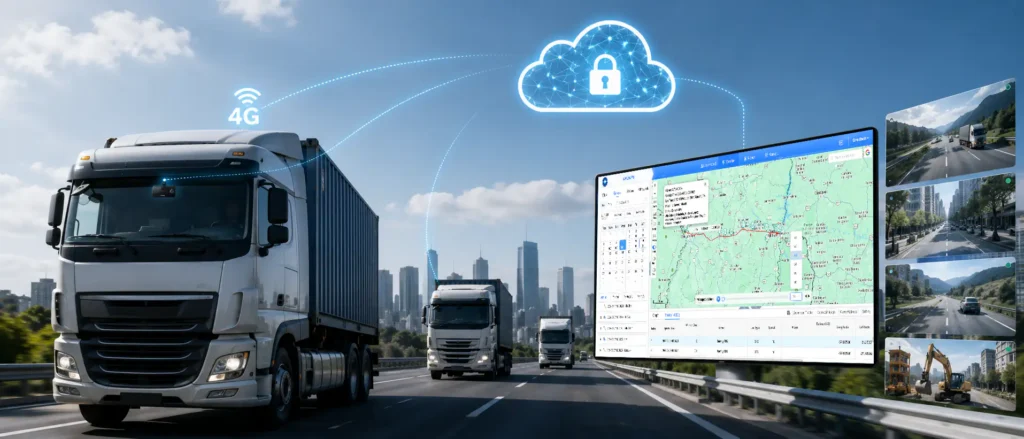
Multi-channel recording is the foundation; multi-channel real-time live streaming is the core value of a 4G solution. But multi-channel simultaneous streaming multiplies bandwidth consumption—three channels of 1080p live streaming consume three times the data of a single channel, so this cost must be controlled.
Mainstream multi-channel live streaming solutions come in several modes:
- ① Multi-channel simultaneous upload triggered by events.Normally no streaming; when an event such as a collision or hard braking occurs, video from all cameras is automatically uploaded for a clip. This ensures every angle is recorded at the moment of an event without consuming much data—since events are, after all, infrequent.
- ② Main-channel streaming + on-demand retrieval of other channels.By default only the front channel streams (or even no front streaming, only event upload); when you want to view a channel, you manually switch to it. Data consumption is close to single-channel, yet other angles are still viewable when needed.
- ③ Multi-channel simultaneous streaming.All cameras stream simultaneously, viewable in split-screen on the platform. This mode offers the best experience but the highest data consumption—three channels streaming simultaneously consume three times the data. Typically only special-purpose vehicles (e.g., escort/security vehicles, police cars) or fleets with special security needs require it.
For most fleets, we recommend the “event-triggered multi-channel upload + on-demand single-channel streaming” mode—the best value. When a key event occurs, video from every angle is automatically saved; for routine checks, you simply pull up one live channel manually. This meets safety-management needs without driving data costs too high.
One more important technical point: can the platform display multiple channels simultaneously? Some solutions can transmit multiple channels, but the platform can only view them one at a time—which greatly diminishes the value of multi-channel. A good platform should support multi-split-screen viewing: 1, 4, 9, or 16 channels, however you want to see them.
GreatWill platform supports simultaneous multi-split-screen viewing, displaying up to a dozen or more channels at once, so one screen can monitor the live status of several vehicles. For a 4G three-channel dash cam vehicle monitoring device, viewing front, in-cab, and right blind-spot angles simultaneously in split-screen boosts management efficiency far beyond single-channel—many customers say that after using three-channel split-screen, a single safety supervisor can manage twice as many vehicles.
AI Capabilities That Work With Multi-Camera Systems
Multi-channel cameras + AI is the next stage of fleet safety management. Multi-channel video provides whole-scene data, and AI makes that data automatically generate value—without anyone having to watch, AI automatically detects problems.
DMS and ADAS: Front + Interior AI Coverage
The most common AI combination is front ADAS + in-cab DMS—also the standard AI feature set for dual- and three-channel systems.
ADAS (Advanced Driver Assistance System), based on the front camera:
- Forward Collision Warning (FCW): automatically alerts the driver when following too closely or at risk of a rear-end collision.
- Lane Departure Warning (LDW): alerts the driver when the vehicle drifts out of its lane—especially common during fatigued driving.
- Leading Vehicle Departure Reminder: the vehicle ahead has moved but you haven’t—very useful at traffic lights.
- Pedestrian Collision Warning: alerts the driver when a pedestrian is ahead.
DMS (Driver Monitoring System), based on the in-cab camera:
- Fatigue driving detection: automatically alerts when the driver dozes off or closes their eyes.
- Distracted driving detection: automatically alerts when the driver looks at a phone or glances around, losing focus.
- Smoking detection: automatically records when the driver smokes while driving.
- Phone-call detection: automatically records when the driver uses the phone while driving.
- No-seatbelt detection: automatically reminds when the driver is not wearing a seat belt.
- Driver identification: facial recognition confirms an authorized driver is at the wheel, preventing proxy driving or personal use.
According to industry data analysis, fleets equipped with ADAS + DMS see accident rates drop by 40%–50%, with rear-end accidents down 55% and fatigue-related accidents down 60%. This effect is far better than reliance on after-the-fact education and fines alone.
Moreover, AI alerts are real-time—warning the driver at the very moment danger arises can prevent an accident.
GreatWill’s AI algorithms are specially optimized for commercial vehicle scenarios. Commercial vehicles differ from private cars—larger bodies, greater following distances, relatively stable speeds, and different driving behaviors. Directly using a private-car AI algorithm yields a high false-alarm rate. Our algorithms are trained on large volumes of real commercial-vehicle data, keeping the false-alarm rate well controlled so drivers won’t disable alerts out of daily annoyance.
Blind Spot Detection and Side Collision Warnings
Blind-spot detection and side-collision warning—the right blind spot is one of the truck’s biggest safety hazards. But cameras alone are not enough—a driver cannot watch the road ahead and a right-side screen at the same time; especially when turning, the driver’s attention is on the front and road conditions, making it hard to divert focus to a blind-spot view.
- Blind-spot pedestrian/vehicle detection: AI identifies pedestrians and vehicles in the right blind-spot camera feed in real time; if an object enters the blind spot, it immediately alerts the driver.
- Right-turn assist: when the vehicle turns right, AI focuses on the right blind spot and alerts the driver via voice and visuals when pedestrians or non-motorized vehicles are present.
- Lane-change assist: when changing lanes, AI monitors the rear-side for approaching vehicles and checks whether distance is sufficient, reminding the driver to change lanes safely.
This AI blind-spot assist function—BSD (Blind Spot Detection)—is especially valuable for fleets that frequently run in urban areas and turn right often. City roads have many people, vehicles, and non-motorized traffic, and right turns are the most accident-prone. With real-time AI alerts, the driver’s burden is much lighter and accident rates drop.
Of course, blind-spot AI is still in a rapid development stage, and accuracy varies considerably between vendors. When selecting, you must test it in real conditions—check the false-alarm rate and missed-detection rate in your operating scenario. Too many false alarms and drivers, annoyed, will turn the alerts off—rendering the installation useless.
GreatWill’s right blind-spot AI function is currently widely used in logistics and construction fleets, and customer feedback on accuracy is positive. Of course, AI algorithms are continually iterated; our team keeps optimizing, using customers’ real-scenario data to keep training the model and make it more accurate over time.
Cargo Monitoring and Rear-View AI
Cargo-area monitoring and rear AI—applicable to four-channel and above configurations with a cargo camera and rear camera.
What can cargo AI do?
- Cargo status monitoring: AI automatically identifies whether cargo has shifted, toppled, or moved abnormally. If cargo falls during transport, it automatically alerts so the driver can stop and handle it promptly.
- Intrusion detection: when parked, if someone illegally enters the cargo area, AI automatically identifies and alerts, preventing cargo theft.
- Loading/unloading counting: AI automatically counts how many items are loaded/unloaded—though accuracy is not yet 100%, it is suitable as a supplementary reference.
- Smoke/fire detection: if smoke or flames appear in the cargo area, AI immediately identifies and alerts, preventing fires—especially valuable for dangerous-goods and high-value cargo transport.
What can rear AI do?
- Rear collision warning: when the following vehicle is too close with rear-end risk, AI alerts the driver.
- Reversing assist: when reversing, AI identifies obstacles and pedestrians behind, alerting the driver to prevent reversing accidents.
- Rear vehicle classification: identifies what type of vehicle is behind (car, truck, motorcycle), with different risk levels calling for different responses.
Not every fleet needs all of these AI functions, but for fleets in specific scenarios they are highly valuable. For example:
- Dangerous-goods transport: cargo smoke/fire detection is a necessity.
- High-value cargo transport: cargo-shift detection and intrusion detection are very valuable.
- Engineering and sanitation vehicles: reversing AI assist reduces reversing accidents.
AI functions should not be chosen by quantity—they must match your actual scenarios. Choosing the right AI functions can greatly reduce accident rates and management costs; picking a pile of unused AI is simply a waste of money. GreatWill’s multi-camera 4G dash cam wholesale solutions can flexibly configure AI functions based on your fleet’s scenarios.
Cost-Benefit Analysis: Is Multi-Channel Worth the Investment?
Multi-channel solutions are certainly more expensive than single-channel—more costly equipment, installation, storage, and data. But is the extra cost worth it? This section does the math clearly.
One-time investment: equipment, hardware, and installation
Equipment cost—specific details require project customization, please consult:
- Single-channel 4G: approx. $150–250 per unit
- Dual-channel (front + in-cab) 4G: approx. $200–350 per unit
- Three-channel (front + in-cab + right blind spot) 4G: approx. $250–450 per unit
- Four-channel and above (split-type): approx. $400–800 per unit (more channels = more expensive)
Installation cost—specific details require project customization, please consult:
Single-channel: $50–80 per unit
Dual-channel: $80–120 per unit
Three-channel: $120–200 per unit (right blind-spot wiring runs outside the vehicle, more complex)
Four-channel and above: $200–400 per unit
Other one-time costs: SIM card (a few to a dozen-plus dollars, some included), first-year platform fee (sometimes included in equipment price), training and deployment fees.
Estimate: a one-time investment for one three-channel 4G recorder (equipment + installation + first-year platform) is approx. $400–700, depending on brand, configuration, features, and purchase volume.
Ongoing costs: storage, data, and platform fees
- Platform fee: Basic version 5–15∗∗perunit/month;Advancedversion(AI+fullreports)∗∗5–15∗∗perunit/month;Advancedversion(AI+fullreports)∗∗15–30; Enterprise version $30+.
- Data fee: event-triggered mainly 2–5GB/month/unit (close to single-channel); frequent streaming 5–10GB; multi-channel 24h streaming dozens of GB (generally not recommended).
- Storage fee: multi-channel stores locally on SD card, cloud only receives event videos—incremental cost is small; full cloud backup scales proportionally with channel count.
- Maintenance fee: repairs, accessories, technical support, approx. 5%–10% of equipment cost per year.
Estimate: annual ongoing cost for one three-channel device (platform + data + maintenance) is approx. $200–500.
ROI: how long to break even?—specific details require project customization, please consult
Take a 50-vehicle fleet with the three-channel solution as an example:
Accident savings: annual at-fault accident cost 175,000;accidentratedown40175,000;accidentratedown40107,000**.
Insurance discount: AI multi-channel systems often cut premiums 5%–15%; 100,000premiumat10100,000premiumat1010,000**.
Management efficiency: video + platform lets 2 people manage what 3 did → conservatively, annual savings $10,000.
Driver retention: fewer accidents and safer conditions lower turnover, saving recruiting and training costs.
The bottom line:
- One-time investment: 50 × 500=∗∗500=∗∗25,000**
- Annual ongoing cost: 50 × 300=∗∗300=∗∗15,000**
- Annual savings: 10.7 + 1 + 1 = $127,000
- Break-even: 2.5 ÷ (12.7 − 1.5) ≈ 0.23 years → breaks even in under 3 months
Even on a conservative half-savings basis, break-even is still under six months. A multi-channel 4G recorder is not a cost—it is a fast-payback, high-return investment.
We at GreatWill can build a more precise ROI analysis for you using your own fleet size and accident rates.
Frequently Asked Questions
How to choose between dual- and three-channel? How many cameras does my fleet need?
This depends on your vehicle type and operating scenarios. For small vans, panel vans, and urban delivery vehicles—compact bodies with relatively small blind spots—dual-channel (front + in-cab) is basically sufficient and offers the best value. For large vehicles such as medium/heavy trucks, semi-trailers, and engineering vehicles, we strongly recommend at least three channels (front + in-cab + right blind spot)—because the right blind spot is the biggest accident risk for these vehicles, and the three-channel solution has the highest ROI. For special-purpose vehicles, dangerous-goods transport, high-value cargo transport, or those needing all-around coverage, consider four channels and above. A simple rule of thumb: the larger your vehicle, the bigger the blind spots, and the higher the cargo value, the more channels you need. If unsure, start with a few three-channel units as a pilot and let the actual results speak.
Do multi-channel cameras consume a lot of power? Will they drain the battery after parking?
During normal driving there is nothing to worry about—the power draw of multi-channel devices is perfectly fine for the vehicle’s alternator and will not affect normal electrical use. The thing to watch is the parking-monitor function—if the device keeps working after the engine is off, it does consume battery power. But legitimate commercial devices have low-voltage protection: when battery voltage drops to a set threshold (e.g., 11.8V), the device automatically shuts down to ensure the vehicle can still start. If you need parking monitoring, choose a device with a low-power mode that enters low-power standby when parked and wakes only on collision or vibration to record—this draws very little power and generally lasts about a week without issue. Exactly how long depends on battery condition and device power draw, so confirm with your supplier.
With multi-channel simultaneous recording, is the SD card capacity enough? How soon is it overwritten?
This depends on channel count, resolution, and card capacity. For reference: at 1080p, one channel uses about 2–4GB per hour. For three channels recording simultaneously, that’s about 6–12GB per hour. A 128GB card holds roughly 10–20 hours; a 256GB card holds roughly 20–40 hours. If a vehicle runs 8 hours a day, a 128GB card holds about 2–4 days and a 256GB card about 4–8 days. For commercial fleets, we generally recommend at least a 128GB card, and 256GB for long-haul. Of course, with a 4G cloud-storage solution, event videos auto-upload to the cloud for permanent storage, and the local SD card is only a cache—capacity need not be large, just enough for the day’s video.
Won’t an in-cab camera invade driver privacy? What if drivers resist?
This is an issue many fleets face, and if handled poorly it stalls adoption. The key is “positioning” and “communication.” First, position the camera as a safety-protection tool, not a surveillance tool—emphasize that it proves the driver is not at fault in accidents, enables rapid rescue in emergencies, and protects the driver rather than spying on them. Second, establish a transparent usage policy: who can view, under what circumstances, for how long, how long data is retained, who has permissions—write it clearly, publish it to all staff, so drivers know where they stand. Third, restrict access: only safety-related roles may view when necessary, with an operation log—not just anyone. Fourth, you can set a privacy mode: the in-cab camera automatically turns off or is masked during rest breaks or after the driver’s shift. With clear rules and boundaries, most drivers can understand and accept it—after all, the system also protects their safety.
Will multi-channel devices have a higher failure rate than single-channel? What if one breaks?
In theory, more cameras do mean more potential failure points. But legitimate commercial-grade multi-channel devices, with higher design standards, better materials, and stricter testing, do not necessarily have a higher actual failure rate than cheap single-channel units. The key is choosing a reliable brand and supplier. Also, look at after-sales support—when a device breaks, how fast can it be replaced? Are loaner units available? How long is the warranty? On-site repair or ship-back? These matter more than the failure rate itself, because a broken device is not the problem—how quickly it is restored to operation is what affects your business. GreatWill devices come with free replacement for non-human damage within warranty, and we have a loaner-unit mechanism: large customers can keep a few spare units on hand and swap instantly when one breaks, so fleet operations are unaffected. GreatWill owns its own manufacturing plant and has been making in-vehicle video equipment for 19+ years—from the earliest single-channel SD-card recorders to today’s multi-channel 4G + AI + cloud platform, through several generations of technological iteration. Our dual-, three-, four-, and five-channel products have all been validated by numerous fleet projects; their reliability, stability, and practicality have been tested in real scenarios.
The customers we have served include intercity logistics, urban delivery, engineering transport, dangerous-goods transport, and overseas brand OEM—fleets of all vehicle types, scenarios, and sizes. Different fleets have different blind-spot pain points, so our solutions differ too—we don’t force a standardized product on you, but recommend the most suitable configuration based on your actual situation.
If you are evaluating a multi-channel dash cam solution, you can contact our team to discuss the following:
- What channel configuration suits your fleet’s vehicle types and operating scenarios
- Specific configuration plan and cost budget (equipment + installation + platform)
- Prototype testing and pilot cooperation plans
- AI feature options and customization requirements
We can provide a tailored solution proposal and quote based on your fleet’s actual situation, and help you calculate a clear ROI.
Related Articles
If you are interested in multi-channel 4G dash cams and fleet safety management, the following articles may be helpful to you:
Why 4G Dash Cams Are Essential for Commercial Truck Fleets
How 4G Live Streaming Dash Cams Transform Real-Time Fleet Monitoring

Responses
Discussion
0 responses
No responses yet
Start the discussion with a practical question or field note related to this article.