

When procuring a 4G dash cam, it is the subscription and data usage—not the hardware—that make up the bulk of the three-year total cost of ownership. A 4G dash cam is an in-vehicle camera with a built-in cellular module, its core feature is uploading video, reporting location, and pushing event alerts in real time over the mobile network, without relying on a phone hotspot or garage Wi-Fi. Unlike pure Wi-Fi dash cams, it stays connected continuously while driving.
Use cases: remote fleet management, commercial-vehicle safety monitoring, and logistics vehicle dispatching. — Below, three images are placed side by side to introduce GreatWill complete 4G Dash Cam product line, you may first review how the hardware maps to the platform.
When selecting a 4G dash cam for your fleet, the hardware is only a one-time investment the real long-term costs are the monthly subscription fee, data, and the SIM card. The monthly subscription typically consists of four parts:
- Cloud storage, real-time location, data, and AI features.
- Data costs depend on resolution, live-viewing frequency, and retention policy.
- For the SIM card, prefer a built-in eSIM/IoT card to eliminate the per-device activation overhead.
- Cellular pricing is tiered by fleet size—the larger the fleet, the lower the unit price.
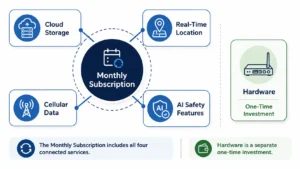
What Drives 4G Dash Cam Monthly Subscription Cost
Only by understanding the composition can you tell which costs a quote bundles in and which you still have to pay separately.
A standard business subscription usually includes four components the quoted price depends on how they are combined:
- Cloud storage duration: whether event and continuous footage is kept in the cloud for 7, 30, or 90 days directly widens the cost gap.
- Real-time location & tracking: live maps, geofencing, and trip replay are the foundational capabilities of fleet management.
- Cellular data allowance: the size of the data plan consumed by uploads, remote playback, and live viewing.
- AI safety features: advanced driver assistance, driver-behavior coaching, and automatic event alerts.
The pricing factors that determine your final unit price are: fleet vehicle count (the starting point for volume discounts), video resolution (720p/1080p/2K/4K, which affects storage and data), cloud retention days, and whether the SIM and data are built in. The same word ‘monthly fee’ can bundle completely different content—when requesting a quote, be sure to confirm each item individually.
Dash Cam Data Plan Cost: What Actually Consumes Data
What actually consumes data is not ‘the device being online,’ but the following:
- Resolution: 4K/2K produce several times the per-minute file size of 1080p.
- Live-viewing frequency: when dispatchers frequently pull streams remotely, data usage far exceeds event-triggered uploads only.
- Upload strategy: uploading only event clips versus continuous upload differ by an order of magnitude in data usage.
- Retention policy: the longer footage is kept in the cloud, the more downstream data playback generates.
For fleets, a shared data pool (pooled data) is usually more cost-effective: one vehicle uses less, another uses more, so nothing is wasted overall. When requesting a quote from the vendor, ask three key questions: is data shared, how is overage billed, and is there a cap? For the cost structure of cloud storage solutions, see the GreatWill Cloud Storage Management Guide.
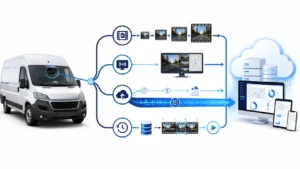
SIM IOT Card for Dash Cam Cost and Why eSIM Wins
The SIM card itself is cheap, but inserting, activating, and replacing cards one by one across dozens or hundreds of units is the hidden labor cost. The hardware-level choice directly affects your operations workload.
- Built-in eSIM: activated at the factory, multi-network roaming, zero on-site operation. Ideal for fleets that are widely distributed with many vehicles.
- Physical IoT card (BYO): can bring your own corporate data pool—flexible, but requires per-device management and replacement.
The procurement decision is straightforward: prioritize a built-in eSIM to minimize operations if you already have a corporate data agreement, then discuss a bring-your-own-card (BYO) option. Fleets needing deep customization or integration with their own platform may consider GreatWill 4G Linux Dash Cam, whose open system facilitates secondary development and system integration. For details on device activation and power-up, see and Inquiry GreatWill Professional Installation Guide.
4G Cellular Dash Cam Pricing Plans Compared
Cellular pricing is usually tiered by fleet size. Knowing what each tier includes tells you which tier to negotiate for your scale and what discount you can get. (For Reference Only)
| Tier | Fleet Size | Cloud Storage | Live Viewing | Management Features | Contract Flexibility |
|---|---|---|---|---|---|
| Starter | 1–10 units | 7 days | Basic | Single account | Mostly monthly |
| Standard | 10–50 units | 30 days | Supported | Driver coaching | Monthly / Annual |
| Fleet | 50–250 units | 30–90 days | Supported | Shared data pool, management console | Annual discount |
| Enterprise | 250+ units | Customizable | Supported | API, SSO,APK, custom retention | Custom |
4G LTE Dash Cam adopts this kind of tiered subscription: volume discounts can often be negotiated starting from as few as 100 units. Lock in the fleet price first and then scale up—it is cheaper than piloting a small batch and renegotiating later.
Build a TCO Model Before You Buy
The subscription fee looks small per month, but over three years it can exceed the hardware cost. Use a fixed model to tally the costs clearly, and you’ll see which quote is truly cost-effective.
Break the three-year total cost of ownership into fillable factors:
- Hardware investment (one-time)
- Monthly subscription fee × 36 months
- Data overage reserve
- SIM / activation fee (built-in eSIM is usually 0)
- Operations labor (card insertion, replacement, troubleshooting)
- Potential savings: insurance discounts, accident defense win rate, fuel optimization
We recommend fixing the period at 36 months and comparing side by side the two structures from different vendors—’low hardware but high monthly fee’ versus ‘high hardware but low monthly fee’—and the conclusions are often the opposite. For the complete selection criteria, see the 4G LTE Dash Cam Buying Guide.
Supplier Verification Checklist
What different vendors bundle varies wildly. Bring this checklist when requesting quotes to quickly filter out vendors with vague pricing.
- Does the monthly fee include cloud storage days and data allowance? How much of each?
- How is overage billed? Is there a cap?
- Is the SIM built in? Does it support multi-network roaming?
- What is the contract term and the early-termination clause?
- Data retention & compliance: is it encrypted, and is the storage region controllable?
- Does it include system integration APIs and a management console?
- From how many units do volume discounts start? How much is the annual-payment discount?
- Support level: is it 24/7, or only available on the Enterprise tier?
Consolidate the factors and checklist above into a table and send it to vendors—the quotes you get back will be far more accurate. For a tailored estimate based on your fleet size and resolution, contact GreatWill for a custom fleet quote and review GreatWill full 4G Dash Cam product line.
FAQ
What is the average 4G dash cam monthly subscription cost for a business?
A commercial-grade 4G dash cam’s monthly fee is the sum of four components—cloud storage, real-time location, data allowance, and AI features—with the final unit price varying by fleet size, resolution, and retention days the larger the fleet, the lower the unit price. The exact range must be quoted by the vendor based on your vehicle count and configuration.
How much does a dash cam data plan cost?
Data costs depend on resolution, live-viewing frequency, and upload strategy. A shared data pool is more suitable for fleets to avoid per-device overage whether data can be shared, how overage is billed, and whether there is a cap are the three points to confirm most when requesting a quote.
How do cellular dash cam pricing plans differ by fleet size?
Cellular pricing is generally tiered by size: small fleets focus on basic cloud storage and a single account medium-to-large fleets add a shared data pool and management console the Enterprise tier provides system integration, single sign-on, and custom retention. Volume discounts can typically be negotiated starting from around 100 units.
Recommended Reading
For further understanding of 4G dash cam selection, deployment, and fleet management, the following resources serve as extended reading:
- 4G Dash Cam product overview
- Front-and-rear dual recording and remote real-time monitoring solution
- Fleet bulk deployment and hardware selection
- Fleet Management complete solution guide
- Dash cam data compliance and storage strategy
- Commercial fleet cost-reduction and efficiency case study




Responses
Discussion
0 responses
No responses yet
Start the discussion with a practical question or field note related to this article.