
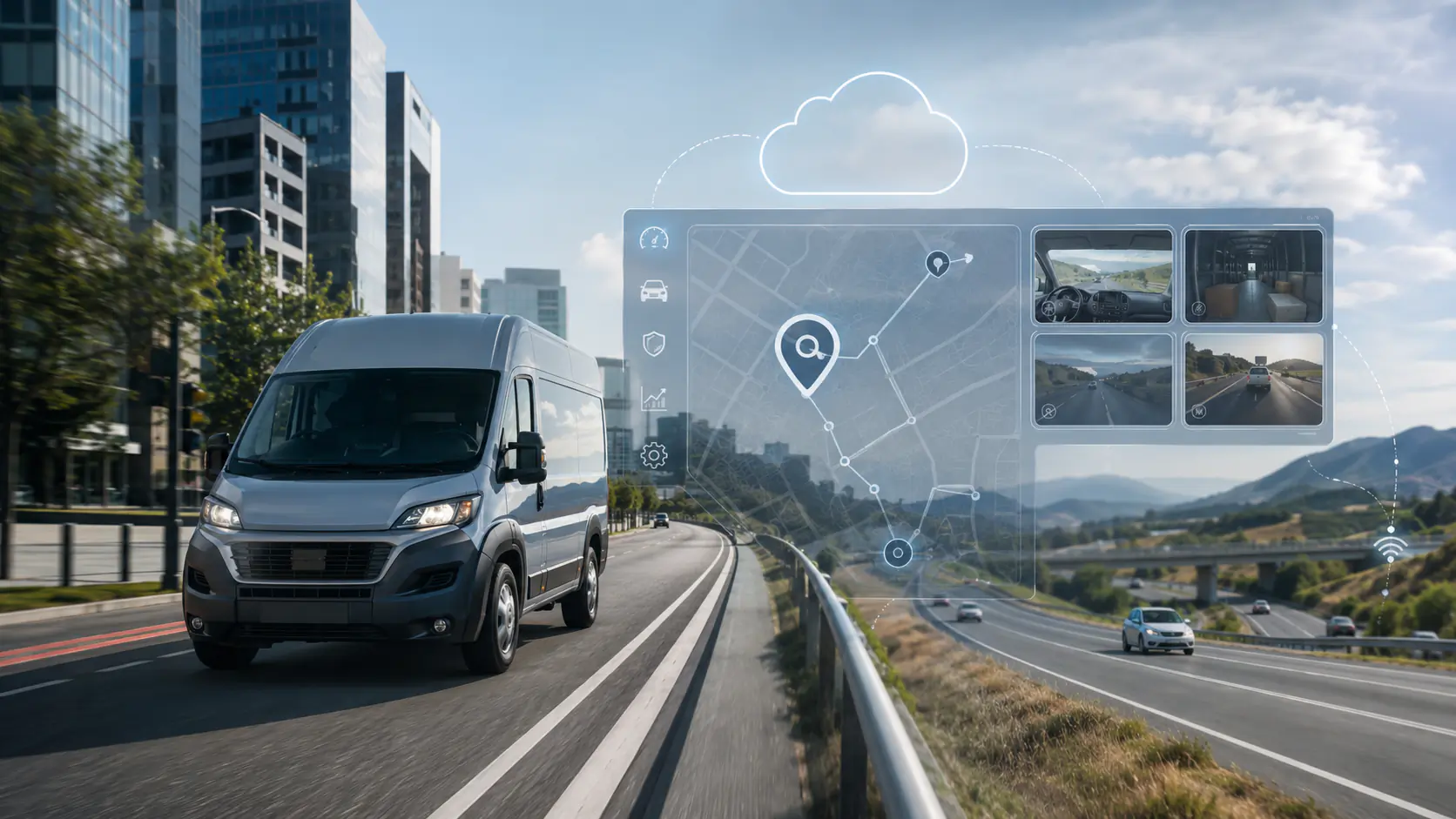
When evaluating 4G in-vehicle cameras, what really matters is the three-year total cost of ownership (TCO), not the per-unit quote. GreatWill lays out hardware, 4G data, cloud storage, installation, and hidden costs, provides a TCO model scaled to fleet size, and explains which factors lower TCO and which configurations are worth paying for in a fleet. Contact us for an exact quote.
A 4G in-vehicle dash cam (4G Dash Cam) is a commercial vehicle camera with a built-in cellular module that streams video and location in real time, its core feature is remote visibility and evidence retention independent of WiFi. Unlike WiFi-only cameras that support only local storage, it lets fleet managers remotely pull accident and driving data at any time over the cellular network. Typical applications include logistics fleets, construction and hazardous-materials transport, and taxi and government fleets.
How much does it actually cost to run a 4G dash cam across a full three-year fleet lifecycle—where the money goes, and whether it can be saved.
- The per-unit quote is only a small fraction of the three-year total cost, the real spend is in connectivity and platform.
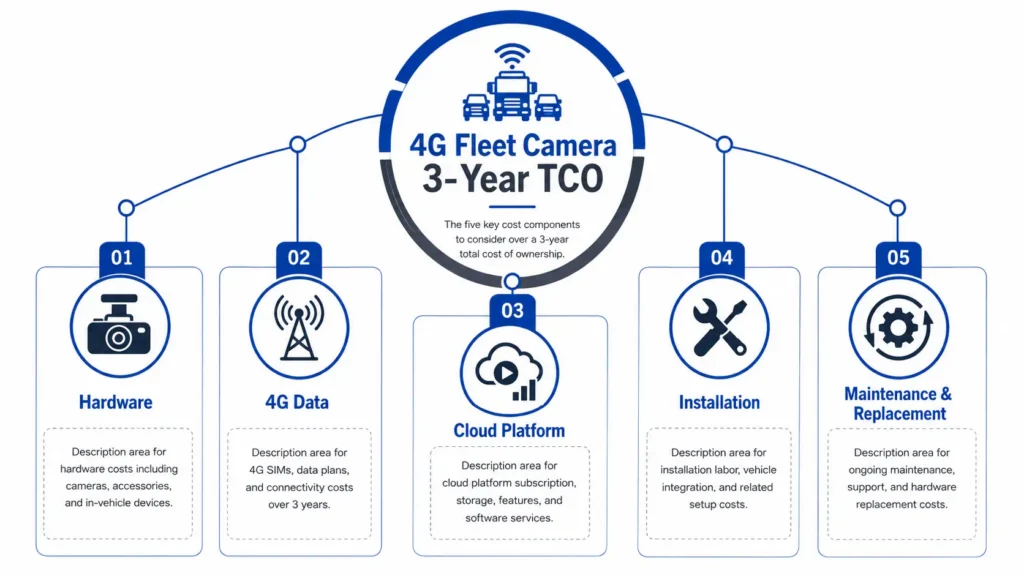
- TCO must be broken down into five components: hardware + data + cloud platform + installation + hidden costs.
- The larger the fleet, the flatter the per-unit monthly cost and the faster the payback.
- To lower TCO, four levers are most effective.
What Total Cost of Ownership Means for a 4G Dash Cam Fleet
One-time hardware investment, 4G connectivity and data, cloud storage and fleet management platform, installation and onboarding, and the easily overlooked replacement and hidden costs.
Hardware: The Factors Behind Unit Pricing
Key factors affecting unit price include: number of lens channels (single, dual, triple), network standard and module grade, positioning and sensor accuracy, whether it has AI driving-behavior recognition, local storage and power-loss protection, and warranty length. More channels, stronger AI, and longer warranty naturally mean a higher unit price.
As a 4G dash cam manufacturer, GreatWill advises fleets to first set the number of channels and the AI tier based on vehicle type and regulatory needs, then discuss price—avoid paying for unused features and avoid missing critical evidence capabilities. For specific configurations and quotes, contact us.
4G Connectivity and Data Plans
This is the core difference from WiFi models and the largest ongoing cost. It determines whether you can see the footage remotely the moment an incident happens and whether you can locate vehicles at any time.
Cost is driven by the data plan, and data depends on the upload strategy: event-triggered uploads (sent on collision, hard braking, or violations) cost far less than always-on live streaming. Plans are usually billed monthly, cross-border or nationwide multi-network coverage is slightly higher. For details, review the plan structure and price comparison.
Cloud Storage and the Fleet Management Platform
After a 4G dash cam uploads video, it must be stored, retrieved, and turned into driving-behavior reports—this part relies on the cloud platform. It is often the most underestimated item in TCO, yet also where the value is most concentrated.
Platform fees are usually billed per vehicle per month, differences come from: cloud video retention period, depth of AI event recognition, driving scores and reports, and whether it integrates with your existing dispatch or insurance systems. When choosing a platform, focus on whether evidence can be pulled instantly when needed and whether reports can be used directly for driver coaching—not just on unit price.
Installation and Fleet Onboarding
The installation method directly incurs a one-time cost and also affects later stability. Professional hidden-wiring, hardwired power installation is more stable but costs more per unit, magnetic or plug-in self-installation is cheaper and suits light fleets.
Onboarding costs also include binding the first batch of devices, account-to-vehicle mapping, and brief training for drivers and administrators. For large fleets, we recommend bundling installation and training into the contract to avoid scattered later expenses. GreatWill 4G product line covers everything from self-install to professional installation.
Hidden and Replacement Costs
Vibration, high temperatures, and human damage lead to device replacement, data overages incur extra charges, repairs during warranty gaps are out-of-pocket.
Reserve a certain proportion of annual replacement budget by fleet size, and prefer a three-year warranty over a one-year one—turn the ‘unexpected’ into a ‘cost already accounted for.’ For fleets running multiple shifts or on complex road conditions, this reserve should be set even higher.
The 3-Year TCO Model
Reference example—for reference only, actual situations require consulting GreatWill.
Numbers are based on a typical dual-lens 4G configuration and are intended to illustrate the cost structure, not to represent a fixed quotation. Actual costs vary by configuration, plan, and installation method.
| Cost per vehicle | Low | Mid (typical) | High |
|---|---|---|---|
| Hardware (one-time) | $199 / ~$199 | $274 / ~$274 | $449 / ~$449 |
| Installation (one-time) | $0 | $110 | $150 |
| 4G data (36 months) | $540 | $720 | $1,080 |
| Cloud & platform (36 months) | $432 | $648 | $1,008 |
| Replacement reserve (~8%/yr) | $48 | $66 | $108 |
| 3-yr total / vehicle | $1,219 | $1,818 | $2,795 |
| Monthly equiv. / vehicle | $34 | $50 | $78 |
TCO Across Fleet Sizes
Reference example—for reference only, actual situations require consulting GreatWill.
Per-unit monthly cost barely rises with scale—volume purchasing often pushes hardware and platform unit prices down, so a large fleet is not ‘more expensive’ but ‘pays back faster.’
| Fleet size | Hardware + install | Recurring / Annual recurring | 3-yr TCO | Per-unit monthly |
|---|---|---|---|---|
| 10 units | $3,840 | $4,560 | $17,520 | $58 / ~$58 |
| 50 units | $19,200 | $22,800 | $87,600 | $58 / ~$58 |
| 200 units | $76,800 | $91,200 | $350,400 | $58 / ~$58 |
When comparing fleets horizontally, do not compare only the unit price. The per-unit monthly cost of a small fleet may be close to that of a large fleet, but the absolute savings and negotiation leverage of a large fleet are significantly greater.
Where 4G Actually Pays Back
The other half of cost is return. Insurance discounts, lower accident and fraud claims, and fuel savings from improved driving behavior brought by 4G models let most fleets see net gains in about a year. GreatWill has dedicated an article to ROI analysis data and deployment.
4G vs WiFi-Only: The TCO-Correct Choice
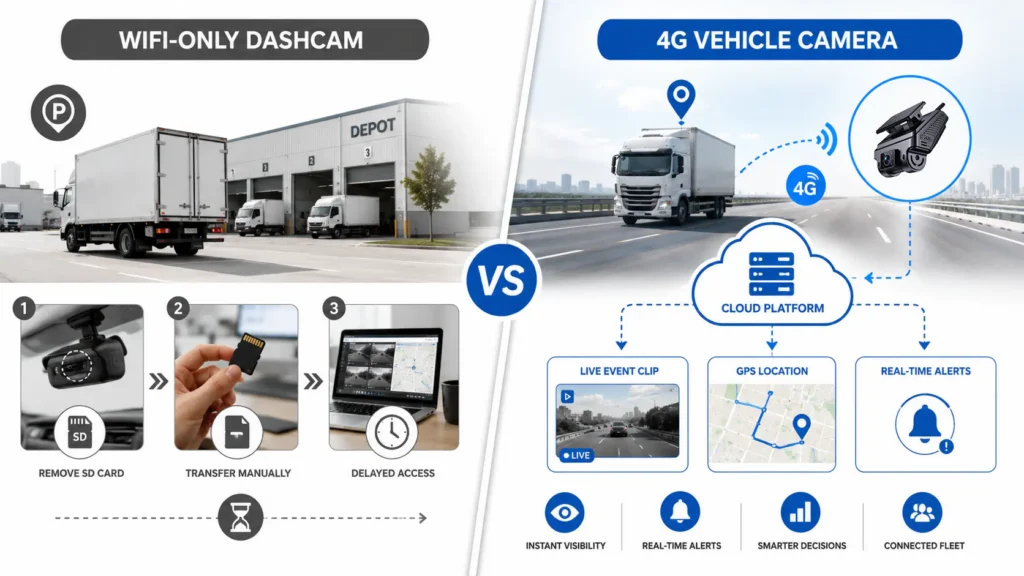
Many buyers’ first instinct is ‘just buy the cheaper WiFi model.’ But from a TCO perspective, this choice is often more expensive.
| Comparison | 4G dash cam | WiFi-only dash cam |
|---|---|---|
| Real-time remote access | Anytime, independent of WiFi | Only near WiFi |
| Instant incident alert | Pushed to backend in real time | Manual SD card removal required |
| Evidence retention reliability | Cloud-stored, hard to lose | Relies on SD card, easily overwritten |
| Insurance discount eligibility | Usually qualifies | Mostly does not qualify |
| True TCO efficiency | Optimal | Cheap upfront, high later risk |
When a claim fails to produce evidence because the SD card was overwritten, the few dollars saved in monthly fees become insignificant. For fleet operations, 4G is the more defensible choice on total cost of ownership.
How to Lower Your Fleet’s TCO
GreatWill’s four practical recommendations for fleet customers:
- Bundle hardware, data, and cloud platform into a one-stop service—this is the biggest price-reduction lever.
- Use event-triggered uploads instead of always-on live streaming, and data costs drop immediately.
- Use self-install kits for light vehicles, apply professional hardwired installation for heavy trucks and regulated vehicles.
- Activate insurance telematics discounts directly—this is a near-zero-cost payback.
The most cost-effective combination depends on your fleet size, vehicle types, and regulatory intensity. Tell us your requirements, and GreatWill will model with your real parameters and provide a quote.
FAQ
How much do 4G dash cams cost? (For reference only, actual situations require consulting.)
A commercial dual-lens 4G unit typically costs several hundred dollars, but the true cost of ownership also adds 4G data (~$15–$25/month), cloud and platform (~$12–$28/month), and installation ($75–$150 per unit). Over three years, per-unit monthly cost is about $45–$60.
What is the total cost of ownership for fleet dash cams? (For reference only, actual situations require consulting.)
Total cost of ownership = one-time hardware + installation + ongoing 4G connectivity + cloud storage and platform + replacement and hidden costs, modeled over the device lifecycle (usually three years). A 50-vehicle fleet’s three-year TCO is roughly $85,000–$95,000, or about $47–$52 per vehicle per month.
What does a dash cam cost for business?
For a business, the purchase price is only 15–20% of lifecycle cost, the rest is ongoing connectivity and cloud spend. After factoring in insurance discounts, fewer accidents, and fuel savings, most fleets break even in about 6–14 months.
Are 4G dash cams worth it compared with WiFi-only?
Worth it for fleet operations. WiFi models often can’t pull footage when evidence is needed and usually don’t qualify for insurance discounts, the saved monthly fees are far from enough to offset a single unaccepted claim.
How fast do fleets get ROI from 4G dash cams?
Typically 6–14 months comes from insurance and claim savings, including fuel and downtime, the three-year net benefit often reaches 2–4× the cost.
Related Articles
- 4G Dash Cam Fleet ROI: Cost Reduction and Return Analysis
- 4G Dash Cam Subscription & Plans: Complete Pricing Guide for Business
- How to Choose a 4G Dash Cam Manufacturer for Your Business




Responses
Discussion
0 responses
No responses yet
Start the discussion with a practical question or field note related to this article.