
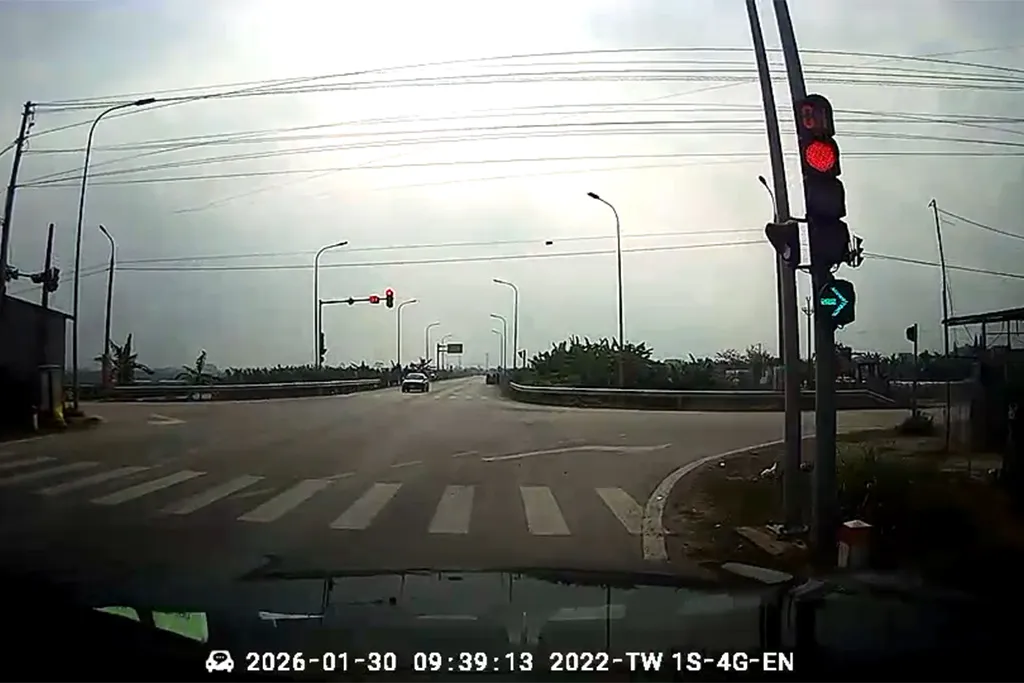
Front Dash Cam: The First Line of Defense for Driving Safety
As the core recording device for the front view of a vehicle, the front dash cam excels in accurately covering high-frequency frontal risks and providing irrefutable evidence. In daily driving, sudden incidents ahead of the vehicle occur far more frequently than those behind—whether it is a sudden hard brake by the vehicle in front on the highway, a pedestrian jaywalking on urban roads, or a fraudulent accident claim deliberately staged on an unfamiliar road. The front dash cam captures real-time footage, clearly recording key information such as the time, location, and the liable party’s actions of the accident, serving as conclusive evidence for traffic police liability determination and insurance claims.
Suitable for most basic driving scenarios such as urban commuting and highway driving, the front dash cam is an entry-level device that meets car owners’ core safety needs, and also a fundamental prerequisite for subsequent upgrades to a front & rear dashcam.
The high-frequency applicable scenarios of the front dash cam basically cover the most common risk situations in car owners’daily travel, which is the core reason why it has become a must-have device. Additional auxiliary functions of some front dash cams, such as lane departure warning and forward collision warning, can also help car owners avoid driving errors and further improve driving safety, catering to the basic needs of new drivers, long-distance drivers and other groups.
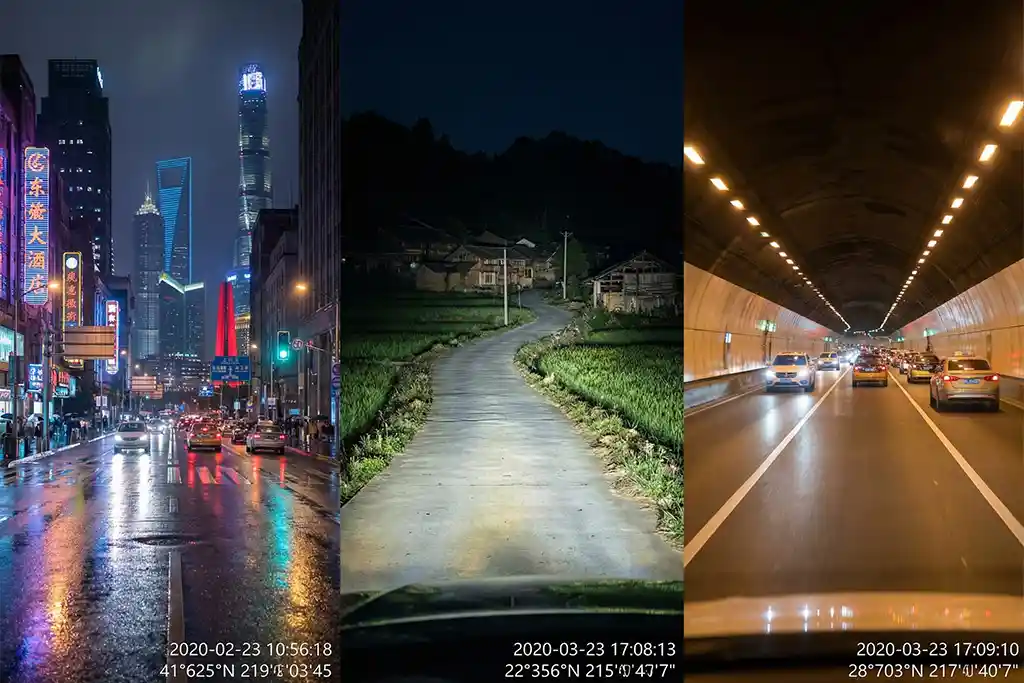
Core Features of Front Dash Cams
-
As the basic core model of dash cams, manufacturers prioritize optimizing image quality, night vision, and frame rate for maximum clarity in evidence collection.
-
Covers more than 90% of core frontal accident scenarios, serving as the key basis for liability determination and insurance claims.
-
Easy installation, low cost, no complicated wiring, compatible with all vehicle models.
-
Low storage usage, longer recording time with the same storage capacity, and more stable data.
Core Limitations
-
Single viewing angle with blind spots at the rear and sides, unable to record accidents such as rear-end collisions and parking scratches at the rear.
-
No evidence-gathering capability for chain rear-end collisions and rear fraudulent accident claims, easily leading to liability disputes.
-
The single viewing angle can only corroborate frontal situations without supplementary side and rear views, resulting in incomplete evidence collection for some complex accidents.
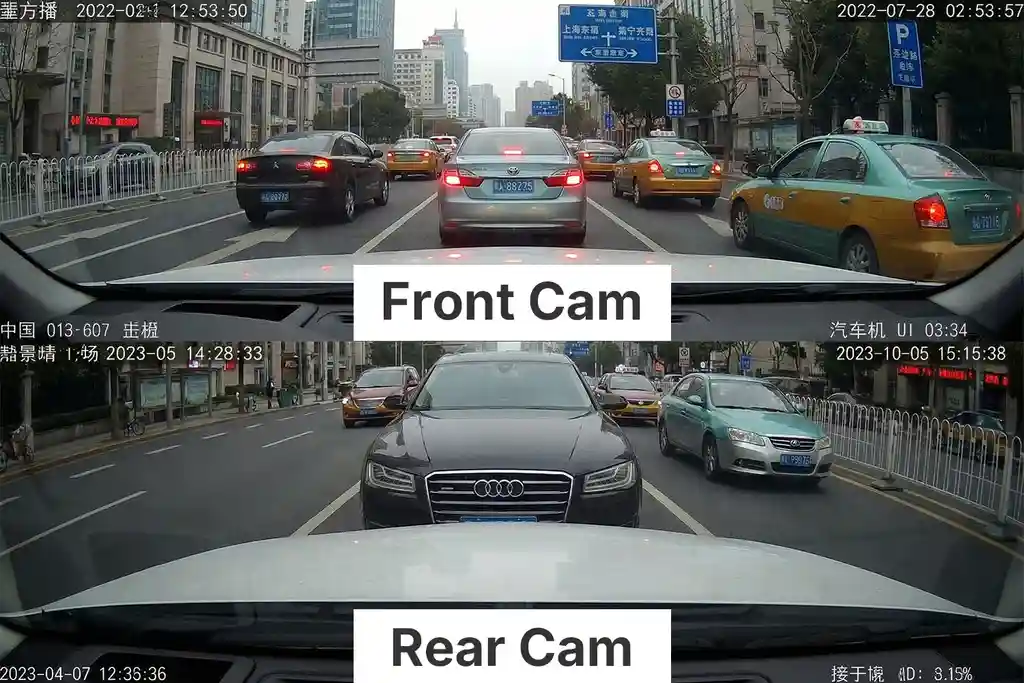
Rear Dash Cam: The Key Supplement to Compensate for Visual Blind Spots
The core value of the rear dash cam is to accurately fill the visual gaps of the front dash cam, focus on risk scenarios at the rear of the vehicle and around the trunk, and form a second safety net for driving safety. In the rear vehicle area not covered by the front dash cam, the rear dash cam can specifically solve the evidence-gathering problems of rear-end collisions by following vehicles, reversing scratches, and malicious acts from the rear. It also assists in reverse observation and reduces safety risks during parking operations.
Rear dash cam footage can clearly record the driving status of the following vehicle, whether it maintains a safe distance, and whether there are illegal acts such as speeding or lane changing, completely eliminating the possibility of the following vehicle shirking responsibility and providing direct evidence for liability determination. For reversing operations, especially for new drivers or those driving large vehicles, the rear windshield has a natural visual blind spot. The real-time footage of the rear dash cam can intuitively show obstacles, pedestrians or low objects at the rear, effectively avoiding scratches during reverse parking and parallel parking.
The rear dash cam is also an indispensable part of the front & rear dashcam system. Only with the combination of the rear dash cam can full coverage of the front and rear views of the vehicle be achieved and a complete safety protection system be constructed.
The necessary scenarios for the rear dash cam are mostly the blind spots covered by the front dash cam, and the incidence of such scenarios in daily driving is not low, making it extremely practical for specific groups of people. Parking lot parking is one of the core necessary scenarios for the rear dash cam. When the vehicle is parked unattended, it is prone to scratches by passing vehicles at the rear, collisions by pedestrians, or malicious damage such as keying and window smashing. When the parking monitoring function of the rear dash cam is turned on, it can record rear dynamics throughout the process and help car owners identify the responsible party.
Some rear dash cams support recording the rear seat view inside the car, which can monitor the riding status of children in the rear seat in real time and detect sudden situations in a timely manner. For ride-hailing and carpool drivers, the rear dash cam can also record the behavior of rear seat passengers and avoid liability disputes between passengers and drivers.
Tips: The rear dash cam can only be used as a supporting device for the front dash cam or integrated into a front & rear dashcam system. Installing it alone does not meet the core driving needs of most car owners.
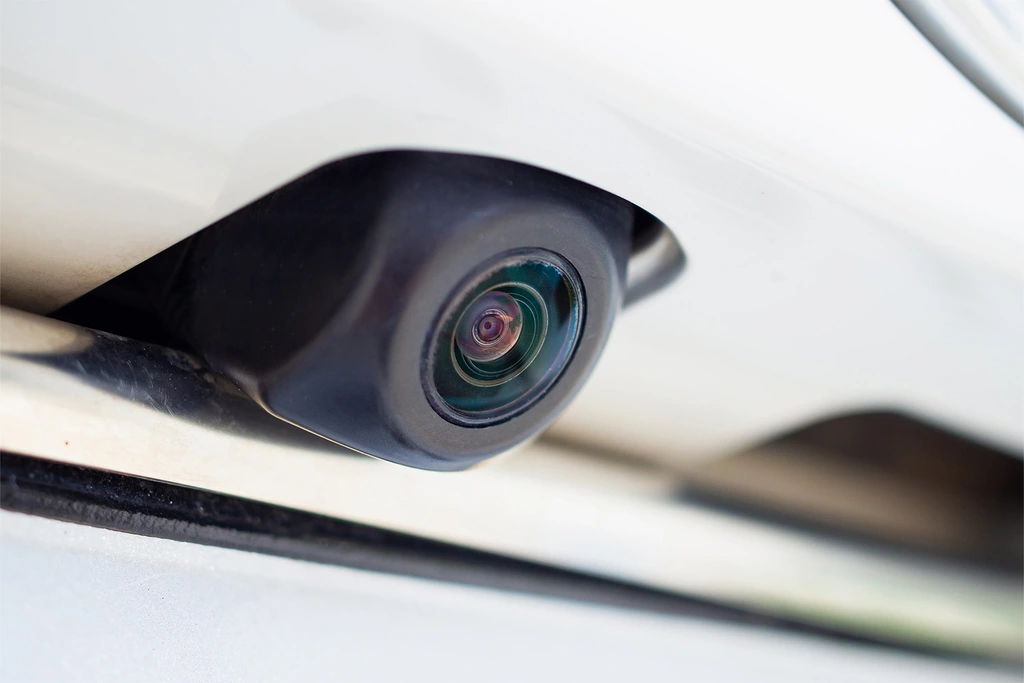
Core Features of Rear Dash Cams
-
A necessary supplement to the front dash cam, accurately covering the rear blind spot and suitable for scenarios that the front dash cam cannot record, such as rear-end collisions and rear parking scratches.
-
Some models are equipped with reverse image function, combining driving evidence collection and reverse assistance to improve reversing safety.
-
Image quality meets basic evidence-gathering requirements, low cost, and easy to match with the front dash cam to form a dual-recording system.
-
Can lock rear collision footage to avoid lack of evidence in chain rear-end collisions and hit-and-run incidents by the following vehicle.
Core Limitations
-
No practical significance when used alone, unable to record core frontal accidents and must be used with a front dash cam.
-
Manufacturers give low priority to optimization, with image quality, night vision and frame rate generally inferior to front dash cams, and limited long-distance license plate recognition capability.
-
Only covers the rear view, with the sides of the vehicle still as blind spots, unable to record side scratches.
-
Installation requires wiring to the rear of the vehicle, which is slightly more complicated than the front dash cam, and some vehicle models need to be adapted with special brackets.
Why Choosing a Front & Rear Dashcam Is Crucial?

A front & rear dashcam is not a simple superposition of front and rear recording functions, but achieves a 1+1>2 protection effect through collaborative work. Its core advantage is to build a 360° dead-angle-free safety barrier for driving, covering all driving and parking scenarios.
The dual-recording device can record the front and rear footage of the vehicle at the same time to form a complete accident chain evidence—for example, in a chain rear-end collision, the front dash cam can prove the distance from the vehicle in front and the cause of the collision, while the rear dash cam can restore the entire process of the rear-end collision by the following vehicle. High-quality front & rear dashcams can also realize synchronous display of front and rear footage, assisting car owners in observing the front and rear blind spots of the vehicle. Especially during overtaking, meeting other vehicles, reversing and other operations, it effectively reduces the rate of driving errors. It is suitable for all driving scenarios such as urban commuting, highway driving and rural roads, truly achieving one installation, all-round protection.
Core Features of Front & Rear Dashcams
-
Full viewing angle coverage of front and rear blind spots, adapting to more than 95% of driving and parking accident scenarios with complete and dead-angle-free evidence collection.
-
The front cam features high definition for core liability determination, and the rear cam is suitable for rear-end collisions and reversing scratches, meeting the needs of dual scenarios with one device.
-
Some rear cams are integrated with reverse image function, providing dual practical value of driving evidence collection and reverse assistance.
-
Dual lenses record synchronously, and complex accidents such as chain rear-end collisions can be completely restored to avoid liability disputes.
Core Limitations
-
Manufacturers give low priority to rear cam optimization, with image quality, night vision and frame rate generally inferior to front cams, and slightly poor long-distance recognition.
-
Installation requires wiring to the rear of the vehicle, which is more complicated than a single front dash cam, and some vehicle models need to be adapted with customized wiring solutions.
-
Synchronous recording by dual lenses results in high storage usage, with shorter recording time than a single front dash cam with the same storage capacity.
-
Higher cost than single front or rear dash cams, and entry-level models are prone to parameter reduction of the rear cam.
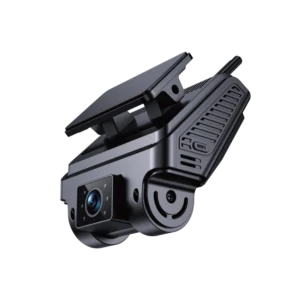
Front & Rear Dashcam: All-Scenario Video Recording & Shooting
Which Car Owners Must Prioritize a Front & Rear Dashcam?
Although front & rear dashcams have significant advantages, they are not a priority for all car owners. The following groups of people need to install a front & rear dashcam especially urgently due to the particularity of their driving scenarios.
New Drivers
Due to insufficient driving experience, poor control of the front and rear vehicle distances, and insensitive perception of visual blind spots, dual-recording devices can assist in observation through real-time footage and record all kinds of situations during driving at the same time. Even if a minor scratch occurs, responsibilities can be quickly clarified, reducing new drivers’ driving anxiety.
Car Owners Who Often Drive on Complex Roads or at Night
Such scenarios have poor light and complex traffic participants, leading to a higher probability of sudden risks at the front and rear. The high-definition night vision function and full viewing angle coverage of the dual-recording device can effectively deal with problems such as fraudulent accident claims at night and scratches on dark roads.
Car Owners with Parking Monitoring Needs
For car owners who park their vehicles in public parking lots for a long time, public areas have a large flow of people and vehicles, making it difficult to trace responsibilities after the vehicle is scratched. The 24-hour parking monitoring function of the front & rear dashcam can guard the vehicle around the clock and provide key evidence for liability tracing.
Family Car Owners with Child Passengers
Dual-recording devices support switching to the rear seat view inside the car or matching with an in-car lens, which can monitor the riding status of children in real time and avoid failure to detect sudden accidents in the rear seat in a timely manner.
Commercial Vehicle Drivers (Ride-hailing, Taxis, etc.)
Facing different groups of passengers, the front & rear dashcam can completely record the situation inside and outside the car, effectively avoid liability disputes between passengers and drivers, and protect the legitimate rights and interests of both parties.
Front vs. Rear vs. Front & Rear Dashcam: Core Difference Comparison & Selection Recommendations
| Comparison Dimension | Front Dash Cam | Rear Dash Cam | Front & Rear Dashcam |
| Coverage | Only the front view of the vehicle, covering the area from the front of the vehicle to the vehicle in front, with rear and side blind spots | Only the rear view of the vehicle and trunk, covering the area from the trunk to the following vehicle, with front blind spots | Dual front and rear views, covering both driving and parking scenarios to achieve dead-angle-free coverage |
| Evidence-gathering Capability | Only able to prove liability for frontal accidents (e.g., lane changing by the vehicle in front, jaywalking, single-vehicle collisions), unable to restore rear accidents | Only able to prove liability for rear accidents (e.g., rear-end collisions by following vehicles, reversing scratches), unable to restore frontal accidents | Can completely record the accident chain with complementary front and rear footage, and handle evidence collection for complex accidents such as chain rear-end collisions and multi-vehicle scratches |
| Applicable Scenarios | Basic scenarios such as urban commuting, highway driving, single-vehicle accidents, and frontal fraudulent accident claims | Supplementary scenarios such as parking lot parking, reverse parking, and malicious acts from the rear; limited scenarios when used alone | All scenarios including urban/highway/rural roads, night driving, public parking, commercial driving, and family driving |
| Cost-Effectiveness | High, affordable price, meeting basic safety needs, suitable for budget-constrained users | Low, similar price to front dash cams when purchased alone but with extremely limited coverage and low practicality; not recommended for separate purchase | Medium to high, 20%-50% higher price than single-recording dash cams, but solves all-scenario safety protection at one time and avoids subsequent additional installation costs |
Tailored Selection Plans for Different Car Owners & Product Recommendations
Combined with the core differences of the three types of devices and the driving needs of different car owners, we can provide tailored selection plans that balance practicality and cost-effectiveness.
-
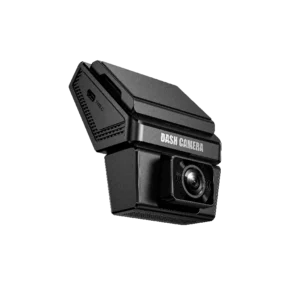
Daily commuters: If you only drive on urban roads with simple traffic conditions and park in a fixed spot for a long time (e.g., private garage), you can prioritize a front dash cam with a limited budget, which is sufficient to deal with high-frequency risks such as frontal collisions and fraudulent accident claims. If you often drive on congested roads, it is recommended to directly upgrade to a front & rear dashcam to avoid rear-end collision disputes. Recommended Product: GD101N
-
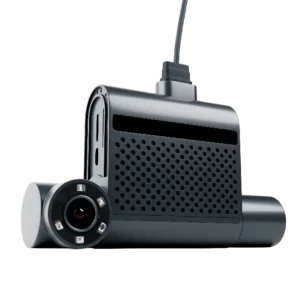
New drivers: Regardless of road conditions, it is recommended to prioritize a front & rear dashcam. Dual-view assistance can reduce misjudgment of blind spots, and the complete evidence-gathering function can alleviate new drivers’ anxiety in the face of accidents and avoid losses due to unclear liability determination. Recommended Product: GD95L
-
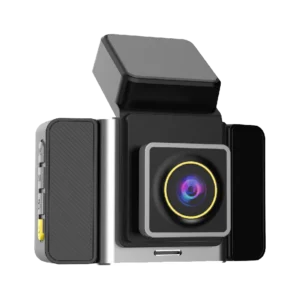
Commercial vehicle drivers (ride-hailing, taxis, etc.): A front & rear dashcam is a must-have configuration—it is necessary to not only record accidents outside the car but also retain footage of rear seat passengers’ behavior to avoid service disputes. It is recommended to choose a dual-recording device with in-car view recording and excellent night vision effect. Recommended Product: GD17
-
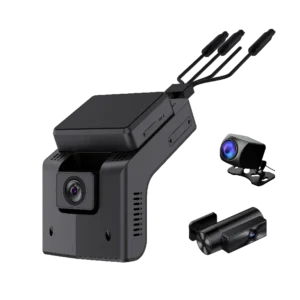
Family car owners: Especially for families who often carry children, prioritize a front & rear dashcam that supports rear seat view switching. It can not only guard vehicle safety but also monitor the riding status of children in the rear seat in real time to eliminate sudden accidents. Recommended Product: GD14 2CH
-
Budget-constrained users with parking monitoring needs: You can first install a front dash cam to meet basic driving safety needs, and then add a rear dash cam to form a dual-recording system later. However, pay attention to choosing compatible devices of the same brand to avoid problems such as mismatched image quality and messy wiring. Recommended Product: GD301
FAQs About Front & Rear Dashcam
Q1: Can a single front dash cam provide evidence for rear-end collision disputes with the following vehicle?
No, it cannot provide direct and complete evidence, and you will most likely fall into liability determination disputes. A single front dash cam only captures the front view of the vehicle and cannot record the driving status of the following vehicle—such as key details including whether the following vehicle was speeding, maintained a safe distance, or changed lanes illegally to cause a rear-end collision. Once a rear-end collision occurs, if the following vehicle deliberately shirks responsibility (e.g., falsely claiming that the front vehicle rolled backward or braked suddenly), the front dash cam footage alone cannot restore the full picture of the rear accident, making it difficult to provide strong evidence to traffic police and insurance companies. This may lead to unclear liability division, insurance claim delays or denials, and even the need to bear losses that should not be your responsibility.
Q2: Is the price of a front & rear dashcam much higher than a single-recording dash cam?
For products of the same brand and configuration, the price of a front & rear dashcam is 20%-50% higher than a single-recording dash cam (front only), with a reasonable overall premium and not “much more expensive”. Specifically, the price of an ordinary front dash cam is mostly between $15-$30, and the price of a front & rear dashcam of the same grade is usually between $45-$75; among mid-to-high-end models, the unit price of a front dash cam is $45-$90, while a dual-recording one is about $75-$150.
In terms of cost-effectiveness, although the initial investment of a dual-recording dash cam is slightly higher, it can cover all front and rear scenario risks at one time and avoid additional costs of installing a rear dash cam separately (the price of a single rear dash cam is similar to a front one, and there may be problems such as brand incompatibility and messy wiring). For car owners pursuing all-scenario safety protection, the premium of a dual-recording dash cam can bring more complete safety guarantees, which is far more cost-effective than a single-recording one.
Q3: Is the night vision effect of a rear dash cam important?
It is extremely important and even directly determines the evidence-gathering value of the rear dash cam. Low-light scenarios such as night driving, tunnel passage, and underground garage parking are high-incidence periods for accidents such as rear-end collisions, scratches, and malicious damage by the following vehicle. If the night vision effect of the rear dash cam is poor, the footage will be blurry with many noise points, making it impossible to clearly identify the following vehicle’s license plate, pedestrian features and accident details—equivalent to losing the core evidence-gathering function of the rear dash cam.
In particular, the rear windshield is easily affected by the reflection of interior lights and dim external light, which places higher requirements on night vision capability. It is recommended to prioritize a front & rear dashcam with starlight night vision or infrared night vision function. Such devices can maintain clear footage in low-light environments, ensure the effectiveness of evidence collection at night and in dark scenarios, and avoid missing key evidence due to poor image quality.



Responses
Discussion
0 responses
No responses yet
Start the discussion with a practical question or field note related to this article.