
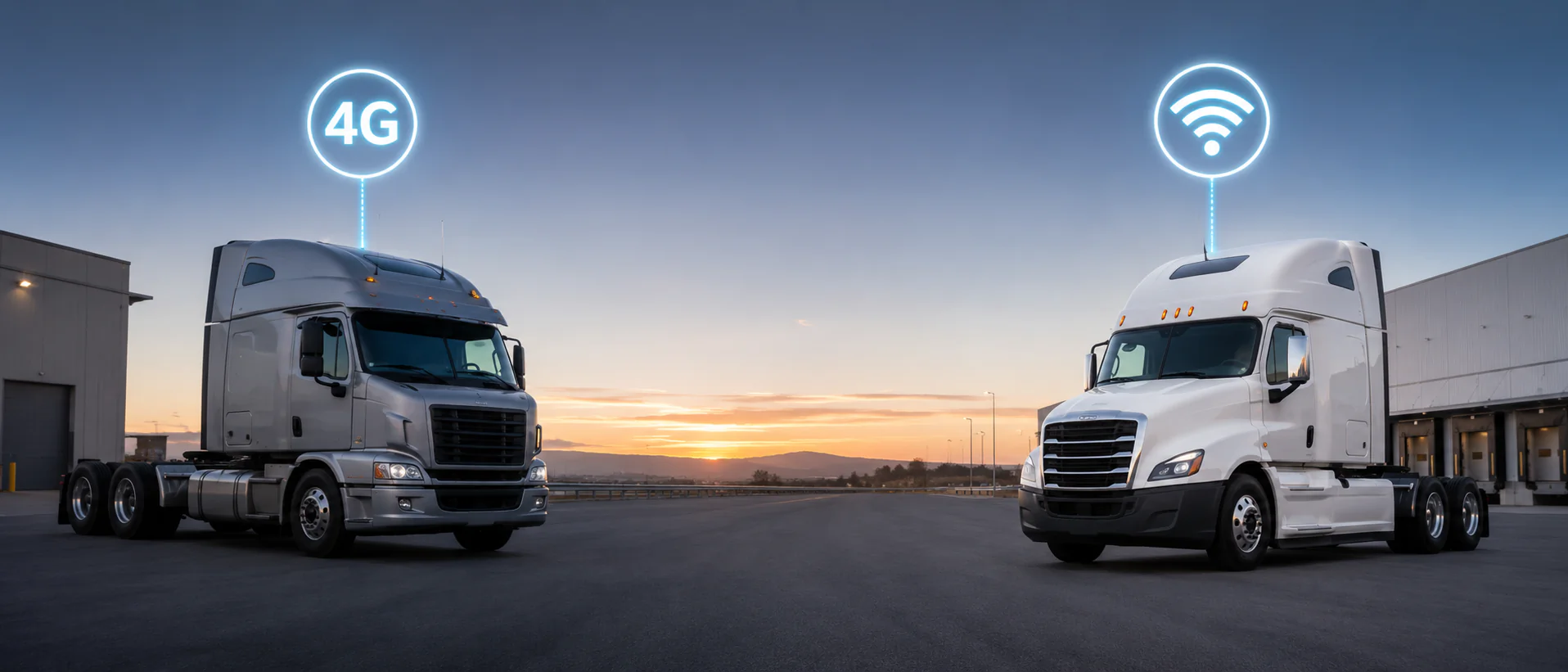
A 4G dash cam is an in-vehicle camera system with a built-in cellular communication module that transmits video data, GPS location, and event alerts in real time via mobile networks, without relying on external WiFi. While a 4G dash cam includes a WiFi hotspot feature for short-range connections from phones and other devices to view live footage and playback, its network connectivity comes entirely from the 4G cellular network. Unlike WiFi dash cams that require an external wireless network or manual data export, the 4G solution stays continuously online, supporting remote live viewing, instant alert push notifications, and cloud-based fleet management.
Core Conclusions
- The 4G solution enables real-time remote viewing and proactive alerts; the WiFi solution can only access data after the vehicle connects to a network.
- The 4G solution supports 24/7 online management; the WiFi solution relies on manual intervention for data collection.
- Over the long term, the management efficiency gains and accident rate reductions from the 4G solution can offset communication costs.
- The choice depends on fleet size, operational model, and how critical real-time visibility is to your business.
How Connectivity Defines Dash Cam Capability
The value of a dash cam is not in capturing video, but in when you can actually see that footage. The connection method determines the speed and scope of information delivery, which in turn determines what you can do with that information.
The full workflow of a WiFi solution is: Record while driving → write to local SD card → vehicle returns to base or connects to WiFi → video uploads to cloud → manager reviews. During the gap between uploads — which could be hours to days — the fleet manager has zero visibility into road conditions. If a vehicle runs a two-day long-haul route, the manager won’t see the first day’s footage until at least the third day. This isn’t real-time management; it’s delayed auditing.
The 4G solution changes the timeline: Record while driving → real-time upload to cloud → manager can view at any time. Hard braking triggers an instant alert with an attached video clip. A customer complaint about delivery timeliness can be resolved by pulling up the GPS trajectory and corresponding footage. When an accident occurs, the backend has already received a notification within seconds. Information shifts from “post-event archiving” to “real-time decision-making tool.”
Real-Time Monitoring: The Operational Difference
The essence of fleet management is not recording problems — it’s catching them in time. Watching a replay after an accident vs. receiving a warning before one escalates are two fundamentally different management capabilities.
The latency of WiFi solutions means managers can only do reactive management — monthly video sampling, pulling footage after incidents to assign responsibility. That’s not management; it’s archiving. For fleets with many vehicles on dispersed routes, manually and regularly exporting video to monitor driver behavior is essentially impractical. A fleet manager overseeing 30 vehicles who relies on WiFi dash cams to track each vehicle’s driving status would have no choice but to hire someone full-time just to read cards and export data.
The 4G solution pulls the management window from “after the fact” to “in the moment.” Speeding, hard braking, route deviation — the system pushes alerts to the manager’s device within seconds. Extended fatigue driving triggers an in-cab voice reminder while the backend simultaneously logs and flags the event. For fleets running cold chain transport, hazardous materials, or high-value cargo delivery, this real-time capability isn’t a bonus — it’s a necessity. Temperature anomaly alerts, route deviation warnings, unplanned stop notifications — every delay means direct financial loss.
Data Access and Incident Response Speed
Incident response speed directly impacts three critical business outcomes: insurance claim efficiency, liability determination accuracy, and customer relationship maintenance cost. The gap between 4G and WiFi solutions on these dimensions is structural, not marginal.
Under the WiFi solution, incident evidence retrieval has a fixed bottleneck: the vehicle must be within configured network coverage → video can upload → manager downloads and reviews. For vehicles on long-haul or cross-regional routes, any mid-journey event can only be retrieved after the vehicle returns to base — typically a day or longer. If the manager needs to provide evidence to an insurer, explain a delay to a client, or respond to a law enforcement check during that interval, they have only the driver’s phone description to work with.
The 4G solution’s incident evidence retrieval window is measured in minutes. Upon collision or hard braking, video clips, GPS coordinates, and timestamps are automatically uploaded to the cloud, and the manager receives a push notification on their phone to review immediately. If an immediate response is needed — medical rescue, roadside assistance, police reporting — the reaction window compresses from hours to minutes.
This isn’t just an efficiency issue. A clear SOP (Standard Operating Procedure) that initiates response “within seconds” is itself proof of fleet safety management maturity, carrying clear commercial value when demonstrating compliance capabilities to insurers or clients.
Installation and Daily Management Workflow
The two solutions have similar installation workloads — both require in-vehicle device mounting and power connection. But the operational process differences amplify with vehicle count. For fleets managing more than 5 vehicles, this difference translates directly into labor costs.
The core of daily WiFi solution management is establishing a data collection workflow: who exports video, how often, how it’s archived after export, and who conducts random checks. The more vehicles, the harder it is to sustain this process. Some WiFi solutions support auto-upload via in-vehicle WiFi hotspots, but this requires the vehicle to have that hardware — adding equipment procurement and network stability uncertainties.
After installation, the 4G solution requires almost no daily manual intervention. Devices auto-connect to the network, auto-upload video, auto-archive to the cloud. Managers only need to review when alerts arrive, or proactively pull live footage and historical trajectories when needed. Built-in IoT SIM cards are managed by the provider, eliminating the need for customers to separately obtain cards, top up, or maintain them. This “plug-and-play” experience is especially important for small and mid-sized fleets without dedicated IT staff — no extra manpower needed to maintain a video data system.
Total Cost Analysis: Hardware, Service, and Hidden Costs
Comparing only equipment purchase prices is meaningless — the cost structures of the two solutions are fundamentally different. Budgeting requires evaluating hardware procurement, installation, communication services, and management labor across four dimensions.
The WiFi solution has lower explicit costs, but implicit costs come from management hours and potential losses from delayed evidence retrieval. A fleet managing 20 vehicles that spends 2 hours per week processing WiFi dash cam video exports and sampling racks up over 100 management hours per year. Converted to labor costs, that amount could already cover a significant portion of 4G device communication fees.
The 4G solution’s monthly communication fees appear to be an extra burden, but they actually replace the WiFi solution’s manual management costs. More importantly, the proactive alert and real-time monitoring features themselves reduce accident rates. In our client service experience, fleets with real-time monitoring see avoidable accidents drop by an average of 20%-30% in the first quarter after deployment. Lower accident rates lead to reduced insurance premiums and improved vehicle availability — the annual value of these two items typically far exceeds communication costs. We recommend including these savings in your comparison during budgeting, rather than looking only at monthly invoices.
→ Evaluating dash cam solutions for your fleet?
Which Fleet Profile Benefits Most from Each Option
The following framework helps you quickly identify which zone your needs fall into, rather than endlessly debating spec sheets.
Wifi Solution Is a Better Fit When:
- Vehicles return to a fixed base (warehouse, depot) daily with stable WiFi availability.
- Fleet size is under 5 vehicles, and the manager can manually read data from each unit
- No rigid real-time monitoring requirement; primary use is post-event evidence and driver assessment.
- Budget is extremely sensitive, and monthly communication fees are currently unaffordable
4G Solution Is a Better Fit When:
- Vehicles operate across regions or stay out for extended periods, with return cycles exceeding 1 day
- Fleet size is 5+ vehicles and growing; manual management is no longer viable
- You need to provide clients with real-time location or transport status (cold chain, express delivery, dedicated logistics)
- Operations involve high-value cargo or hazardous materials with compliance-driven safety monitoring requirements
- Management wants to build a data-driven safety assessment system, not just post-event accountability
Features to Look for When Evaluating 4G Dash Cam Solutions
If you’re leaning toward the 4G solution, the next step is evaluating products across different providers. These dimensions help you build a quantifiable comparison framework, so you’re not misled by seemingly similar numbers on spec sheets.
Network Compatibility & Certification Does the device’s 4G frequency band coverage include the major carriers in your fleet’s operating regions? Frequency distributions differ significantly across China, Europe, North America, and Southeast Asia. Ensure the device has passed carrier network access certification for target markets — otherwise you may face unstable signals or carrier-imposed access restrictions.
Video Quality & Storage Strategy Resolution should be at least 1080P, and night vision performance must be field-tested, not just judged by specs. On storage strategy, confirm support for local SD card + cloud dual storage, with uninterrupted local caching during network outages and automatic backfill upon reconnection, ensuring no trip data is lost.
Power Consumption & Parking Surveillance 4G connectivity means continuous power draw; the device’s power management capability directly impacts vehicle battery life. A good power management solution keeps parking surveillance consumption at milliamp levels, with voltage detection that automatically cuts power to prevent battery drain.
Platform Openness & Integration Does the provider offer API interfaces to connect with your existing fleet management system, or are you locked into their proprietary platform? If your fleet already uses a transport management system, data silos will significantly diminish the value of a 4G dash cam investment.
Provider’s Sustained Service Capability Hardware is only half the solution. SIM card stability, cloud storage reliability, and ongoing platform feature iteration make up the other half. Choose providers with stable communication operations experience and sustained R&D investment — not pure hardware manufacturers who may stop supporting the product after delivery.
FAQ
Is a 4G dash cam worth the extra cost for a small fleet?
For fleets with 10+ vehicles that are frequently on the road, the management hours saved, lower accident rates, and faster evidence response from the 4G solution deliver combined value that exceeds monthly communication fees. For micro fleets of 1-3 vehicles operating locally and returning to base daily, the WiFi solution offers better short-term cost advantage.
Can a 4G dash cam work without WiFi?
Yes. A 4G dash cam connects directly to mobile networks via its built-in cellular module and pre-installed SIM card, without relying on any external WiFi network. It’s important to distinguish: the 4G dash cam’s built-in WiFi hotspot is for short-range connections from phones and other devices to view live footage and playback — this is a local connection, unrelated to the device’s internet access method. As long as there’s carrier 4G signal coverage in the area, the device operates independently.
Will video data be lost when the vehicle enters a signal blind spot?
No. The device continues recording to the local SD card uninterrupted during cellular signal loss. Once signal returns, it automatically backfills offline-period video to the cloud, ensuring full-trip data completeness with no gaps.
Can I gradually switch from WiFi to 4G in my existing fleet?
Yes. Most fleet management platforms support mixed deployment. You can start by deploying 4G devices on priority routes or new vehicles, while continuing to run existing WiFi devices — all vehicle data is aggregated in a unified management dashboard.
How much data does a 4G dash cam consume per month?
Under typical usage (event-triggered upload + standard-definition live preview), a single device consumes approximately 2-5 GB per month. Always-on HD live streaming may reach 30-50 GB. Providers typically offer tiered data plans that can be matched to your actual usage pattern.
Need a customized solution and pricing based on your fleet size and operating regions?
Contact GreatWill sales team for one-on-one professional consultation.



Responses
Discussion
0 responses
No responses yet
Start the discussion with a practical question or field note related to this article.