
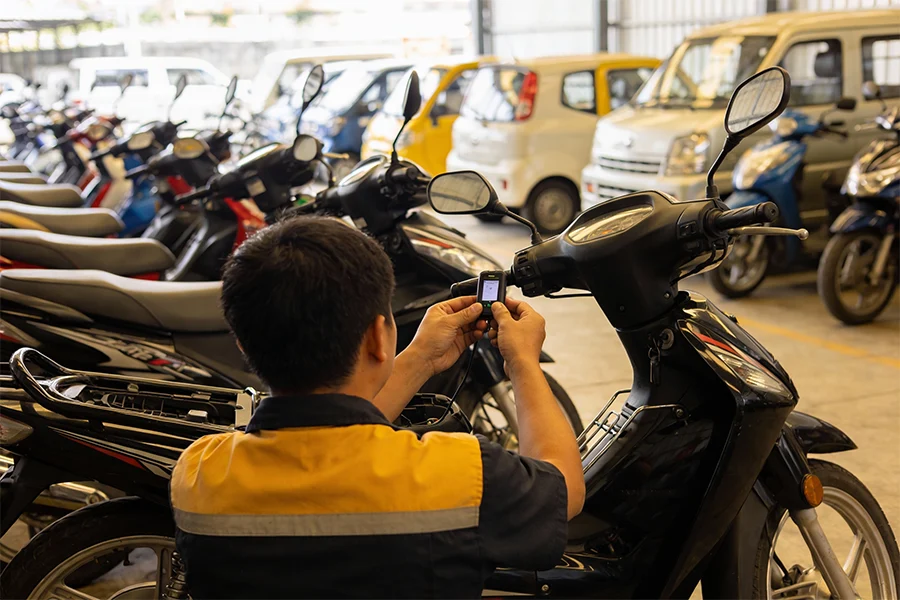
For customers such as auto and motorcycle parts distributors, fleet operation enterprises, and financial risk control institutions, the procurement of GPS tracker is by no means a simple “price comparison and model selection”, but a systematic project that needs to balance compliance, stability, adaptability, and long-term operating costs. Especially against the backdrop of diverse scenarios in the auto and motorcycle industry (long-distance freight, urban commuting, motorcycle travel, etc.) and the iteration of communication technologies (transition from 2G to 4G/5G), scientific procurement decisions directly affect business efficiency and risk control. In the field of GPS positioning and tracking, the network module is the core component determining device performance. 2G GPS Trackers once dominated the market with the advantages of low cost and wide coverage, while the popularization of 4G technology has promoted the upgrading of positioning and tracking devices towards high precision, intelligence, and high stability.
1. Clarify Core Needs and Avoid Blind Model Selection
① Scenario Adaptation Requirements
- Vehicle Type and Usage: Distinguish between different vehicle types such as motorcycles (retro/racing/long-distance motorcycle travel models), trucks (heavy/light/cold chain dedicated), and passenger cars, and clarify the installation method (wired/wireless/strong magnetic adsorption) requirements of the tracker. For example, retro motorcycles need to focus on installation concealment and prioritize wireless devices, while long-distance trucks need to enhance battery life and signal coverage capability in remote areas.
- Operation Area: If the business covers remote mountainous areas, rural areas, and other regions with weak 4G signals, priority should be given to the signal penetration advantage of 2G GPS trackers. If focusing on urban operations and high-speed logistics, the real-time transmission capability of 4G devices is more suitable.
- Priority of Core Functions: Clarify essential functions (such as positioning accuracy, electronic fence, power failure alarm) and value-added functions (such as fuel consumption monitoring, remote diagnosis, data docking with enterprise management systems) to avoid paying additional costs for redundant functions.
② Core Principles for Model Selection
- Prioritize 4G Models: Whether for individual or enterprise users, as long as they are used in China or pursue long-term stability, they should prioritize 4G GPS Trackers to avoid device failure due to 2G network shutdown.
- Pay Attention to Module Type: Choose models equipped with 4G Cat1 modules, which balance low power consumption and high performance. The battery life can be close to that of 2G models, making them suitable for portable scenarios powered by batteries.
- Match Scenario Requirements: For high-precision requirements, select multi-mode positioning (GPS + Beidou) models; for fleet management, select models that support remote control and data statistics; for personal monitoring, select models that support voice calls and electronic fences.
③ Scale and Budget Planning
Are you worried about policy risks or exceeding the budget for bulk purchases? When selecting GPS trackers, the core is to grasp two key points: “low-cost trial and error + long-term stability”! 2G or 4G? The answer is straightforward: prioritize 4G Cat1 models, which save money and worry!
- First, calculate clearly to avoid wasting money! Although 2G models seem cheaper in hardware, they have been fully shut down and banned in China and can only be used overseas for a short period. Additionally, a secondary budget for equipment replacement within 3-6 months must be reserved. The combined comprehensive cost is actually higher, which is purely “saving money in the short term but planting hidden dangers in the long term”!
- On the other hand, 4G Cat1 models are truly “cost-effective kings”! The price is slightly higher than that of 2G models, but there are no additional replacement costs. They are policy-compliant with no risks and have stable signals without interruptions. Whether for fleet management, asset tracking, or personnel monitoring, they can accurately meet the needs.
Choose the right path for bulk purchases to save half the budget! We recommend entry-level 4G Cat1 GPS trackers, which balance cost control and long-term stability, perfectly meeting the core demand of low-cost trial and error.
④ Core Parameter Comparison Table
| Comparison Dimension | 2G GPS Tracker | 4G GPS Tracker |
|---|---|---|
| Network Type | GSM/GPRS 2G network | LTE-FDD/TDD 4G network (most support full Netcom, compatible with 3G/2G backup) |
| Data Transmission Rate | Low-speed transmission (≤100kbps), only capable of carrying basic positioning data | High-speed transmission (≥10Mbps), supporting large-bandwidth real-time data interaction |
| Positioning Accuracy & Supported Systems | Mostly single-mode GPS positioning, error 10-20 meters, update frequency 1-5 minutes/time | Multi-mode fusion positioning of GPS + Beidou + GLONSS, error ≤10 meters, update frequency 30 seconds-1 minute/time |
| Network Coverage & Stability | Wide coverage in remote areas and developing countries, but fully shut down in China, with prone signal interruptions | Full coverage in mainstream scenarios such as cities, highways, and expressways, strong signal penetration, and excellent anti-interference in weak network environments |
| Function Expansion Capability | Only supports positioning, trajectory playback, and basic alarms (vibration/power failure), with no expansion space | Supports intelligent functions such as real-time voice, remote fuel/power cut-off, electronic fence, offline data caching, and data statistics |
| Power Consumption & Battery Life | Low power consumption, small-capacity battery, can be powered by the car’s power supply for long-term use | Traditional 4G has relatively high power consumption (battery life 15-30 days), while Cat1 module models have power consumption close to 2G (battery life 30-50 days) |
2. Auto and Motorcycle Parts Industry Selection Guide: 2G or 4G GPS Tracker?
For B-end procurement in the auto and motorcycle parts industry, the core of choosing between 4G and 2G GPS trackers lies in “scenario adaptation” and “cost balance”. The two are not simply a technical iteration and replacement relationship, but each has advantages to adapt to different business needs.
-
Positioning Accuracy
The positioning accuracy of 2G GPS trackers in open outdoor civilian environments is usually 5-10 meters, which can meet basic positioning and trajectory tracing needs. With more efficient communication and transmission capabilities, 4G GPS trackers have improved positioning accuracy to 1-5 meters. Some high-end models support triple-mode positioning of GPS + Beidou + GLONASS, with better stability in complex environments, making them suitable for urban distribution and high-end fleet management scenarios that require high positioning accuracy. -
Communication Transmission
2G modules rely on GSM/GPRS networks, with slow data transmission rates, only capable of uploading basic positioning data and high latency. 4G modules (preferably LTE Cat.1) have data transmission rates dozens of times higher than 2G, enabling real-time high-definition data transmission, voice calls, and rapid response to remote commands. They also support OTA firmware remote upgrades, allowing flexible function expansion, and are suitable for scenarios that require real-time docking with enterprise management systems. -
Signal Coverage
After long-term construction, 2G networks have an extremely wide signal coverage. Especially in remote mountainous areas, rural areas, tunnels, and other regions with weak 4G signals, they have significant advantages in penetration and stability, making them the preferred choice for long-distance freight and fleets operating in remote areas. Currently, 4G networks have achieved full coverage in core operating areas such as cities and expressway networks, but there are signal blind spots in extremely remote areas, making them more suitable for fleets operating in urban scenarios. -
Power Consumption and Battery Life
2G modules have lower power consumption. With the same battery capacity, the battery life of wireless 2G GPS trackers is 30%-50% longer than that of 4G devices. Some models can stand by for more than 3 months with one positioning per day, making them suitable for low-frequency positioning scenarios such as motorcycle anti-theft and long-term monitoring of long-distance trucks. Due to the larger data transmission volume, 4G modules have relatively higher power consumption. However, with technological upgrades, mainstream 4G devices have narrowed the battery life gap by optimizing the power management system, and can meet the needs of high-frequency use scenarios when paired with fast-charging modules. -
Cost and Cost-Effectiveness
2G GPS trackers have mature hardware R&D and production technologies, lower hardware unit prices, and affordable 2G data plans, making them suitable for small and medium-sized distributors with limited budgets and large bulk purchase scales or operating enterprises in the sinking market. 4G GPS trackers have relatively higher hardware costs and data fees than 2G. However, from the perspective of long-term operation, their efficient data transmission capabilities can support refined management and reduce operational losses, making them more cost-effective for medium and large fleets or high-end supporting scenarios. -
Function Expandability
Limited by transmission rates, 2G devices are difficult to support complex value-added functions and can only realize simple data reporting. 4G devices can expand value-added functions such as fuel consumption monitoring, real-time temperature and humidity monitoring, remote diagnosis, and abnormal behavior analysis. They also support seamless docking with enterprise ERP systems and logistics management platforms through API/SDK interfaces, helping B-end customers achieve refined operations and digital transformation. -
Environmental Adaptability
- Signal Penetration: In scenarios such as high-rise shielding and underground garages, signal interruptions and loss of positioning data are prone to occur, and signal transmission is basically impossible in tunnels, resulting in complete loss of positioning. 4G trackers adopt multi-channel LTE networks, with significantly improved signal penetration and anti-interference capabilities. Most models are equipped with high-gain antennas and can still stably capture signals in high-rise canyons and underground garages. Some 4G GPS trackers support “4G + 2G” dual-mode automatic switching, and can switch to backup networks in weak signal areas such as tunnels to ensure positioning continuity.
- Multi-Scenario Coverage: Most 2G trackers are single GPS modules with weak signal capture capabilities, basically unable to locate in dense forest shielding and indoor environments, and completely unable to work in underground engineering scenarios without 2G signal coverage. 4G trackers are generally equipped with multi-mode fusion positioning modules of GPS + Beidou + GLONSS, with complementary signals from multiple systems, and can still capture effective satellite signals in dense forest scenarios. Rough positioning can be achieved near windows indoors. In 4G signal-weak areas such as underground engineering, some models can cache offline data or switch dual modes to supplement positioning data after the signal is restored, avoiding trajectory loss.
- Extreme Weather Endurance: The hardware design of 2G trackers is simplified, and their protection level is generally low. Hardware overheating failures are prone to occur under high-temperature exposure (such as vehicle center consoles in summer). Battery life is significantly reduced in low-temperature environments in northern winters, and internal components are easily damaged due to insufficient sealing in rainy, snowy, and dusty weather. 4G trackers (especially enterprise-level models) mostly adopt high-protection designs, with better high and low temperature resistance (common operating temperature -20℃~70℃), and waterproof and dustproof levels up to IP65 and above, which can adapt to harsh outdoor climates such as rain, snow, and sand. The battery management system of some low-power 4G Cat1 models is more complete, and the battery life stability under extreme temperatures is better than that of 2G models.
3. Supplier Evaluation: 5 Key Points for Selecting Reliable Partners
Procurement focuses on long-term cooperation. The comprehensive strength of suppliers directly affects procurement quality and subsequent services, which must be strictly evaluated from the following 5 dimensions:
-
Technical R&D and Product Quality Control Capabilities
Focus on inspecting the product’s positioning error (civilian grade needs to be controlled within 5-10 meters), signal anti-interference capability (adapting to complex scenarios such as tunnels and underground garages), and battery life (motorcycle-specific equipment needs to support ultra-long standby in low-power mode). Priority should be given to suppliers with independent R&D capabilities of chip modules. As a professional motorcycle GPS tracker manufacturer, Greatwill’s self-developed positioning algorithm can adapt to multi-band satellite signals and maintain stable positioning in scenarios such as high-speed riding and weak signal areas.
Verify whether the supplier has passed ISO 9001 quality management system certification, CE, FCC, and other overseas market access certifications. Request the supplier to provide product reliability test reports, including high and low temperature tests, waterproof and dustproof tests (motorcycle equipment is recommended to reach IP67 and above), vibration tests, etc., to ensure that the product can adapt to the complex working conditions of motorcycle riding. -
Customization Services and Industry Adaptation Experience
Demand Response and Program Customization: Evaluate whether the supplier can provide services such as hardware function customization (such as adding Bluetooth and acceleration sensors), software system development (such as exclusive APP and background management system), and appearance structure design (such as miniaturization and concealed installation) according to the brand’s market positioning. With years of experience in the GPS tracker field, Greatwill has provided customized products for fleet operators and vehicle manufacturers in many countries around the world, and can quickly respond to the localized needs of overseas markets. -
Production Capacity and Delivery Cycle Guarantee
Inspect the supplier’s production base scale, number of production lines, annual production capacity, and other indicators. At the same time, pay attention to the supply chain layout of its core components and whether it has established long-term cooperation with high-quality chip and battery suppliers to avoid delivery delays due to component shortages. Clarify the supplier’s regular order delivery cycle and the processing capacity of urgent orders. Request the supplier to provide a delivery guarantee agreement, clarify the compensation mechanism for delayed delivery, and reduce the brand’s market risk. -
Price System and Cost Control Capabilities
Evaluate whether the supplier’s quotation system is clear, including hardware costs, R&D costs, certification costs, after-sales service costs, etc., to avoid hidden charges later. At the same time, compare the price range of products of the same quality in the industry to determine whether the quotation is market-competitive. Inspect whether the supplier has the advantage of large-scale production and can reduce costs through bulk purchasing, process optimization, etc., to reserve a reasonable profit margin for the brand. Relying on its large-scale production base and vertically integrated supply chain, Greatwill can provide partners with cost-effective product solutions while ensuring quality. -
After-Sales Service and Technical Support System
It can quickly respond to needs such as equipment installation and commissioning, and fault repair. Evaluate whether the supplier can provide the brand with product operation training, technical document support, remote fault diagnosis, and other services, and pay attention to the response speed and solution efficiency of its after-sales service. Greatwill has established a 7×24 global technical support team, which can provide partners with full-process after-sales guarantee to help the brand steadily expand in overseas markets.
4. Brand GPS Tracker Evaluation
1. Seig Navigation – https://www.kauto.com/index.html
- Core Adaptable Scenarios: Scenarios with high requirements for positioning accuracy and data stability, such as large logistics fleets and engineering vehicles, with outstanding performance in long-distance cross-regional operation scenarios.
- Core Advantages: As an established enterprise in the industry, it has profound technical accumulation, positioning accuracy up to 1-3 meters, and supports triple-mode positioning of GPS + Beidou + GLONASS; it has a complete compliance certification system and strong data security protection capabilities, adapting to the large-scale management needs of large enterprises.
- Disadvantages: The product pricing is relatively high, and the hardware cost and subsequent platform service fees are at the medium and high levels in the industry, with average cost-effectiveness for small and medium-sized enterprises; the customization response cycle is relatively long, making it difficult to quickly match niche models or special function needs.
- Procurement Suggestion: Suitable for procurement by medium and large fleets or group enterprises with sufficient budgets and pursuit of high-end and stable performance.
2. Concox – https://www.jimiiot.com/
- Core Adaptable Scenarios: Passenger car rental, urban short-distance distribution fleets, covering both personal and B-end markets, with strong adaptability in lightweight management scenarios.
- Core Advantages: Rich product models, covering wired/wireless/strong magnetic and other installation methods; rapid iteration of 4G module products, low data transmission delay, supporting multi-terminal (PC/APP/mini-program) management, and easy operation; flexible price range, meeting the needs of different budget levels.
- Disadvantages: Weak product adaptability for complex working conditions such as heavy trucks and operation in remote areas; insufficient focus on B-end customization services, making it difficult to deeply match the differentiated packaging needs of auto and motorcycle parts distributors.
- Procurement Suggestion: Suitable for small and medium-sized distributors or rental enterprises focusing on urban scenarios, mainly with passenger cars or light trucks.
3. Iconcox – https://www.iconcox.com/
- Core Adaptable Scenarios: Three high-frequency B-end scenarios of logistics, engineering, and cold chain, especially with special advantages in temperature and humidity monitoring scenarios of cold chain transportation.
- Core Advantages: Accurate scenario-based product design, such as cold chain-specific equipment can realize real-time temperature and humidity monitoring and abnormal alarms, and engineering vehicle equipment has strong anti-vibration and high waterproof performance (IP68 level); extensive market channels, comprehensive after-sales network coverage, and fast response speed.
- Disadvantages: The product functions focus on scenario-based, with weak versatility and poor cross-scenario reusability; the update and iteration of 2G module products are lagging behind, providing insufficient support for customers relying on 2G signals in remote areas.
- Procurement Suggestion: Suitable for targeted procurement by B-end customers focusing on a single segmented scenario (such as cold chain, engineering).
4. GreatWill – https://greatwilliot.com/
- Core Adaptable Scenarios: Core Adaptable Scenarios: Full range of auto and motorcycle models (motorcycles, heavy trucks, passenger cars, cold chain vehicles, etc.), covering multiple B-end scenarios such as remote transportation, urban commuting, and financial risk control, especially adapting to the bulk procurement and secondary distribution needs of auto and motorcycle parts distributors.
- Core Advantages: Comprehensive product matrix, covering 2G/4G modules, balancing signal coverage in remote areas and real-time transmission needs in cities; outstanding customization capabilities, providing one-stop services such as hardware appearance, interface adaptation, and software platform docking, perfectly matching the differentiated packaging needs of distributors; large-scale production reduces costs, with affordable hardware pricing and no hidden fees, 7×24 technical support, and perfect after-sales guarantee.
- Disadvantages: Slightly less competitive than established high-end brands such as Seig Navigation in bidding for ultra-high-end customized group large-scale projects.
- Procurement Suggestion: Suitable for various B-end customers such as small and medium-sized distributors, fleet operation enterprises, and financial risk control institutions, especially for procurement needs that need to balance multiple scenarios and pursue high cost-effectiveness and customization services.
5. GreatWill: Your Professional Supplier of 2G/4G GPS Trackers
As a senior B-end seller in the GPS tracker industry for auto and motorcycle parts, Greatwill has been deeply engaged in the industry for more than ten years and deeply understands the selection pain points of different customers. For this reason, it has built a full range of 2G GPS tracker and 4G GPS tracker product matrices to meet the needs of various B-end scenarios:
-
Technical Advantages
Greatwill’s 2G GPS trackers adopt industrial-grade communication modules, with signal reception capability improved by 20%, and can still work stably in remote areas. 4G GPS trackers are equipped with the latest 4G LTE Cat.1 modules, with positioning accuracy up to 1 meter and data transmission delay less than 1 second. They are also compatible with the future transition to 5G networks, avoiding rapid equipment obsolescence. -
Customization Services
Greatwill provides one-stop services such as hardware customization (such as appearance and interface adaptation), software docking (such as enterprise management platform and APP development), and function customization (such as anti-theft alarm and fuel consumption monitoring). Both 2G and 4G devices can be seamlessly integrated with the customer’s existing business system. -
Cost and After-Sales Guarantee
Relying on the advantage of large-scale production, Greatwill controls the procurement cost of 2G GPS trackers at a low level in the industry, and provides flexible tariff package cooperation models for 4G devices to reduce customers’ later operating costs. In addition, we provide product quality assurance (inquire with the merchant for details) and 7×24 technical support, to solve the after-sales worries of B端客户. -
Full-Scenario Matrix
Covering 2G/4G full communication modules, adapting to various vehicle types such as motorcycles, trucks, and passenger cars, providing multiple installation methods such as wired, wireless, and strong magnetic, meeting the needs of different scenarios such as remote transportation, urban通勤, and financial risk control.
6. Precise Matching of Applicable Scenarios (2G or 4G)
2G GPS trackers and 4G GPS trackers are not substitute relationships but complementary. B-end customers in the auto and motorcycle parts industry should select models according to their own business scenarios, budgets, and development plans.
-
① Vehicle Monitoring and Management
- Logistics Fleets / Freight Companies
- Recommendation: 4G tracker + OBD interface
- Reason: Real-time scheduling, fuel consumption monitoring, and driving behavior analysis are required, and 4G high-speed transmission meets high-frequency data needs.
- Essential Functions: Remote fuel/power cut-off, ACC detection, trajectory playback, electronic fence.
- Logistics Fleets / Freight Companies
-
② Auto Finance / Rental
- Recommendation: 4G strong magnetic non-installation type
- Reason: Concealed installation to prevent removal, offline storage of more than 10,000 trajectories, suitable for risk control tracking.
- Essential Functions: Vibration alarm, disassembly alarm, parking monitoring.
-
③ Electric Vehicles / Motorcycles
- Recommendation: 2G wired waterproof type (such as TR40)
- Reason: Ultra-small size for easy concealment, extremely low power consumption, GPS + Beidou dual-mode positioning, wide voltage (9-90V).
-
④ Electric Vehicle Rental / Shared Fleet Management
- Recommendation: GT06 protocol 2G tracker (supports 9-90V)
- Management Advantages: Supports unified platform management of multiple devices, and can set ACC detection and electronic fence.
- Operational Functions: Remote monitoring, trajectory query, overspeed alarm.
-
⑤ Long-Distance Inter-provincial Cold Chain Transportation
- Recommendation: 4G solar tracker (GAT30)
- Core Reason: Solar + magnetic dual-mode charging, long-term outdoor battery life without frequent recharging, IP67 dustproof and waterproof to adapt to heavy rain and low-temperature environments.
-
⑥ School Bus Safety Monitoring / Buses / Public Transport
- Recommendation: 4G on-board positioning terminal
- Core Reason: Multiple positioning modes cover indoor and outdoor campus environments, supporting triple alarms for overspeed, overloading, and route deviation.
- Essential Functions: Real-time location viewing via APP, stop record, driving behavior monitoring, historical trajectory report.
GreatWill as a professional GPS tracker supplier, always takes customer needs as the core and provides cost-effective 2G/4G GPS tracker products and customized solutions. If you are looking for a reliable GPS tracker supplier for auto and motorcycle parts or are confused about which product to choose, feel free to contact Greatwill, and let us escort your business development.



Responses
Discussion
0 responses
No responses yet
Start the discussion with a practical question or field note related to this article.