
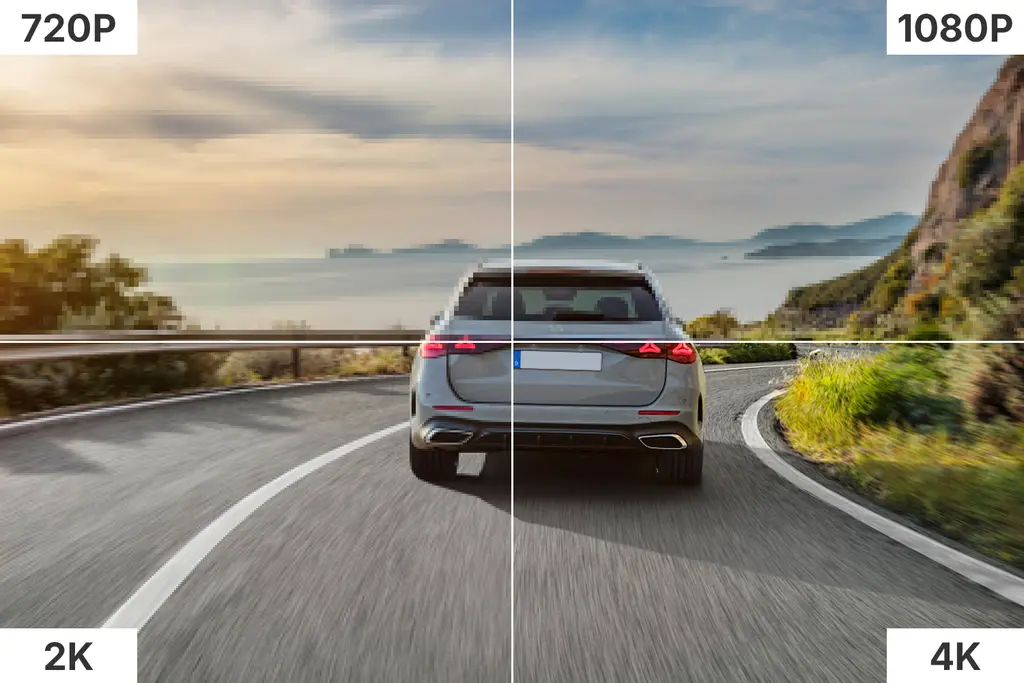
What Exactly is Video Resolution?
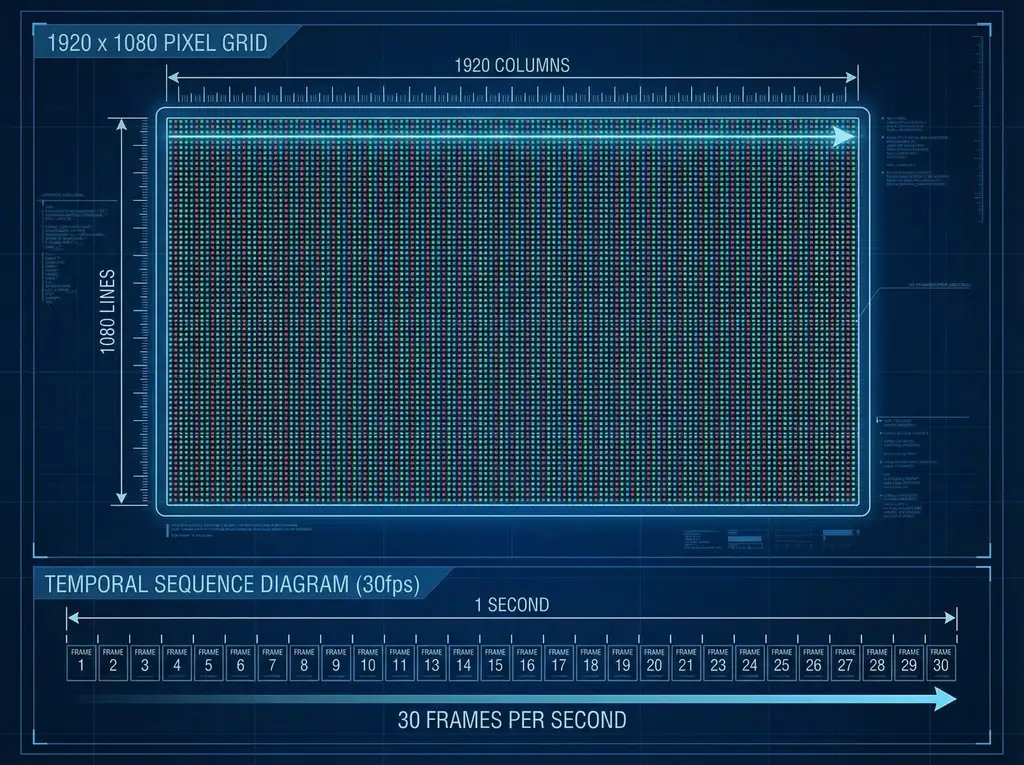
Video resolution refers to the number of pixels per frame in the footage captured by a dash cam. The higher the resolution, the more pixels there are, resulting in sharper, more detailed images. The most common dash cam resolutions are 720p (High Definition), 1080p (Full High Definition), 2K (Quad High Definition), and 4K (Ultra High Definition).
Detailed Breakdown of Four Resolution Options
720P (High Definition)
- Core Specs: 1280×720 pixels, total pixels around 0.92 million
- Advantages: Ultra-affordable price point, minimal storage footprint (a 32GB card can store 15–20 hours of footage), low power consumption, ideal for use as a rear-view camera.
- Disadvantages: Blurry image quality with significant detail loss, obvious pixelation when zoomed in, struggles to clearly identify license plates from a distance, making it unreliable for accident evidence collection. Poor compatibility, as footage appears stretched and distorted when played on high-definition screens.
- Ideal Scenarios: Extremely tight budgets, temporary use where “basic recording” is sufficient (e.g., rental cars).
1080P (Full High Definition)
- Core Specs: 1920×1080 pixels, total pixels around 2.07 million
- Advantages: Budget-friendly, sharpness meets daily needs, capable of clearly capturing license plates and traffic signs on urban roads, satisfying the evidence collection needs for most accidents. Moderate storage pressure (a 64GB card can store 8–12 hours of footage), eliminating the need for frequent backups. Mature and stable hardware with strong compatibility (footage plays smoothly on smartphones, computers, and in-car displays).
- Disadvantages: Limited detail retention when zoomed in, inferior to 2K/4K in capturing details during high-speed driving or long-distance shooting.
- Ideal Scenarios: Daily commuting and urban driving, users prioritizing cost-effectiveness with core needs centered on accident evidence collection.
2K (Quad High Definition/QHD)
- Core Specs: 2560×1440 pixels, total pixels around 3.69 million
- Advantages: Significantly better detail performance than 1080p, can clearly identify license plates at speeds up to 100km/h or from distances within 30 meters. Lower storage pressure than 4K (a 64GB card can store 5–8 hours of footage), balancing high definition with practicality. Superior hardware configuration (usually paired with wide-angle and night-vision lenses), delivering better noise reduction and dynamic capture capabilities at night.
- Disadvantages: Higher price than 1080p models, increased storage requirements, necessitating a 64GB or higher capacity high-speed SD card (TF card).
- Ideal Scenarios: Frequent highway driving and long-distance self-driving trips, where users desire clearer details for evidence collection. Users with a moderate budget (¥1,000–¥2,000) seeking a quality upgrade without shouldering the heavy storage burden of 4K.
4K (Ultra High Definition/UHD)
- Core Specs: 3840×2160 pixels, total pixels around 8.29 million
- Advantages: Unmatched detail capture, can clearly resolve small text on distant road signs and interior vehicle details in static or low-speed scenarios, remaining sharp even when zoomed in. Exceptional image quality with true-to-life color reproduction, perfect for recording travel scenery or sharing footage online. Strong future compatibility, supporting playback on high-definition in-car screens, televisions, and other devices.
- Disadvantages: Premium price tag, extremely high storage pressure, stringent hardware requirements (demanding high-performance processors, sensors, and lenses), with budget 4K models prone to lag and excessive noise. High power consumption, requiring stable vehicle power supply.
- Ideal Scenarios: Users with ample budgets (¥1,500+) pursuing uncompromising evidence integrity. Frequent highway and long-distance driving, where capturing distant details is essential. Owners of high-value vehicles looking to minimize insurance claim risks with high-definition recording. Enthusiasts who enjoy documenting road trips and sharing footage.
Head-to-Head Comparison: 720P vs 1080P vs 2K vs 4K
| Comparison Dimension | 720P | 1080P | 2K | 4K |
|---|---|---|---|---|
| Pixel Density (PPI) | Low (≈70) | Medium (≈108) | High (≈144) | Ultra-High (≈216) |
| Core Image Quality | Blurry with severe detail loss | Sharp enough for daily evidence collection | High-definition and detailed with significant improvement | Ultra-sharp with no loss of detail when zoomed in |
| License Plate Recognition Distance (Daytime) | ≤10 meters (blurry) | 15–20 meters (clear) | 20–30 meters (sharp) | 30–50 meters (ultra-clear) |
| High-Speed Dynamic Capture (120km/h) | Severely blurry, unrecognizable | Basically clear with slight edge blurring | Clear and stable with complete detail retention | Ultra-stable with no motion blur |
| Low-Light Performance (with high-quality hardware) | Excessive noise, useless for evidence collection | Controllable noise, license plates visible within 10–15 meters | Excellent noise reduction, license plates visible within 15–20 meters | Clean low-light performance, license plates visible within 20–25 meters |
3 Key Factors for Choosing the Right Resolution
Clarify Your Core Purpose

- Core need“Accident evidence collection ”(urban commuting) : Choose a mid-range 1080p model—it gets the job done without overspending.
- Frequent highway/long-distance driving: Opt for 2K or 4K for reliable long-distance detail capture.
- Scenery recording and footage sharing: 4K is the top choice for its unmatched image quality and texture.
- Temporary use or low-cost transition: Go for an entry-level 1080p model—it’s far more practical than 720P.
Consider Storage Capacity Tolerance
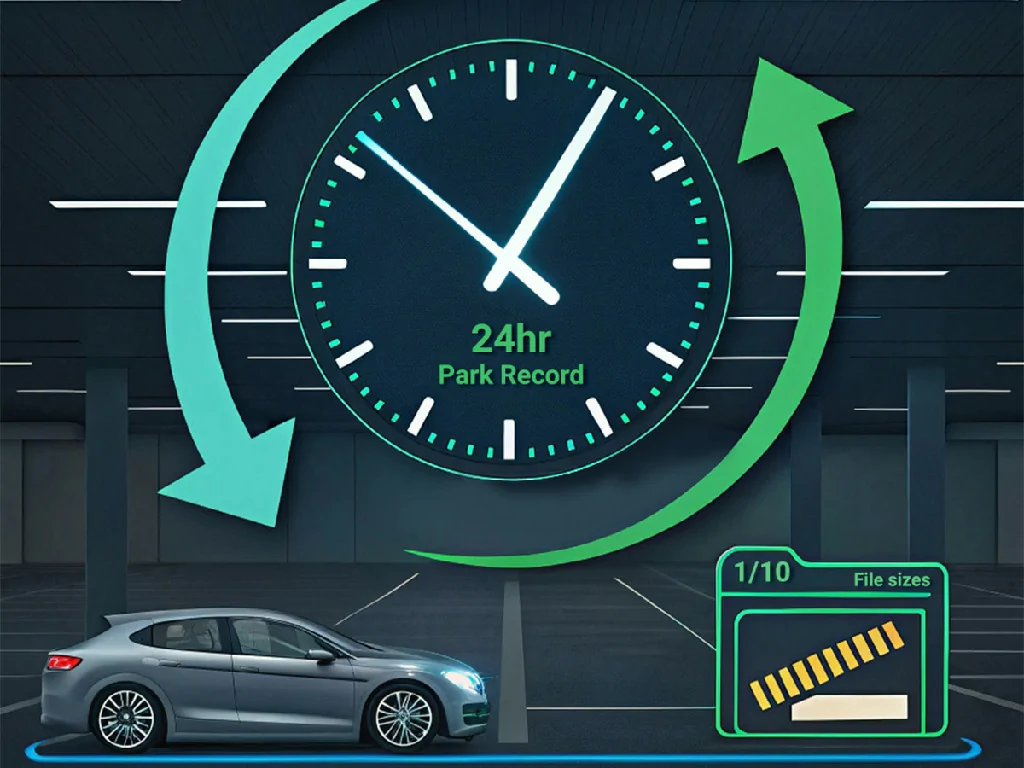
- Hate frequent backups and hassle: 1080p is your best bet (a 64GB card only needs backing up once a week).
- Can accept regular backups (once every 1–2 weeks): 2K works well with a 128GB card.
- Willing to invest time in storage management (1–2 backups per week): 4K requires a 256GB card.
Technical Compatibility: Lighting and Lens Factors
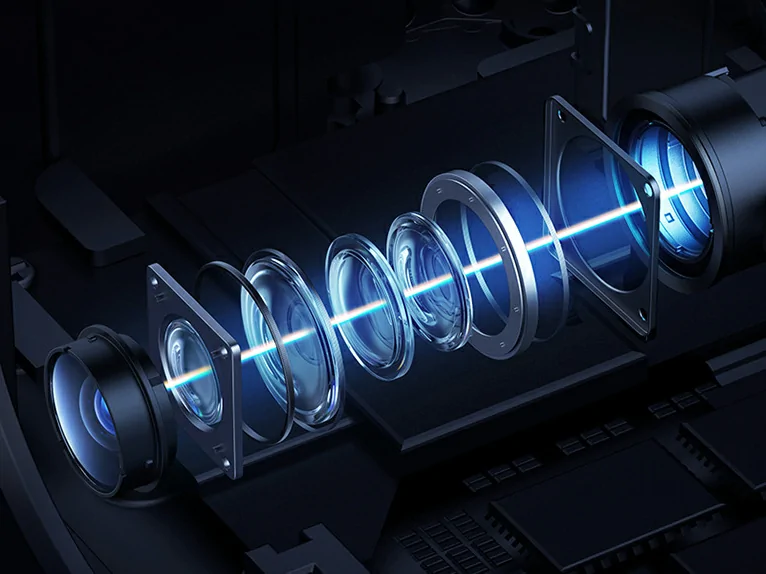
- Low-light environments (night, cloudy days, tunnels): High resolutions (2K/4K) only deliver optimal performance when paired with large-size sensors and night-vision lenses. For users who frequently drive at night, prioritize the “large sensor + high resolution” combination.
- High-light environments (midday sun, back lighting): High resolutions better preserve image details, avoiding detail loss caused by overexposure or underexposure. 1080p footage may fail to capture license plates clearly due to glare, while 2K/4K footage balances light and shadow effectively to retain key details.
Optimal Resolution Selection for Different Scenarios
1. Urban Commuters: 1080P or 2K?
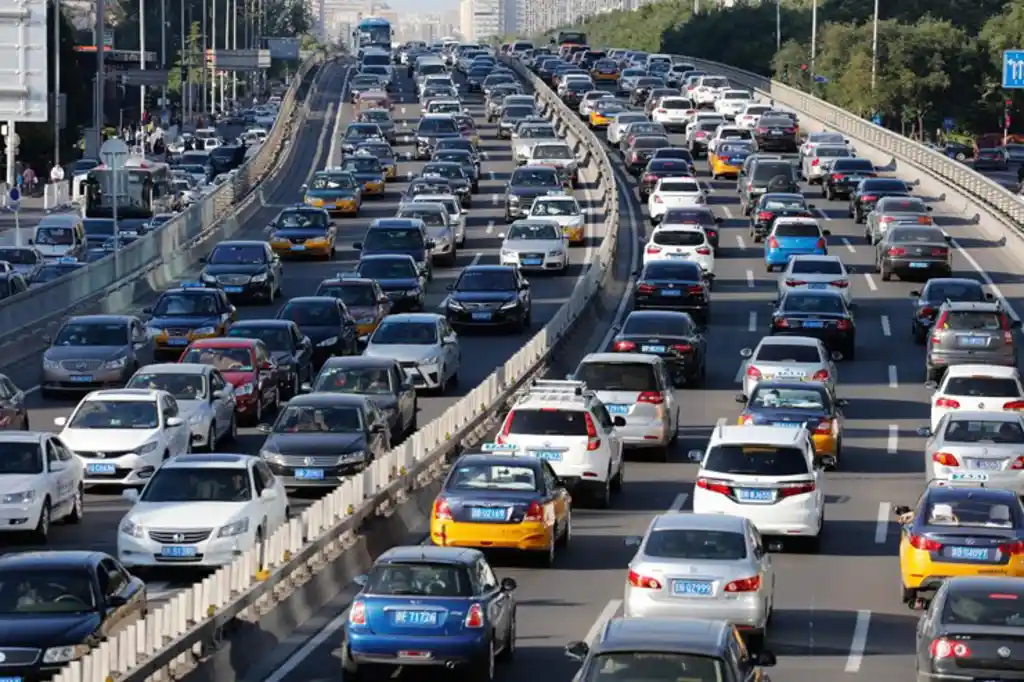
Urban commuting is characterized by low-speed driving, heavy traffic, and mostly short-distance collisions. A 1080p model fully meets needs—it can clearly identify license plates within 15–20 meters, ensuring reliable accident evidence collection. An entry-level 2K model is worth considering only if you frequently encounter cut-ins in traffic jams and need sharper details to capture accident moments, its dynamic capture capability outperforms 1080p slightly, reducing motion blur during short-distance, fast-moving scenarios.
2. Highway/Long-Distance Drivers: Is 2K a Must-Have, and Is 4K Worth It?

2K is a must-have, while 4K suits users with ample budgets who demand uncompromising evidence integrity.The biggest challenge of highway/long-distance driving is long-distance identification—vehicles travel at high speeds (100–120km/h) with large gaps between them. 1080p footage tends to blur around the edges of license plates beyond 20 meters, making it hard to capture accurate details. Equipped with 3.69 million pixels, 2K can clearly capture license plates and road signs within 20–30 meters, making it more reliable for rear-end collisions and lane-changing incidents on highways—it’s the safe choice for highway travel. 4K’s strength lies in its “ultra-detailed redundancy”: it can clearly record small text on road signs and scratches on vehicles from 30–50 meters away, and even capture the actions of other drivers, making evidence more compelling. However, it comes with a higher price tag.
3. Taxi/Ride share Drivers: Cost-Benefit Analysis

The core needs of taxi and ride share drivers are low cost, high reliability, and long recording durations. With daily driving time ranging from 8–12 hours, these users require devices that are durable, cost-effective in storage, and easy to maintain.
- Device Cost: Mid-range 1080p models are reasonably priced and feature mature sensors and wear-resistant casings, making them suitable for high-frequency use. 2K/4K models cost 30%–80% more and have slightly higher failure rates under heavy-load recording conditions.
- Storage Cost: A 64GB card can support a full day of recording with 1080p, while a 128GB card can last two days—with SD card (TF card) costs only ¥80–¥120. 2K requires a 128GB card for a full day of use, and 4K needs a 256GB card, doubling storage costs.
- Maintenance Cost: 1080p requires backups only once every 1–2 days, while 4K needs daily backups, which takes up valuable working time. Although 720P has the lowest cost, its lack of detail makes it useless for accident evidence collection, potentially leading to greater losses due to insufficient proof.
In summary, a mid-range 1080p model offers the best balance of cost, reliability, and practicality, meeting the needs of long-hour recording and high-frequency evidence collection.


Responses
Discussion
0 responses
No responses yet
Start the discussion with a practical question or field note related to this article.