
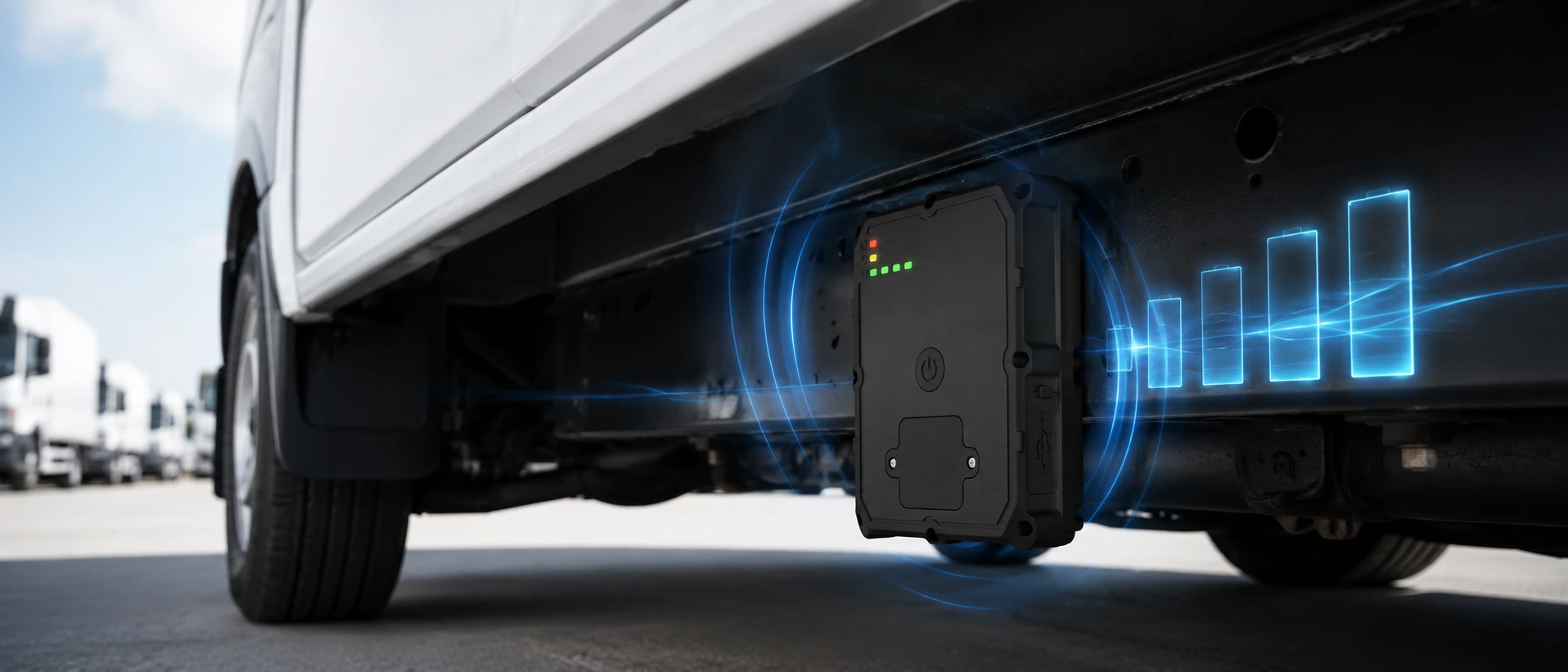
In large-scale asset management and supply chain logistics, regular hardware maintenance often incurs high hidden costs.
For fleet operators and equipment wholesalers, the advantage of magnetic GPS trackers that require no installation is obvious. However, striking the right balance between high-frequency positioning and long battery life directly determines the project’s ultimate return on investment (ROI).
The battery capacity and the underlying choice of chemical materials determine the hardware’s physical size, its resistance to tampering and concealment, and its basic service life.
By configuring an intelligent reporting mechanism via an accelerometer, the device can enter deep sleep mode when stationary, thereby extending battery life by a significant margin.
Optimization of next-generation low-power IoT networks at the RF level is a key technology for avoiding frequent network searches in signal blind spots and reducing standby power consumption.
Establish a quantified TCO calculation model that enables enterprises to clearly assess the true ratio between upfront hardware investments and subsequent labor maintenance costs.
Battery Capacity and Chemistry: The Foundation of Long-Term Asset Tracking
Large-capacity industrial-grade batteries are the foundation for the strong magnetic locator to achieve several years of maintenance-free operation, and also serve as the technical guarantee for stable hardware performance in extremely harsh environments.
When planning large-scale fleet assets, the physical size of hardware, battery capacity, and chemical composition must perfectly match the actual usage cycle. Currently, B2B buyers typically face a choice between lightweight, high-frequency tracking and ultra-long-duration, long-cycle tracking.
Industrial-grade lithium thionyl chloride batteries: These non-rechargeable batteries feature an extremely low self-discharge rate, making them ideal for container or heavy machinery tracking applications that require only 1-2 location updates per day and need to operate continuously for 3 to 5 years.
High-capacity rechargeable lithium polymer batteries: For fleets that need to adjust reporting frequency dynamically based on vehicle status—such as high-frequency reporting while driving and sleep mode when stationary—rechargeable batteries ranging from 5,000 mAh to 10,000 mAh offer greater operational flexibility.
Constraints of the outer casing’s physical specifications: A higher battery capacity implies a larger magnet-attachment area and a heavier outer casing. In actual procurement, it is essential to comprehensively evaluate the balance between the available installation space and the expected recharge-free operating period, avoiding the blind pursuit of large capacity that could prevent the device from being installed discreetly.
Choosing the right hardware metrics is critical for high-volume commercial purchasing. If you are preparing for a wholesale procurement and want to evaluate comprehensive market screening criteria beyond just battery specifications, please read our strategic guide: Magnetic GPS Trackers for Fleet and Wholesale: What Buyers Need to Know in 2026。
Reporting Intervals and Motion Sensoring: Optimizing Power Consumption
By configuring an intelligent motion-sensing algorithm to put the hardware into deep sleep when it’s stationary, you can extend the lifespan of the magnetic positioning device in the most direct and effective way.
Fixed-frequency blind reporting not only wastes precious battery power but also generates a large amount of redundant data. Modern industrial-grade hardware achieves fine-grained control over device power consumption through built-in acceleration sensors and adaptive firmware.
[Vehicle Fleet Asset Status] ──> Stationary ──> Deep Sleep Mode (Microamp-Level Current / Wireless Module Turned Off)
└──> Motion  ──> Adaptive Wake-up (Milliampere-Level Current/High-Frequency GPS Reporting)
Power Consumption Difference Between Static and Dynamic Modes: When the vehicle is stationary or a container is stored in a port, the locator switches to a low-power sleep mode, consuming current at only the microampere level. As soon as the device detects vibration or movement, it immediately wakes up the wireless module to perform positioning and reporting.
Power Consumption Difference Between Static and Dynamic Modes: When the vehicle is stationary or a container is stored in a port, the locator switches to a low-power sleep mode, consuming current at only the microampere level. As soon as the device detects vibration or movement, it immediately wakes up the wireless module to perform positioning and reporting.
Advantages of hardware-adaptive firmware: Excellent hardware vendors provide support for batch, remote updates of reporting logic (OTA) in the background, enabling fleet managers to freely switch between “safe real-time monitoring” and “ultra-long endurance mode” at any time according to phased business needs.
Want to understand the underlying hardware engineering that enables these adaptive sleep states? Explore the technical blueprint of power utilization in our featured article: How Do Magnetic GPS Trackers Work? A Technical Overview for Fleet Buyers.
Network Evolution: How Low-Power IoT Networks Extend Device Longevity
The energy efficiency performance of the network communication module largely determines the continuous operating time of the high-magnetic locator after a single charge.
Energy Efficiency Advantages of Low-Power IoT Networks: Compared to traditional communication methods, the new-generation low-power IoT networks feature specialized energy-saving mechanisms that allow devices to maintain ultra-long-period handshake sleep states with base stations when they are not transmitting data, significantly reducing power consumption during RF reception.
Signal searching can invisibly drain the battery: In cross-border transportation or remote mining areas, signal blind spots can cause the tracker to continuously attempt to search for a network. Hardware equipped with an excellent power-management chip will limit the frequency of these searches in such scenarios, preventing the battery from being rapidly drained due to indiscriminate network scanning.
Long-term technological compatibility in deployment: When selecting large quantities of equipment, purchasers should prioritize hardware that fully supports mainstream low-power network standards. This not only can increase the average device battery life by more than 30%, but also helps avoid the forced retirement of hardware due to network shutdowns in the coming years.
Network efficiency and battery life are deeply intertwined with regional cellular network standards. To protect your hardware investment from the impact of future global infrastructure shutdowns, and to learn how to ensure that device battery life aligns seamlessly with the long-term lifecycle of network technologies, be sure to read this essential technical compatibility report: 2G Sunset and the Future of Fleet Telematics: Why 4G LTE and CAT-M1 Matter。
Custom Battery Engineering: Tailoring Power Solutions for Non-Standard Fleets
In large-scale B2B procurement, the physical structure of fleet assets often imposes extremely stringent physical constraints on the dimensions of the tracker’s housing. In such cases, conventional standard components—due to the physical law that “charge capacity is proportional to volume”—often cannot be directly fitted into the designated space. This necessitates manufacturers to provide magnetic GPS tracker battery options and non-standard customized solutions.
In large-scale B2B procurement, the physical structure of fleet assets often imposes extremely stringent physical constraints on the dimensions of the tracker’s housing. In such cases, conventional standard components—due to the physical law that “charge capacity is proportional to volume”—often cannot be directly fitted into the designated space. This necessitates manufacturers to provide magnetic GPS tracker battery options and non-standard customized solutions.
Vibration-Proof Structural Safety & Low-Leakage Circuitry
In the long-term, severe vibrations experienced by construction machinery or container trailers, the terminals of conventional battery cells are highly susceptible to microscopic fractures or internal short-circuit failures caused by friction against the casing. Our custom-designed hardware features a structurally composite wrapping made of high-density flame-retardant EVA and self-adhesive shock-absorbing foam.
In the long-term, severe vibrations experienced by construction machinery or container trailers, the terminals of conventional battery cells are highly susceptible to microscopic fractures or internal short-circuit failures caused by friction against the casing. Our custom-designed hardware features a structurally composite wrapping made of high-density flame-retardant EVA and self-adhesive shock-absorbing foam.
High-Frequency Adaptive Cycling Route (Industrial-Grade Lithium Polymer Battery / Li-Polymer Battery Customization)
Designed for transportation fleets that require real-time tracking (reporting every few minutes in dynamic mode, entering sleep mode when stationary) and frequent turnover. This solution abandons consumer-grade cells (such as those used in mobile phones) and instead employs industrial-grade pure lithium cobalt oxide or multi-component composite material cells. The customization focuses particularly on improving cycle life ratio.
Customized Shell and Battery Capacity
Based on the specific scenario and endurance requirements, we customize the battery size—ultra-thin, high-capacity lithium polymer batteries. This allows us to determine the exact dimensions of the GPS tracker, ensuring maximum concealment. The device can be seamlessly hidden within gaps or recesses of non-standard assets.
Magnetic Force & Weight Balancing Engineering
A large-capacity battery means increased weight, which in turn raises the risk of drops. By using neodymium-iron-boron (NdFeB) magnets, we can achieve tens of kilograms of vertical pulling force while occupying an extremely small physical volume. These magnets are incredibly powerful yet compact and lightweight—making them ideal for fleet-level magnetic GPS devices. Combined with a non-slip, wear-resistant silicone casing, this design ensures that the hardware will remain securely in place, even under high vibration conditions found in construction machinery or on bumpy roads.
Wide-Temperature Electrolyte Customization
For fleets deployed in transnational cold chains, Middle Eastern oil fields, or Siberian mining regions, standard commercial-grade batteries quickly lose their effectiveness. Customized solutions employ special ultra-wide-temperature-range electrolytes that enable rechargeable batteries to maintain a discharge efficiency of over 85% even under extreme conditions ranging from -40°C to +85°C, thereby preventing environmental-induced leakage at the root level.
-
Low-temperature customization (low-temperature cold chain/polar projects): Custom-designed electrolytes with exceptionally low freezing points ensure that the hardware can still deliver more than 80% of its rated capacity even under extreme cold conditions as low as -40°C, effectively preventing false low-battery alerts caused by sudden voltage drops (volt-drop window) during winter.
-
High-temperature customization (for Middle Eastern oilfields/around vehicle chassis engines): Employs high-temperature-resistant diaphragms and a specially formulated flame-retardant electrolyte, enabling the device to operate safely and reliably for extended periods at temperatures up to +85°C, thereby effectively mitigating the risk of battery swelling or thermal runaway from the source itself.
Firmware Optimization & OTA Power Tuning
Tailored Power-Saving States
Built-in high-precision three-axis/six-axis accelerometer (G-sensor) with adaptive filtering algorithms. For example: After the GPS device has been stationary for 5 minutes, the firmware forcibly cuts off power to both the GPS chip and the cellular RF module, putting the device into a deep sleep state (current consumption drops to the microampere level ≤ 15 µA). As soon as even the slightest vibration exceeding 0.1 G is detected, the device instantly wakes up adaptively.
Smart Network Search Logic
In cross-border maritime transport or remote, desolate regions, signal blind spots are common. Traditional trackers, unable to find a network, will continuously increase their transmission power and frequently search for networks, causing the battery to drain rapidly within just a few days. Our custom firmware employs a blind-spot protection back-off search protocol: when no network signal is detected, the device gradually reduces its network-scan frequency—from once per minute down to once every hour, or even once every four hours. Meanwhile, it temporarily stores unsent location data in the built-in flash memory chip. Once the signal is restored, the device will batch-upload the stored location data in one go, thereby preventing the battery from being “silently drained” by futile, continuous network searches.
Our technical experts at GreatWill can tailor-make hardware power consumption profiles and exclusive battery cells specifically designed to meet the requirements of your particular physical space and scheduling cycles. Feel free to directly submit your non-standard asset parameters to receive a free feasibility assessment report.
Security and Tamper Resistance
For companies that own hundreds or even thousands of vehicles, the initial purchase price of trackers is just the tip of the iceberg. The labor costs associated with frequent battery replacements or manual removal and recharging, as well as vehicle downtime losses, often far exceed the value of the hardware itself.
| Evaluation Dimensions | 500mAh Mini Tracker (High-Frequency Reporting) | 6000mAh Magnetic Tracker (Smart Sleep Mode) |
|---|---|---|
| Typical Application Scenarios | Temporary vehicle dispatch, personnel tracking | Trailer management, container leasing, heavy machinery |
| Single-Charge Battery Life | 3 – 7 days | 1 – 3 years (depending on reporting frequency) |
| Annual Manual Maintenance Frequency | Approx. 50 times | 0 – 1 time |
| Asset Downtime Risk | Extremely high (due to frequent disassembly) | Extremely low (kept adsorbed for long periods) |
| Fleet Overall TCO Performance | High later operation and maintenance costs | High upfront hardware investment, low long-term total cost |
In large-scale fleet planning, selecting high-capacity, strong-magnetic tracking devices paired with a scientifically designed sleep strategy can reduce manual maintenance costs to nearly zero over the asset’s entire lifespan. Fleet managers should work backward from the vehicle’s depreciation period and the business turnover cycle to determine the required specifications for the hardware batteries.
For special structural requirements, you can also refer to our Industry Standard Deployment Manual:Installation & Deployment Options. GreatWill custom engineering team is always ready to perform advanced tuning of measured power consumption profiles based on your non-standard asset parameters.
Procurement FAQ Matrix: Battery Performance and Fleet Management Audit
Absolutely not required. The wireless magnetic GPS devices fully support OTA batch firmware updates. Fleet managers can use the management platform to push new reporting intervals and sensor sensitivity settings to thousands of trackers with a single click. The hardware will seamlessly receive and implement these changes in power consumption logic during its next automatic wake-up, enabling you to remotely and dynamically adjust battery life across the entire fleet, regardless of geographic location. Signal jamming poses a significant power consumption challenge for wireless trackers. Low-end devices, when subjected to jamming, can drain their batteries within just a few days due to continuous attempts to search for networks (high-power RF transmission). Industrial-grade magnetic locators are equipped with an intelligent power-saving algorithm—anti-jamming—that detects persistent base station jamming in the environment and inability to establish a connection. When such conditions are identified, the hardware proactively limits the frequency of network searches and activates the built-in accelerometer to perform a dual-check for stationary status, thereby preventing “high-power penalties” caused by jamming interference and ensuring that, once the interference is lifted, the device still has sufficient battery power to operate normally. This depends on the turnover frequency of your assets. Single-use lithium thionyl chloride (Li-SOCl2) batteries boast an extremely high energy density and a self-discharge rate that is nearly zero. Since no charging circuit needs to be reserved, their enclosure can achieve an IP68 sealing rating. For assets such as shipping containers and heavy machinery rentals—characterized by “high stealth, ultra-long maintenance cycles (3–5 years), and only 1–2 reports per day”—lithium-thionyl chloride batteries offer the best total cost of ownership (TCO). On the other hand, rechargeable lithium-polymer batteries are ideal for transportation fleets that require real-time tracking (e.g., daily driving with frequent, dynamic positioning). Although these batteries need regular recharging, they eliminate the costly expenses associated with replacing the entire hardware or batteries altogether after several years. When the light sensor built into the bottom of the tracker detects a change in light—meaning the device has been forcibly removed from its dark environment—the firmware instantly activates the highest-power emergency mode (Panic Mode): it forcefully wakes up the wireless module, enables high-frequency GPS/cellular triple-redundant positioning, and frequently reports real-time location data at a rate of once every 10 seconds, allowing fleet management to quickly recover the asset. This mode consumes only a specific, limited amount of power per activation; as long as false alarms don’t occur too frequently, it will never significantly degrade the device’s overall battery life over its multi-year operational lifespan. For large-scale deliveries, we provide complete, traceable discharge verification documentation along with the fleet’s hardware. This report is based on our laboratory’s high-precision battery simulation and integrated testing system. By extracting the business scenario parameters actually defined by the buyer—such as an operating temperature of -10°C, a weak-signal LTE/CAT-M1 environment at -85 dBm, static standby every 24 hours, and dynamic GPS reporting every 15 minutes—we conduct high-frequency accelerated discharge aging tests over several weeks, in proportion to real-world conditions. The final output is a quantified “Power Consumption and Lifespan Measured Report,” which includes a detailed distribution of actual milliampere-hour (mAh) consumption. Strong magnetic devices and high-capacity lithium batteries are classified as highly sensitive items in cross-border logistics. Qualified suppliers must provide comprehensive compliance documentation for bulk purchasers: For lithium batteries, this includes UN38.3 certification, MSDS (Material Safety Data Sheet), and a report certifying the air or sea freight transportation conditions; for strong magnetic modules, an aviation magnetic shielding test must be conducted to ensure that the magnetic field strength outside the packaging complies with the IATA Dangerous Goods Regulations (DGR) Class 9 restrictions. Provided that the above requirements for independent packaging and compliance certification are met, large-scale shipments of these devices can be cleared through customs entirely as whole units—without the need to remove the batteries—for both sea and air transport. – Information provided for reference only.
If, during fleet operation, we discover that certain assets require more frequent monitoring, do we have to remove the devices and manually reset the power consumption mode?
When a fleet is deployed on a large scale, if it encounters malicious power outages or interference from signal jammers, what “power consumption penalties” will the wireless magnetic locator’s battery and reporting mechanism experience?
Is the battery in the strong magnetic tracker of a non-removable design (a single-use lithium-thionyl chloride battery) or a rechargeable lithium-polymer battery? Which one offers better TCO (total cost of ownership) in fleet management?
If the locator experiences strong magnetic detachment or is maliciously removed (triggered by light sensing), how much power will the hardware consume instantly when the alarm is triggered? Will this shorten the overall battery life?
If the buyer chooses to have us customize a high-capacity battery and hardware solution, how will you verify and validate the authenticity of the “theoretical battery life data” provided by your company’s laboratory when making bulk deliveries?
Does the battery’s shell design with strong magnetic adsorption comply with the safety regulations of the International Air Transport Association (IATA) and the Maritime Dangerous Goods Code? Is it necessary to remove the batteries when shipping them in bulk by sea or air?




Responses
Discussion
0 responses
No responses yet
Start the discussion with a practical question or field note related to this article.