
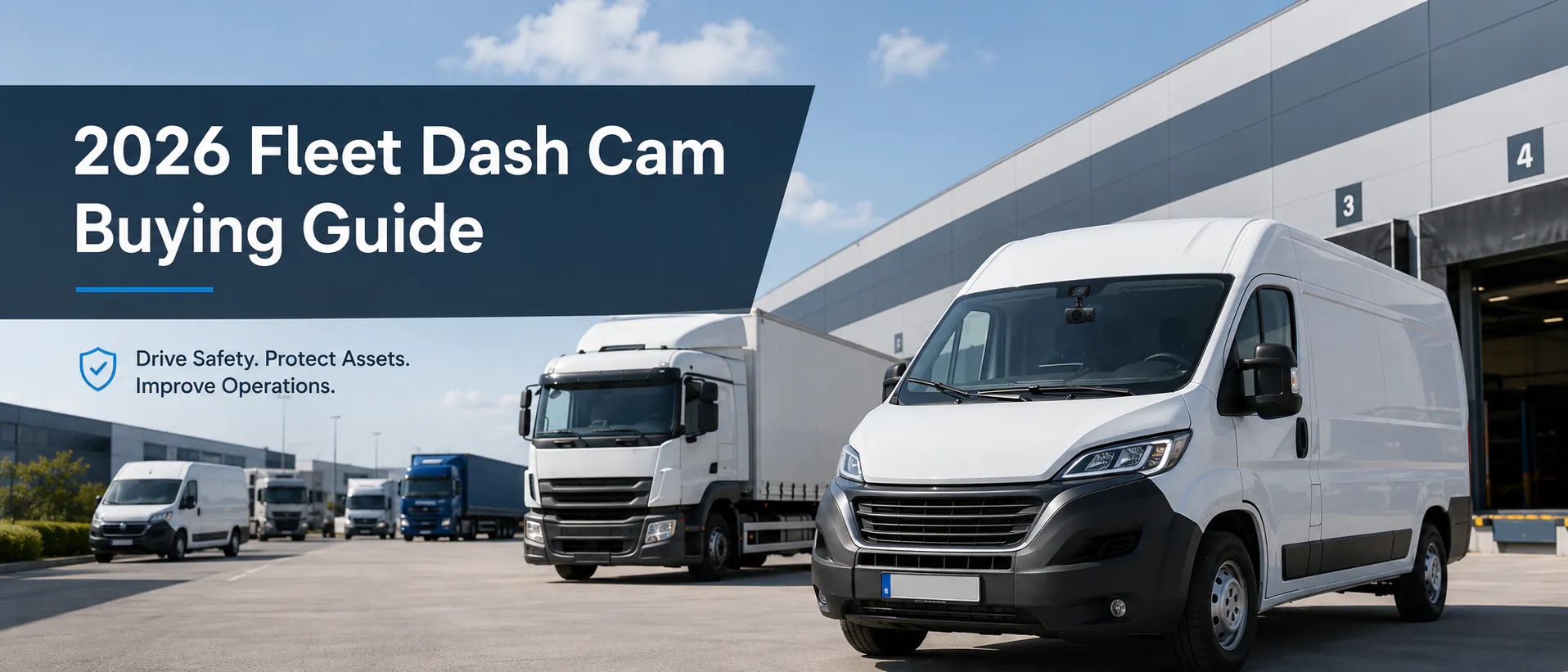
As fleet safety management shifts from “reactive forensics” to “proactive prevention,” 4G LTE dash cams have evolved from an optional accessory into essential infrastructure. For B2B customers deploying at scale, the selection criteria go far beyond resolution and price — network compatibility, platform scalability, and the scenario-specific adaptability of AI algorithms each have a direct impact on 2-3 years of operational costs and safety management outcomes.
Key Takeaways
- The fundamental difference between a 4G dash cam and a WiFi dash cam is not simply about “whether it can go online” — it’s about whether it enables a closed-loop remote management system.
- The same device can perform vastly differently across different fleet types, and the real-world gap may far exceed what the spec sheet suggests.
- Device unit price does not equal total cost — platform subscriptions, SIM data plans, maintenance labor, and replacement cycles are where the bulk of TCO actually resides.
- A supplier’s customization capability and willingness to continuously iterate are far better indicators of long-term partnership quality than current on-paper specifications.
What Is a 4G LTE Dash Cam for Commercial Fleets
A 4G LTE dash cam is an in-vehicle video surveillance terminal with a built-in cellular network communication module. Its core capability goes far beyond simply “having a 4G signal” — it delivers three closed loops that traditional dash cams cannot achieve: a remote real-time monitoring loop, a cloud storage loop, and a device management loop. In commercial fleet scenarios, these three closed loops define the ceiling of what safety management can accomplish.
4G Dash Cam vs. WiFi Dash Cam — What Changes at Fleet Scale
A side-by-side comparison of individual units won’t reveal the gap. The real differences become magnified across three dimensions when deploying at scale.
| WiFi Dash Cam | 4G Dash Cam | |
|---|---|---|
| Remote Real-Time Monitoring | Depends on WiFi coverage; blind spots once the vehicle leaves the premises | Cellular real-time transmission, full-area coverage |
| Video Retrieval | Remove SD card for playback or export after vehicle returns to base | Remote access, cloud playback, instant retrieval post-incident |
| Alert Response | Local buzzer only, no remote push notifications | Collision / anomaly / fatigue alerts pushed to management backend in real time |
| Firmware Updates | Manual operation, one device at a time | OTA remote bulk upgrade |
| Device Health Monitoring | No way to know if a device is working until you check the SD card after an incident | Online status, storage status, camera status reported in real time |
| Data Security | Evidence lost if SD card is damaged or missing | Dual local + cloud storage, critical footage auto-uploaded |
| Bulk Management Efficiency | Low; labor-intensive, device-by-device operation | High; unified platform managing hundreds to thousands of devices |
| Deployment Cost | Lower unit price, higher labor cost for management | Higher unit price, significantly lower long-term management cost |
| Suitable Fleet Size | Under 10 vehicles or single unit | 20+ vehicles, medium to large commercial fleets |
Choosing between a 4G dash cam and a WiFi dash cam is not, at its core, a budget question — it’s a question of management precision: how many vehicles in your fleet are you willing to leave in a monitoring blind spot? Choose the 4G dash cam that suits your fleet size.
7 Evaluation Criteria for Business-Grade 4G Dash Cams
① Video Quality and Multi-Channel Coverage
Resolution & Frame Rate:1080P (1920×1080) is sufficient for the vast majority of commercial scenarios — capturing license plates, faces, and road conditions clearly. The value of 2K (2560×1440) lies in scenarios that demand capturing fine details at a distance, such as rear blind spots on large vehicles or nighttime surveillance in open parking lots. For frame rate, 25fps is the commercial standard; anything lower will cause motion blur in fast-moving footage.
Multi-Channel Configuration:This is the single biggest dividing line between commercial and passenger vehicle selection. Different fleet types require entirely different channel counts:
- Dual-Channel (Front + Cabin): The standard configuration for ride-hailing and taxi fleets. The front camera covers road conditions, the cabin camera covers in-vehicle activity — solving driver-passenger dispute forensics.
- Three-Channel (Front + Cabin + Rear): The choice for light logistics trucks and small passenger vehicles. The rear view has direct value for reversing accidents and rear-end collision determination.
- Four-Channel (Front + Cabin + Rear + Side): A requirement for heavy trucks, buses, and school buses. Multi-angle coverage is both a compliance prerequisite and the guarantee of incident coverage with no blind spots.
Night Vision Performance:A significant portion of commercial vehicle operations takes place at night. The infrared illumination range and the legibility of license plates under low-light conditions matter far more to real-world utility than daytime resolution specs. Every spec sheet says “supports night vision,” but real-world results vary dramatically — always request actual nighttime sample footage from the supplier.
② 4G Network Compatibility and Global Frequency Bands
4G networks are not globally uniform. Carriers in different countries and regions use different frequency bands. A 4G dash cam that runs flawlessly in mainland China may fail to connect in Southeast Asia, and may drop to 3G in Europe. The issue is not the device itself — it’s frequency band coverage.
Three critical checkpoints during selection:
- Map out all carrier frequency bands in your operating regions. Not just “I need it to work in Europe,” but “Germany primarily uses B3/B7/B20, France uses B3/B7/B28.” The local carrier band table for your target market is the first document you need before selection begins.
- Verify that the device’s 4G band list covers the mainstream bands in your target region. “Supports 4G” is not enough — you need to know which 4G bands. Check both FDD-LTE and TDD-LTE.
- Understand the fallback network. In 4G coverage dead zones, can the device automatically fall back to 3G/2G to maintain connectivity? This determines data continuity on remote routes.
→ View The Full Product Line’s Global Frequency Band Support Matrix
③ AI Safety Features — ADAS, DMS, and BSD
AI capabilities are the second dimension where 4G dash cams pull away from WiFi dash cams. But it’s also the area most prone to overselling — it’s not about having more features, it’s about picking the right ones for your scenarios.
ADAS (Advanced Driver Assistance Systems): Road-facing, detecting forward collision risk, lane departure, lead vehicle start, etc. A hard requirement for logistics heavy trucks and long-haul passenger transport — drivers spend extended hours behind the wheel, and ADAS collision warnings and lane departure alerts are the last line of defense against fatigue driving. The value is relatively limited for urban ride-hailing — low-speed city driving with frequent lane changes means false alarm rates will degrade the driver experience.
DSM (Driver Status Monitoring): Cabin-facing, detecting fatigue driving (yawning, eye closure), distraction (phone use, smoking), and other abnormal driver behaviors. A hard requirement for hazardous materials transport and long-haul passenger transport. For ride-hailing, it is more often used for service quality management — confirming whether drivers are using phones while driving or smoking in the vehicle, tied to platform compliance scoring rather than pure safety.
The core principle for AI feature selection: follow the accident data. Review your fleet’s accident records from the past 12-24 months, identify the high-frequency incident types, then match the corresponding AI functions. Don’t let a supplier’s sales pitch define your risk profile for you.
④ Storage Strategy — Local Recording and Cloud Backup
Local storage (SD card): Continuous loop recording, serving as the first landing point for video data. The key parameters are not maximum capacity (256GB-512GB is already standard today), but these three:
- Video Encoding Format: H.265 saves approximately 40% storage space compared to H.264, storing more footage at the same capacity.
- File format: TS stream format rather than MP4 prevents file corruption on sudden power loss — commercial vehicle power is unstable, and this difference has a huge impact in real accident scenarios.
- Loop Overwrite Strategy: Whether emergency video has lock protection to prevent being overwritten in the loop.
Cloud Storage (Requires Customization & Subscription): The 4G dash cam uploads video to the cloud via cellular network. Two key decisions here:
- Upload Strategy: “Full upload” vs. “event-triggered upload.” Full upload comes with considerable data and cloud storage costs; event-triggered upload (auto-upload on collision, emergency button trigger, timed keyframe upload) provides a better balance between cost and security.
- Cloud Retention Period: Incident tracing typically requires 30-90 days of historical data. The longer the cloud retention, the higher the annual subscription cost. Set the period based on actual compliance requirements and incident investigation experience — don’t default to the longest option.
The core value of dual storage is not “having an extra copy” — it’s “being able to access it.” When an incident occurs on the road, the operations center can pull the footage from the cloud instantly, without waiting for the vehicle to return to base.
⑤ Fleet Management Platform Integration
In the 4G connected dash cam space, the hardware determines what you can see; the platform determines what you can use and what you can accomplish.
Five Dimensions To Evaluate When Assessing a Platform:Real-time concurrent capacity: How many video streams can the platform pull simultaneously, and with what latency? For fleets of 100+ vehicles, multi-split monitoring (9-split, 16-split) and sub-3-second latency are baseline requirements.
Synchronized Track & Video Playback: Can you click any point on the map trajectory and jump to the corresponding video at that moment? This is the core of accident investigation efficiency.
Alert rule configurability: Not all fleets need the same alert thresholds. Overspeed thresholds, collision sensitivity, geofence boundaries — whether you can configure these yourself determines whether the platform is “functional” or “truly useful.”
Multi-Level Permission Management: Super admin, regional admin, fleet manager, driver — different roles see different data and have different operational capabilities. This is a hard requirement for medium to large fleets.
Api Openness: Can the platform integrate with the customer’s existing ERP, dispatch system, or TMS? If data is trapped within the platform’s closed ecosystem, the larger the deployment, the more severe the information silo becomes.
⑥ Build Quality and Environmental Durability
Commercial vehicles operate in far harsher environments than private cars. High-temperature sun exposure, cold starts, sustained vibration, dust and moisture — these are the norm, not edge cases.
Energy Storage: Prioritize supercapacitor solutions over lithium batteries. Lithium batteries risk swelling and safety hazards under high-temperature sun exposure — temperatures under a commercial vehicle windshield can easily exceed 70°C in summer. Supercapacitors offer a wider temperature tolerance range (-20°C to 70°C or higher) and far exceed lithium batteries in charge-discharge cycle life.
Operating Voltage: The power environment in commercial vehicles, heavy trucks, and construction vehicles is more complex than in passenger cars. Wide voltage support (9-36V DC) accommodates voltage fluctuations across different vehicle types, preventing frequent reboots or hardware damage from unstable power. Some construction vehicles may even require low-voltage tolerance below 8V.
Operating Temperature Range: A wide nominal range on paper is not enough. Ask the supplier: How long does cold start take to reach normal operation in a -20°C environment? Does image quality or recording frame rate degrade during 8 hours of continuous operation in a 70°C environment? These are questions that spec sheets won’t answer but that real-world deployments will face.
⑦ OEM/ODM Customization Capability
For brands, distributors, and large fleet operators, procuring a 4G dash cam is not just a hardware purchase — in many cases, it’s a long-term partnership involving branding and customization.
Customization Dimensions Worth Paying Attention To:
- Appearance Customization: Logo silkscreen, housing color (PANTONE matching), custom packaging. MOQ typically 100-500 units, short lead time.
- Accessory Customization: Lens specs (resolution/FOV/aperture), sensor upgrades, I/O modifications. Involves hardware changes, higher MOQ (1,000+ units), requires mold development lead time.
- Software Customization: Branded boot animation, feature tailoring (streamlined by workflow), factory preset configurations. Flexible MOQ, fast delivery.
- Platform white-label: Full branding of the app and cloud platform. MOQ 500+ units, 20-30 day delivery cycle.
- Api Integration: Open SDK and API to bring the dash cam’s real-time video streams, GPS data, and alert information into the customer’s own platform.
A supplier’s customization capability should not be judged solely by their list of supported customization items. Look at three things: the maturity of their customization process (are there clearly defined milestones for requirements confirmation → sample approval → mass production?), the size and industry experience of their engineering team, and their track record of past customization projects.
4G Dash Cam Selection by Fleet Type
The value a 4G dash cam delivers plays out entirely differently depending on the fleet type. Below, we break down the differentiated configuration priorities across four typical commercial scenarios.
Logistics and Heavy Truck Fleets
Logistics fleets are characterized by extended time on the road, cross-regional operations, and solo drivers. In this scenario, safety is the top priority, followed by evidence preservation.
Recommended Configuration Focus:
Multi-Channel Coverage: Forward-facing + in-cabin + cargo area/rear. The blind spot area on heavy trucks is far larger than on passenger vehicles — multi-angle monitoring is the foundation for reducing accident disputes.
Adas + Dsm Dual Ai: Fatigue during long-haul driving is the number one cause of logistics accidents. ADAS handles collision warnings, DSM handles fatigue and distraction detection — the two systems work in tandem to form a closed safety loop.
Wide-Voltage Power Supply: Heavy truck power environments are highly unstable and require 9-36V wide-voltage compatibility.
Local 512GB + cloud event upload: Logistics vehicles have irregular return-to-base cycles. High-capacity local storage ensures no data loss on the road, while the cloud auto-uploads critical footage upon collision events, giving the operations center instant visibility.
In logistics scenarios, the payback period for a 4G dash cam is typically measured in “one avoided accident loss” — and the average claim processing cost of a heavy commercial vehicle accident makes that an easy calculation.

Ride-Hailing and Taxi Fleets
The core need in ride-hailing and taxi scenarios is dual-channel forensics. The point of friction is not road hazards — it’s between driver and passenger.
Recommended Configuration Focus:
Dual-Channel As Standard: Front camera covering road conditions + cabin camera covering the interior. This is the baseline compliance configuration for commercial passenger vehicles.
Emergency Alert Button: One-touch trigger by the driver, auto-uploading 30 seconds of footage before and after the trigger to the cloud and pushing an alert to the management backend. This feature doesn’t need AI algorithms — its mere presence reduces the probability of disputes escalating.
Compact Form Factor & Installation: Ride-hailing vehicles are more sensitive to device size. Compact mini models (e.g., the GD09 series) fit better in vehicles with limited windshield space. Explore full specs of the compact mini 4G dash cam.
Instant Cloud Upload: Emergency event footage needs to be uploaded to the cloud within seconds of triggering, preventing evidence loss due to device tampering or destruction.
In ride-hailing selection, the functional boundaries of DSM need to be thoroughly communicated with drivers. Fatigue detection and distraction detection are primarily safety-oriented, not surveillance-oriented — how this is communicated directly affects driver acceptance and device online rates.

Public Transit — Bus and School Bus
Buses and school buses are defined by fixed routes, high passenger capacity, and public safety accountability. Regulatory requirements often exceed the operator’s own internal demands.
Recommended Configuration Focus:
Comprehensive Multi-Channel Coverage: Entry/exit areas at front and rear doors, driver area, passenger cabin, exterior front and rear — a DVR solution with 4 to 8 cameras is the standard configuration for this scenario.
Adas + Dsm + Bsd Full Ai Suite: With their large vehicle bodies, bus blind-spot accident risk is high — BSD (Blind Spot Detection) is the differentiating requirement for this scenario. ADAS collision prevention and DSM anti-fatigue are baseline.
Passenger Flow Counting Integration: The 4G dash cam’s cameras, combined with algorithms, can count boarding and alighting passengers, helping operators analyze route passenger volume patterns.
Platform Management Precision: Bus companies typically have their own dispatch systems. The 4G dash cam’s management platform must provide full API integration capability, embedding video surveillance data into the existing operational management system.

Construction and Heavy Equipment Vehicles
Construction vehicles operate in the harshest environment of all commercial scenarios — high temperatures, heavy dust, severe vibration, prolonged idling, and weak network coverage in remote areas.
Recommended Configuration Focus:
Industrial-Grade Protection: Dust and water resistance rating (IP65-IP67), shock-resistant structural design, high-temperature-tolerant supercapacitors (no lithium battery design).
Multi-Mode Positioning: GPS + BeiDou + LBS + GLONASS multi-constellation positioning, ensuring accuracy and availability in remote job sites. Accuracy must be within 2.5 meters.
Wide-Band 4G + Data Caching: 4G coverage is unstable in remote areas. The device must support high-capacity local caching (256GB-512GB+) with automatic backfill upload once the network is restored.
External Sensor Expansion: Fuel sensors, temperature sensors, tilt sensors — monitoring needs for construction vehicles often extend beyond video. The hardware’s I/O expansion capability defines the ceiling of what the solution can do.
The procurement decision cycle for construction vehicles tends to be longer, but once a solution is locked in, repurchase rates and long-term partnership stability are both very strong — because this scenario has the highest dependency on the supplier’s technical service support.
Total Cost of Ownership
The 3-year Total Cost of Ownership (TCO) for a 4G dash cam breaks down as follows:
| Cost Component | Share of TCO | Notes |
|---|---|---|
| Hardware Procurement | 30%-40% | One-time device investment |
| SIM Data Plan | 20%-30% | Ongoing expense, scales linearly with device count |
| Cloud Platform & Storage Subscription | 15%-25% | Billed per device or by storage volume |
| Installation & Deployment | 5%-10% | One-time cost; installation labor hours for commercial vehicles typically exceed those for passenger vehicles |
| Maintenance & Replacement | 5%-10% | Labor and parts for fault replacement and after-sales repair |
| Management Labor | Hidden cost | A well-designed platform can drastically reduce this; a poorly designed one amplifies it in the opposite direction |
Three easily overlooked facts in TCO calculation
The lower the device unit price, the higher the share of data plan and platform fees in the 3-year TCO. This means if you choose a low-cost device based solely on hardware price but pair it with an expensive platform and data plan, your total cost may actually end up higher.
Fault replacement cost depends on the average labor hours per troubleshooting event and the device’s plug-and-play readiness. Well-designed devices support remote diagnostics and OTA firmware fixes — many issues never require a technician to physically access the vehicle. This difference becomes significant at a scale of one to two hundred vehicles.
Data plans are negotiable with the supplier. When deploying in bulk, the per-device monthly data fee has more bargaining room than you might think. Don’t accept the supplier’s first quote.
The TCO model is recommended to be calculated on a 3-year cycle, as the typical replacement cycle for commercial vehicle dash cams is 3-5 years, and 3 years is the most commonly used time window in procurement decision evaluation.
Supplier Qualification Checklist for B2B Buyers
Selecting the device is only step one. Selecting the supplier determines your partnership experience for the next 3-5 years. Below are six verification dimensions, ranked by importance:
| Dimension | What to Verify | Why It Matters |
|---|---|---|
| Factory Certifications & Systems | ISO 9001 (Quality Management), IATF 16949 (Automotive Quality Management) | It’s not just “do they have a certificate” — it’s whether they have automotive-specific quality systems. Consumer electronics QC logic does not apply to commercial vehicle hardware. |
| Production Capacity & Lead Time | Standard monthly capacity, peak capacity, sample-to-mass-production lead time | Assess whether the supplier can support your business growth — you need 200 units today, but you may need 2,000 a year from now. |
| R&D Team Size & Experience | Number of hardware and software engineers, average years of industry experience | A 4G dash cam is a continuously iterating product. The supplier’s R&D capability determines what level of product you’ll get in the next version. |
| Global Frequency Band Coverage | Whether they offer region-customized band solutions | In cross-border deployments, mismatched frequency bands mean dead devices. |
| OEM/ODM Track Record | Which customers they’ve served, and to what depth of customization | Case studies may not include brand names (NDAs are common), but they should at minimum be able to describe the depth of customization and delivery outcomes. |
| After-Sales Response Mechanism | Remote diagnostic capability, OTA firmware update frequency, fault unit handling process and turnaround time | The real experience after bulk deployment is determined by after-sales quality. |
Two recommended verification actions
Request sample testing — don’t just read the spec sheet. Install the sample in an actual operating vehicle and run it for a week. Test night vision performance, 4G transmission stability, and platform usability. Spec sheets don’t lie, but they only tell you what they’re able to tell you.
Request a factory visit or video factory audit. Observe the production line in operation, quality control processes, and inventory management. A supplier willing to let you see their factory has, at minimum, confidence in their manufacturing capabilities.
FAQ
What’s the approximate monthly data consumption for a 4G dash cam?
It depends on the upload strategy. With event-triggered upload only (auto-upload on collision + scheduled keyframes), a single device typically consumes 1-3GB per month. With full-time real-time video upload, a single 1080P channel consumes approximately 0.5-1GB per hour — at 8 hours of daily operation, monthly data usage can reach 120-240GB. For most commercial scenarios, a hybrid strategy of event-triggered upload + on-demand remote retrieval is recommended, striking a balance between cost and security.
How long can cloud-stored video be retained?
Standard plans typically offer 7-90 days of cloud retention, with longer periods customizable based on compliance requirements and enterprise budgets. Critical event-triggered footage (collisions, emergency alerts) can usually be set for permanent retention. The loop cycle for local SD card storage depends on card capacity, camera count, and quality settings — a 512GB card with dual-channel 1080P recording typically retains 7-14 days.
Can 4G dash cams be centrally managed across multiple vehicles?
Yes — this is one of the core advantages of 4G dash cams over WiFi dash cams. Through a fleet management platform, a single computer or mobile phone can monitor hundreds or even thousands of devices in real time. The platform supports multi-split-screen simultaneous viewing, unified alert rule configuration, bulk OTA firmware upgrades, and role-based permission management. The key is to verify the platform’s maximum concurrent device count and video latency.
Will recording be interrupted if the 4G signal is poor?
No. The 4G dash cam performs local SD card recording and cloud upload simultaneously, with two independent links. When the 4G signal is weak, local recording is entirely unaffected. Cloud upload pauses, data is cached locally (on the SD card), and upload automatically resumes and backfills once the signal is restored. The device’s local storage capacity (256GB+ recommended) determines how much data can be buffered during a network outage.
What’s the typical MOQ for OEM/ODM customization?
Light customization at the appearance level (logo printing, boot screen, factory presets) has an MOQ as low as 200 units. Housing color or packaging customization typically requires 500 units. Deep customization involving hardware changes (lens specs, sensors, I/O, housing molds) ranges from 1,000 to 3,000 units. Platform white-labeling and API integration have an MOQ of roughly 500 units. It’s recommended to test market response with a small batch of standard products first, then progressively advance customization.
How do I choose between supercapacitor and lithium battery solutions?
For commercial vehicles, prioritize the supercapacitor solution. Supercapacitors’ temperature tolerance range (-20°C to 70°C and above) far exceeds that of lithium batteries — under a sun-exposed windshield, they will not swell or pose safety hazards. Additionally, supercapacitor charge-discharge cycle life far exceeds that of lithium batteries, delivering higher reliability over the long service life of commercial vehicles. Lithium battery solutions only hold an advantage in extremely cold regions (sustained operation below -30°C), as supercapacitor capacity degradation is more pronounced in extreme low temperatures.
What’s the false alarm rate for ADAS and DSM in real-world use?
Algorithm maturity directly affects driver acceptance — systems with high false alarm rates often end up being covered up or powered off by drivers. ADAS false alarm rates are higher in low-speed urban driving with frequent lane changes than on highways. DSM false alarms are mainly concentrated in occlusion scenarios — wearing sunglasses, wearing a mask, profile angles, etc. It’s recommended to run the sample on actual operating routes for 3-5 days during the testing phase, recording false alarm frequency and type, rather than relying solely on the supplier’s lab data.
What is the average service life of the device?
The design service life of commercial vehicle 4G dash cams is typically 3-5 years. Actual lifespan depends on the operating environment — the high-temperature, high-dust conditions of construction vehicles will shorten it, while urban road conditions come closer to the design value. Supercapacitor solutions have a clear lifespan advantage over lithium battery solutions in high-temperature scenarios. The supplier’s warranty period is usually 1 year; the responsiveness of after-sales maintenance and fault replacement is more worth paying attention to than the warranty period itself.
Continue Reading
- Fleet Video Surveillance Platform Selection Guide
- GPS Tracker and 4G Dash Cam Co-Deployment Strategy
- Commercial Vehicle AI Safety Features Explained (ADAS / DSM / BSD)
Need to discuss a tailored solution for your fleet size and operating scenario?
Contact us for customized product recommendations and volume pricing.



Responses
Discussion
0 responses
No responses yet
Start the discussion with a practical question or field note related to this article.