

Why 4G Dash Cams Are Essential for Commercial Truck Fleets
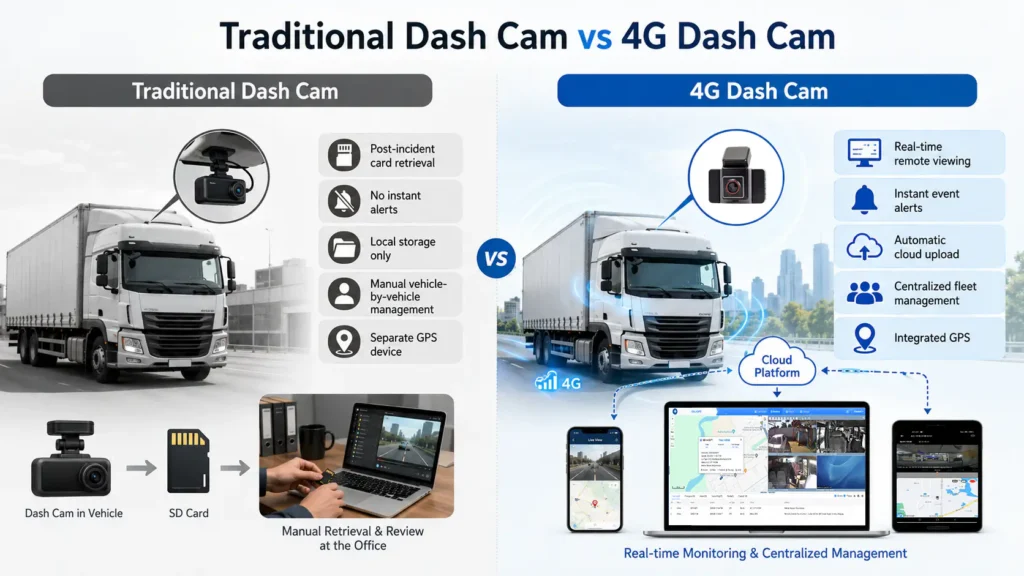
4G dash cams are no longer optional for commercial truck fleets. Real-time video transmission, automatic incident evidence upload, and remote driver behavior monitoring — these capabilities directly impact accident liability determination, insurance claims, and fleet operational efficiency. A 4G dash cam is an in-vehicle video device that enables real-time video transmission and remote management via cellular networks. Unlike traditional local-storage dash cams, 4G versions support remote live viewing, automatic event uploads, and cloud-based centralized management. Typical applications include long-haul freight monitoring, delivery vehicle management, and multi-fleet centralized dispatch.
Commercial truck fleets operate across wide geographic ranges, carry heavy loads, and face accident risks and claim costs far exceeding those of passenger vehicles. 4G dash cams leverage real-time connectivity to upgrade traditional post-incident forensics into proactive warning and active intervention. Fleet operators should focus on the following dimensions when selecting the best dash cam for truckers:
Real-time video monitoring: Remotely view vehicle status and detect anomalies promptly
Automatic incident evidence upload: Collision, hard braking, and other event videos are instantly transmitted to the cloud
Driver behavior management: Remotely collect driving behavior data to optimize training
Cross-region unified management: Centralized monitoring across multiple vehicles and routes
Insurance and compliance: Meet the evidence chain requirements for fleet insurance and regulatory oversight
Truck fleets operate across wide geographic ranges, carry heavy loads, and face accident claim costs far higher than passenger vehicles — these characteristics make 4G connectivity an operational necessity rather than a luxury.
The first reason is remote visibility. A 4G dash cam allows dispatch centers to view real-time forward-facing footage from any location. When a vehicle experiences a collision or abnormal stop on a remote highway, the device immediately pushes an alert to the management platform, enabling dispatch personnel to assess the situation and initiate emergency response without delay.
The second reason is evidence chain timeliness. When events such as collisions, hard braking, or sharp turns are triggered, a 4G dash cam automatically uploads critical video clips to the cloud, eliminating the risk of evidence loss due to local storage card damage or deliberate deletion.
The third reason is the centralized management demand of scaled fleets. A fleet with 50+ trucks relying on traditional dash cams for manual card retrieval would incur prohibitive management costs. 4G versions enable multi-vehicle remote monitoring, event aggregation, and driver behavior analysis through a unified platform, elevating management efficiency by an order of magnitude.
| Comparison Dimension | Traditional Dash Cam | 4G Dash Cam |
|---|---|---|
| Video Access | Post-incident card retrieval | Real-time remote viewing |
| Event Notification | None | Collision/hard braking instant push |
| Evidence Storage | Local storage card | Automatic cloud upload |
| Multi-Vehicle Management | Per-vehicle manual operation | Unified platform centralized management |
| GPS Positioning | Requires additional device | Built-in integration |
Key Features That Define a Truck Fleet Dash Camera
Determining whether a product is suitable as a truck fleet dash camera requires examining four core dimensions: network stability, power compatibility, storage strategy, and management platform.
Network: Truck fleets need devices supporting multi-band 4G LTE. Long-haul vehicles crossing provincial boundaries encounter varying carrier signal coverage across regions, and multi-band support minimizes signal dead zones. Devices should also feature offline caching — continuing local recording during weak signal periods and auto-syncing when signal is restored.
Power Supply: Truck and passenger vehicle electrical systems differ. Semi-trucks and heavy-duty trucks typically use 24V power systems, while most passenger vehicle dash cams only support 12V. When selecting a 4G dash cam for semi trucks, confirm the device supports wide-voltage input (9-36V) or includes a dedicated voltage conversion module.
Storage Strategy: Fleets should opt for a “local + cloud” dual-backup strategy. Critical event videos (collisions, hard braking) automatically upload to the cloud, while daily driving footage is stored on local high-capacity storage cards. This approach ensures evidence security while controlling data costs.
Management Platform: A quality 4G dash cam should be paired with a mature vehicle management backend, supporting simultaneous multi-vehicle live monitoring, event video aggregation, driver behavior scoring, and trip trajectory replay.
Explore our complete 4G dash cam product line.
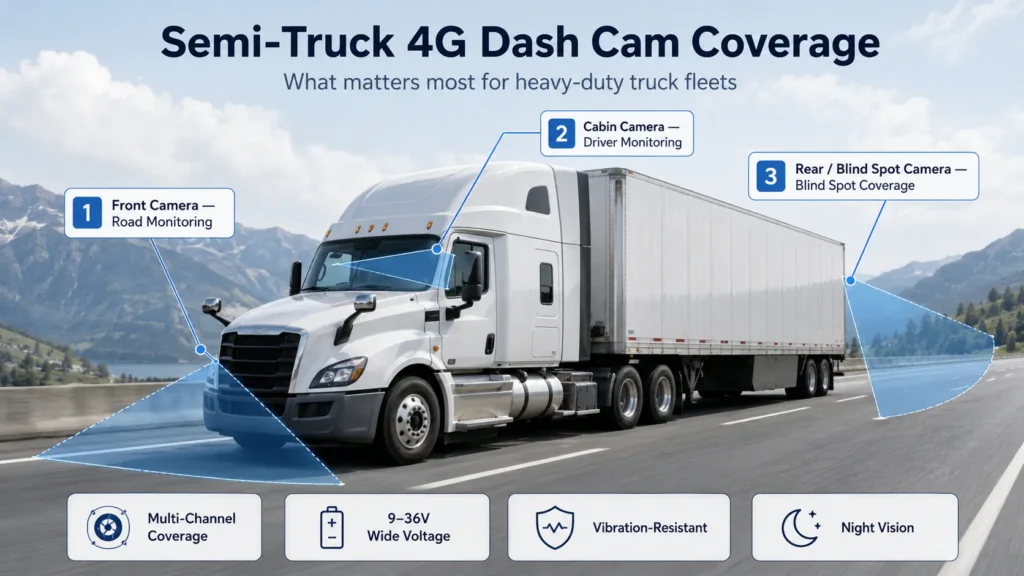
Semi-trucks and heavy-duty trucks differ significantly from light vehicles in power systems, vibration environments, and blind-spot coverage requirements.
Power System: 24V power compatibility is the first threshold for semi-truck selection. Some 4G dash cams only support 5V/12V input — directly connecting to a 24V system will damage the equipment. Before procurement, confirm the device natively supports 24V or includes a compliant voltage conversion module.
Vibration Protection: Semi-trucks experience vibration intensity far exceeding passenger vehicles during high-speed driving and rough road conditions. Equipment requires industrial-grade shock-absorbing mounting brackets and reinforced lens structures. Lens loosening causes video blur, directly compromising evidence validity.
Blind-Spot Coverage: Semi-trucks need multi-angle coverage: forward road conditions, in-cabin driver status monitoring, and rear blind spots. Multi-channel 4G dash cams can simultaneously connect multiple cameras through a single main unit for unified management and upload.
Purpose-built 4G truck dash cam optimized for truck scenarios.
Night Vision: Critical for long-haul nighttime driving. Truck drivers frequently drive at night, and infrared night vision lenses and color technology ensure clear, distinguishable video in low-light conditions.
| Semi-Truck Selection Dimension | Key Spec Requirement |
|---|---|
| Power System | Native 24V or wide voltage 9-36V |
| Vibration Rating | Industrial-grade shock-absorbing bracket |
| Channel Count | Front + cabin + rear multi-channel |
| Night Vision | Infrared night vision camera |
| Local Storage | 128GB-512GB+, supports loop recording |
Dash Cam for Delivery Trucks: Different Priorities
Delivery vehicles operate in more intensive patterns — frequent stop-and-go, urban traffic, multiple delivery stops — these characteristics dictate that delivery fleets have entirely different dash cam priorities from long-haul freight.
Event Triggering: In urban delivery, hard braking, sharp turns, and collisions occur far more frequently than in highway scenarios. A dash cam for delivery trucks needs to support more granular event triggering strategies — beyond collisions and hard braking, it should also cover sharp turns, sudden acceleration, and parking collisions, ensuring every potential dispute has video evidence.
Multi-Stop Management: This is a unique requirement for delivery fleets. Drivers may stop at 20-30 delivery points in a single day, and the 4G dash cam combined with GPS positioning can record the time and location of each stop, helping fleet managers verify delivery efficiency and identify abnormal dwell times.
Cargo Door Monitoring: Delivery vehicles are prone to cargo disputes during unloading. Adding an auxiliary camera at the cargo door can record the loading and unloading process, providing direct evidence for cargo damage or shortage disputes.
Driver Identity Management: Critical in multi-shift delivery operations. A single delivery vehicle may be driven by different drivers across shifts, and the 4G dash cam’s driver card recognition automatically records the driver identity for each trip, linking driving behavior data to specific individuals. Multi-vehicle centralized management 4G fleet dash cam.
| Delivery Vehicle Selection Dimension | Key Requirement |
|---|---|
| Event Triggering | Collision + hard braking + sharp turn + sudden acceleration + parking |
| GPS Function | Stop point recording + trajectory replay |
| Auxiliary Camera | Cargo door monitoring |
| Driver Identification | Driver card auto-recognition |
| Urban Communication | 4G signal urban coverage optimization |
How 4G Dash Cams Cut Truck Fleet Operating Costs
The direct impact of 4G dash cams on fleet operating costs manifests across three dimensions: insurance premiums, incident processing efficiency, and driver management efficiency — each with quantifiable improvement potential.
Insurance Premiums: Real-time monitoring and automatic event upload reduce insurance companies’ loss assessment costs and fraud risks, with some insurance providers offering 5-15% premium discounts for fleets equipped with 4G dash cams. The specific discount depends on fleet size and device capabilities.
Incident Processing Efficiency: The improvement comes from the immediacy of evidence access. In traditional workflows, post-incident card retrieval and video export require hours or even days. 4G versions automatically push video to the management backend when events occur, allowing fleets to review evidence remotely while handling the incident on-site, reducing liability determination cycles from days to hours.
Driver Management: Leveraging remote access to behavior data. 4G dash cams continuously record and upload hard braking, sharp turns, speeding, and other behavior data, enabling fleet managers to identify high-risk drivers and develop targeted training plans, reducing accident rates and maintenance costs at the source.
Detailed ROI analysis of 4G dash cams for fleet operating costs.
Choosing the Best Dash Cam for Truckers: Procurement Checklist
When determining equipment selection, establishing a judgment framework across three dimensions — product specifications, supplier capability, and deployment cost — can systematically reduce blind spots in procurement decisions.
Here is a verification checklist for commercial truck fleets procuring 4G dash cams:
Network Standards: Whether it supports mainstream local 4G LTE bands and features offline caching
Power Compatibility: Whether it natively supports truck 24V systems or wide-voltage input
Storage Strategy: Whether it supports local + cloud dual backup, cloud storage capacity and retention period
Management Platform: Whether it provides a multi-vehicle centralized management backend with event aggregation and trajectory replay
Installation Method: Whether it supports hardwired installation and whether the mounting bracket meets truck vibration requirements
Video Quality: Night vision performance, wide-angle coverage, and frame rate meeting evidentiary standards
Multi-Channel Support: Whether it supports auxiliary cameras for blind-spot coverage
Supplier Qualifications: Manufacturer’s production capacity, after-sales responsiveness, and firmware update strategy
Each item above directly impacts equipment performance in actual fleet operations. We recommend requesting trial devices from suppliers before procurement, testing for at least one week on actual operating routes, with focus on video transmission stability in signal coverage areas and event triggering accuracy.
Frequently Asked Questions
What does the monthly fee for a 4G dash cam include?
The monthly fee for a 4G dash cam typically includes two core services: cellular data and cloud storage. Data is used for real-time video transmission and event alert push notifications, while cloud storage automatically saves event video clips. Package structures and data allowances vary significantly among providers — we recommend selecting a tier based on fleet size and real-time monitoring needs.
Can semi-trucks and light delivery vehicles use the same 4G dash cam?
Semi-trucks and light delivery vehicles have different power systems — semi-trucks typically use 24V, while delivery vehicles are mostly 12V. If the same device supports wide-voltage input (9-36V), it can be compatible with both vehicle types. However, vibration environments, installation positions, and blind-spot requirements also differ, so we recommend selecting corresponding configurations based on actual vehicle type.
How do 4G dash cams work in remote areas with weak signals?
In remote areas with weak cellular signal coverage, a 4G dash cam automatically switches to local storage mode, continuously recording video to the local storage card. When the vehicle re-enters signal coverage areas, the device syncs pending event videos to the cloud. This mechanism ensures no critical evidence is lost in signal dead zones.
Does installing a 4G dash cam require professional installation services?
Commercial truck fleet 4G dash cam installation involves vehicle power system connection, sensor wiring, and device mounting — we recommend professional installation. Professional installation ensures stable power supply, accurate device angles, and proper cable protection, avoiding equipment failure or video loss caused by improper installation. 4G Dash Cam Fleet Management: A Complete Solution Guide Multi-Channel 4G Dash Cams: Why Fleets Need Multi-Camera Systems 4G Dash Cams with GPS Tracking: Enhancing Fleet Visibility and Safety




Responses
Discussion
0 responses
No responses yet
Start the discussion with a practical question or field note related to this article.