

Against the backdrop of global telecommunications providers accelerating the retirement of legacy second-generation cellular infrastructure (the global 2G sunset), cross-border logistics providers and heavy industrial asset managers find themselves at a technological crossroads. Tracking hardware that remains tethered to obsolete networks faces severe systemic dropout risks and extensive coverage blind spots due to missing band profiles during international transit.
Consequently, tier-one fleet operators and enterprise asset holders are shifting their corporate hardware standards toward advanced 4G magnetic GPS tracking devices. This migration represents far more than a forced compliance measure; it is a critical strategic investment aimed at maximizing supply chain visibility and driving down hardware maintenance overhead. Adopting this next-generation positioning technology secures maximum operational efficiency across a fleet’s next ten-year technology lifecycle.
The retirement of legacy 2G assets forces global procurement teams to choose between maintaining a vulnerable status quo until total terminal failure or proactively migrating to robust 4G hardware architectures. For heavy industrial operations relying on non-invasive deployment and ultra-long battery performance, this hardware evolution impacts much more than baseline connectivity—it directly dictates the resilience of an enterprise’s asset protection line.
The Critical Timeline of Global 2G Sunsets and Logistics Risks
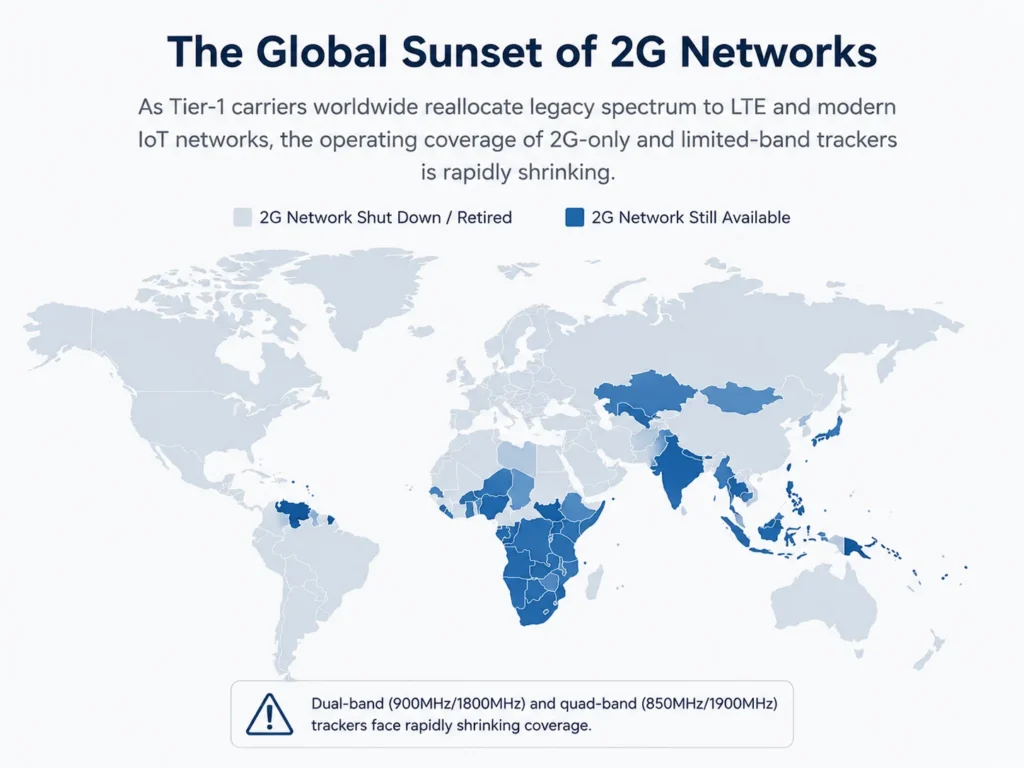
As tier-one global telecom carriers reallocate legacy spectrum resources to high-efficiency, ultra-low latency LTE and modern industrial IoT networks, the operational footprint for dual-band (900MHz/1800MHz) and quad-band (850MHz/1900MHz) tracking terminals is rapidly collapsing. The local pace of these carrier decommissioning schedules determines the exact urgency for cross-border fleets and regional wholesale distributors.
| Region / Country | 2G Sunset Status & Timeline Forecast | Direct Risks to Supply Chains & Fleet Operations |
|---|---|---|
| North America (USA, Canada) | The vast majority of Tier-1 carriers finalized their network shutdowns by late 2022; remaining legacy guard bands are being systematically cleared. | Legacy 2G equipment deployed in this zone exhibits widespread offline dropouts, cellular handshake failures, and major data packet loss. |
| Southeast Asia | Advanced hubs like Singapore and Taiwan have fully deactivated legacy bands; Thailand, Malaysia, and Indonesia are phasing out regional spectrum blocks. | Long-haul cross-border transit frequently encounters severe tracking dropouts as legacy terminals fail to roam across regional carrier handoffs. |
| South America & South Africa | Major regional telecom groups have implemented multi-stage sunsets, aggressively migrating legacy spectrum over to LTE narrowband IoT layers. | Deployed heavy machinery and high-value shipping container trackers face ballooning signal blind spots and sharp spikes in terminal battery drain. |
Procurement strategies that lag behind local carrier decommissioning schedules expose enterprise asset managers to immediate, high-cost terminal dropouts. Faced with an irreversible global network sunset, proactive technological adaptation is the only viable path to mitigate supply chain disruption. To eliminate operational downtime during hardware changeouts, GreatWill has engineered adaptive 4G replacement architectures tailored to regional sunset timelines. Click here to request the Global 4G All-Network Magnetic GPS Tracker Procurement Whitepaper
Signal Evolution: Understanding 4G LTE, Cat-M, and 3G/2G Legacy Network Efficiencies
The industrial transition from legacy 2G and 3G over to 4G technology introduces improvements that go far beyond raw data throughput; it represents a total optimization of underlying baseband modulation architectures and power-consumption control loops. A common misperception among fleet supervisors is that higher network bandwidth automatically translates to shorter terminal lifespans. In reality, modern high-integration hardware design explicitly refutes this assumption.
The shift in telecommunication standards establishes definitive technical advantages at both the physical and application layers:
-
Throughput Speeds and Data Latency: Legacy 2G systems restrict data packet limits to a narrow 9.6 kbps to 40 kbps window, making them incapable of processing complex multi-sensor tamper alerts or extended multi-station cell tower calibration payloads. Conversely, 4G cellular and low-power IoT networks complete uplink handshakes in fraction-of-a-second windows, dropping total over-the-air transmission uptime per report down to millisecond intervals.
-
Base Station Capacity and High-Density Concurrency: Within major global shipping ports or dense fulfillment hubs, legacy 2G base station channels quickly hit peak saturation, causing severe signal collisions and missed packet reports among hundreds of clustered terminals. 4G architectures utilize Orthogonal Frequency Division Multiplexing (OFDM) to maximize physical layer capacity, ensuring flawless single-point transmission rates even during dense warehouse deployments.
-
The 3G Bridging Trap: While some purchasing departments consider 3G hardware as a temporary buffer option, carrier data shows that 3G spectrum is being clawed back even faster than 2G in numerous territories due to its inefficient frequency allocations. Standardizing directly on true 4G equipment is the single most effective risk-mitigation strategy to insulate your supply chain from a costly secondary hardware recall within the next three years.
For non-wired, standalone magnetic tracking assets, 4G integration introduces advanced power-saving architectures, specifically Power Saving Mode (PSM) and Extended Discontinuous Reception (eDRX). These protocols reduce terminal power draws down to microamp levels during idle intervals. Consequently, by drastically shrinking the required over-the-air broadcast windows, a 4G high-bandwidth terminal achieves an operational lifespan that meets or exceeds that of traditional slow-speed 2G hardware using identical battery capacities.
Balancing Power and Bandwidth: 4G Architecture TCO Analysis
When global fleet managers evaluate 4G cellular hardware upgrades, their primary engineering concern centers on whether the high transient current required by broadband modules will degrade total tracking terminal lifespans. This section breaks down power-consumption dynamics across different network topologies to help your procurement team construct an accurate Total Cost of Ownership (TCO) model.
For free-wiring, battery-dependent magnetic devices, 4G network protocols fundamentally re-engineer the terminal’s power-to-lifecycle curve. While a legacy 2G terminal pulls a smaller peak broadcast current (typically 200mA – 300mA), its narrow bandwidth forces the device to remain awake and transmitting for tens of seconds per report.
Under 4G LTE and low-power industrial IoT architectures, even if the peak current reaches 500mA or higher during active transmission, streamlined protocol stacks and high uplink transmission speeds compress the active radio window down to milliseconds.
[Legacy 2G/3G Narrowband Transmission Profile]
Low Current + Prolonged Active Broadcast Window = High Total Energy Drawn ───> Triggers Battery Passivation & Early Failure [Modern 4G Low-Power IoT Transmission Profile]
High Current + Millisecond Active Broadcast Window = Low Total Energy Drawn ───> Advanced eDRX/PSM Keeps Battery Inline for Extended Lifecycle
To calculate true multi-year asset maintenance budgets, procurement professionals should evaluate this technical financial breakdown:
| Cost Metric (Based on a 50,000-Terminal Deployment) | Legacy 2G / 3G Magnetic Hardware DOCX | 4G Low-Power All-Network Magnetic Hardware DOCX |
|---|---|---|
| Total Energy Invested Per Data Payload | ≈ 120 mAs (Driven up by carrier packet collisions and repeated retries) | ≈ 25 mAs (Ultra-fast uplink with zero redundant base station searching) |
| 5-Year Field Maintenance & Battery Swapping Cost | Severe Overhead (Repeated network retries deplete internal cells within 24 months) | ≈ 0 (Based on a standard 24-hour interval reporting profile) |
| Dropouts & Missing Cargo Claim Exposures | High Risk (Blind spots scale by over 300% as regional carriers turn off base towers) |
Minimized Risk (Leverages robust 4G coverage layers to yield a 99.9% operational uptime) |
Cross-Border Logistics: Mitigating Risks via Multi-Band Compatibility (Band Lock)
Intercontinental asset allocation and warehouse freight paths frequently break down due to regional differences in 4G frequency layouts across global telecom providers. Protecting a cross-border supply chain requires choosing hardware built with component-level multi-band support.
A common pitfall for regional industrial distributors and system integrators is assuming that any generic 4G terminal will operate flawlessly worldwide. In reality, global 4G LTE infrastructure is fragmented across more than 40 separate frequency bands.
For example, North American networks rely heavily on bands B2, B4, B12,and B66, whereas European and Asian operators prioritize bands B1, B3, B7, B20, B38,and B40. If an organization deploys hardware pinned to a single regional band profile, a shipping container moving across ocean lanes will drop completely offline the moment it enters a destination port.
Therefore, for packaging and hardware R&D and manufacturing, the following hardware-level measures must be adopted to provide procurement guarantees for B-end customers:
-
Global Full-Band Module Integration: Motherboards feature highly integrated, industrial-grade global cellular modems that natively cover the primary LTE bands deployed by multinational telecom conglomerates like AT&T, Verizon, and Vodafone.
-
Intelligent Multi-Mode Handoff Algorithms: If the primary 4G band degrades inside isolated mountain corridors or deep port terminals, the device seamlessly scales back to legacy 3G/2G bands (acting as an emergency fallback link) or routes packets through low-power narrowband IoT channels to maintain constant tracking validation.
Strategic ROI: How Upgrading to 4G Boosts Fleet Operational Value
For high-volume wholesale distributors and service providers managing thousands of assets, transitioning to a new hardware standard demands a significant capital expenditure (CAPEX). Justifying this budget requires assessing the concrete operational yield delivered by high-bandwidth, multi-module hybrid positioning architectures.
[4G Strong Cellular Lock / Rapid Handshake] ──> [Minimizes Network Search Uptime] ──> [Reduces Current Draw / Extends Field Life]
└──> [Enables High-Frequency High-Precision Positioning] ──> [Optimizes Real-Time Fleet Efficiency]
In heavy vehicle tracking and industrial asset allocation, premium 4G magnetic hardware delivers distinct operational advantages:
Multi-Topology Hybrid Positioning Reliability: The current generation of GreatWill 4G Magnetic GPS Trackers integrates a co-developed GNSS, LBS base station, and WiFi scanning array. Capitalizing on 4G upload speeds, the terminal scans surrounding WiFi hotspot MAC addresses and cell towers simultaneously, delivering precise location data even inside subterranean parsing facilities or dense urban canyons.
Instantaneous Two-Way Command Execution: If a control center flags an unauthorized route deviation on an international container cargo, operators can broadcast high-frequency polling instructions via our GreatWill Vehicle Tracking & Management Platform (e.g., accelerating data updates from 24-hour cycles down to 60-second intervals). 4G bandwidth ensures these commands execute immediately, whereas legacy 2G units facing poor signal conditions can hang for hours before opening a downlink handshake.
Industrial Battery Packs and Smart Power PMICs: 4G magnetic tracking terminals are packaged with high-capacity, industrial-grade lithium-manganese or lithium-thionyl chloride cells exceeding 10,000mAh. Controlled by advanced power management chips and internal 3D accelerometers, the device monitors motion states automatically—dropping into deep sleep and cutting cellular power during prolonged rest, and waking up in milliseconds to broadcast coordinates when motion is detected. This harmony between high-bandwidth connectivity and micro-amp sleep cycles forms the technical foundation for optimized fleet efficiency.
For procurement portfolios requiring specialized magnetic mounting bases or hardened, high-endurance battery modifications for particular trailer or heavy equipment series, feel free to explore our dedicated One-Stop Customization Service Page.
Fleet Hardening: Balancing Multi-Scenario Deployment and Environmental Resilience
When rolling out an enterprise-wide hardware swap, terminal versatility dictates field deployment speed and multi-scenario asset adaptability. Compared to traditional wired tracking solutions that require tapping into vehicle batteries and altering vehicle wire harnesses, magnetic configurations offer unmatched deployment flexibility and portability. For heavy-duty logistics and equipment rental fleets operating under harsh conditions, engineering priorities concentrate on two specific areas:
Magnetic Adhesion and Tamper Security
By utilizing high-remanence Neodymium (NdFeB) rare-earth magnets, our devices maintain a permanent physical lock onto truck chassis, container skins, or heavy excavator bodies through severe, long-term industrial vibration. Concurrently, an integrated optical or mechanical anti-tamper sensor positioned on the baseplate triggers an instant alert via the 4G network if the hardware is detached or exposed to light.
Industrial-Grade Waterproofing and Outer Shell Armor
To withstand open-air rail yards, ocean transit, and heavy mining sites,GreatWill’s ruggedized terminal enclosures conform to advanced environmental ingress protection standards.
| Mechanical Metric | Engineering Standard & Technical Compliance | Field Operational Advantage for Fleet Managers |
|---|---|---|
| Ingress Protection (IP) | Rated to IP67 or higher via dual-shot injection molding and high-elasticity silicone sealing gaskets. | Defies torrential rain, saltwater wash-down, and high-pressure chassis cleaning; prevents internal condensation. |
| Thermal Range Stability | Deploys specialized industrial battery cells certified to run from −20∘C up to +70∘C. | Guarantees stable chemical output and zero capacity drop-offs during summer container baking or arctic cross-border transit. |
These deliberate engineering details give 4G magnetic hardware remarkable field turnover efficiencies. Operations managers can integrate a third-party contract vehicle or a high-value leased crane into the comprehensive GreatWill Global Fleet GPS Tracking Device within seconds via non-invasive “peel-and-stick” placement, recovering the asset with zero damage once the job concludes.
Verticals in Focus: Industry-Specific Specifications for 4G Hardware Procurement
Different industrial asset profiles impose completely distinct demands regarding data intervals, casing materials, and warning parameters. This section examines two primary B2B application environments to outline exact hardware compatibility profiles.
Heavy Equipment & Machinery Rental Fleets

Operational Pain Points: Multi-million dollar excavators and piling rigs operate on rugged construction sites, facing mud immersion, structural shock, and high risks of cross-border asset theft. Target 4G Specification: Requires an anti-vibration structural shell matched with an internal 3D accelerometer. Capitalizing on 4G’s instantaneous bandwidth, the GPS device calculates real-time Geo-fencing parameters locally, firing off high-frequency alert packets to management dashboards if machinery leaves a pre-set job site outside authorized working hours.
Intermodal Freight & Ocean Container Tracking
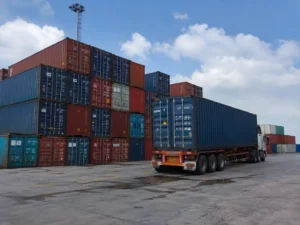
Operational Pain Points: Cargo stays at sea for weeks at a time without access to auxiliary power, while dense steel container walls create a Faraday cage effect that degrades GPS satellite signals.
Target 4G Specification: Must feature high-capacity industrial Li-SOCl2 batteries (ranging from 5000mAh – 20000mAh) coupled with hybrid WiFi/LBS positioning modes. When GPS signals are blocked, the terminal uses 4G networks to report adjacent vessel base station IDs and port WiFi router signals, allowing cloud servers to instantly calculate accurate position coordinates via reverse lookups.
Sourcing Checklist: Transitioning Fleet Hardware Without Supply Chain Disruptions
At the absolute tipping point of global 4G network migration, international procurement directors and industrial systems integrators must adopt a structured evaluation checklist to ensure new capital hardware assets secure at least a five-year lifecycle.
Future-Proof Cellular Core: Reject low-cost 2G/3G clearance inventories. Prioritize multi-mode baseband chipsets that inherently support global 4G bands and confirm operational compatibility with upcoming narrowband IoT scaling rollouts within your target markets.
Empirical Power Audits: Look beyond the nominal battery milliamp-hour (mAh) rating printed on the spec sheet. Require your manufacturing partner to provide verified current draw metrics under specific real-world behaviors—such as total standby decay rates when configured for single daily data reports.
Platform API and Firmware Interoperability: Robust tracking components require capable software backends. Confirm that the underlying asset management system delivers seamless Over-The-Air (OTA) firmware updates, multi-tenant reporting, adaptive geo-fencing, and full RESTful API capabilities to route field data directly into your corporate ERP or WMS infrastructure.
To assist your organization in navigating global telecommunication changes smoothly and avoiding terminal dropouts, GreatWill’s applications engineering desk is ready to assist. We can design a high-ROI 4G hardware transition and platform integration roadmap tailored to your primary operational geography, turnaround frequencies, and CAPEX allocations.
Procurement Intelligence: Technical & Supply Chain FAQ
From a B2B asset tracking ROI perspective, current 5G Sub-6GHz or mmWave modules impose hardware costs and peak power requirements that far exceed the operational scope of industrial tracking. 5G’s massive throughput is engineered for high-definition video streaming and autonomous vehicle arrays, whereas a standard positioning packet consumes only a few dozen bytes. 4G cellular architectures—especially when paired with low-power industrial IoT frameworks—will remain the dominant global infrastructure for the next 10 to 15 years, delivering an ideal balance of cost, battery life, and global availability. Yes. Utilizing the GreatWill Cloud Tracking & Management Platform, operators can manage hardware updates without recalling physical units from the field for manual serial-cable flashing. Taking advantage of 4G bandwidth, our platform pushes updated configuration files, APN profiles, or power-saving firmware patches to thousands of active field terminals in seconds without interrupting routine reporting intervals, significantly reducing long-term maintenance costs for systems integrators. GreatWill PCBA is designed with a dual solution at the factory: it supports standard industrial Micro/Nano IoT SIM card slots with shockproof locks to prevent ejection under vibration. For cross-border logistics customers, GreatWill enables low-level, protocol-based APN auto-configuration between global roaming SIM cards and local designated carrier networks, solving traffic procurement challenges for B-end customers in cross-border operations. Unshielded, consumer-grade alternatives frequently suffer from baseband signal distortion and satellite search failures caused by close-proximity magnetic fields. To solve this, GreatWill’s Industrial-Grade 4G Magnetic Trackers incorporate a highly permeable magnetic isolation layer between the rare-earth magnets and the internal PCB substrate. Furthermore, the internal omnidirectional 4G and ceramic GNSS antennas undergo rigorous simulation and matching network tuning. This ensures that outward RF radiation patterns remain completely unaffected by the static magnetic field beneath, preserving top-tier satellite acquisition and cellular connection performance.
Given the ongoing 2G/3G sunsets, why shouldn’t we bypass 4G and adopt 5G magnetic trackers immediately?
Do your 4G magnetic tracking devices support remote Over-The-Air (OTA) firmware updates? How do we handle network protocol shifts post-deployment?
Facing complex IoT SIM card restrictions across different countries (such as eSIM / physical SIM / roaming SIM), how does your hardware mainboard adapt?
Will the high-flux Neodymium magnets on a tracker disrupt the internal 4G or GNSS antenna signals during operation?




Responses
Discussion
0 responses
No responses yet
Start the discussion with a practical question or field note related to this article.