

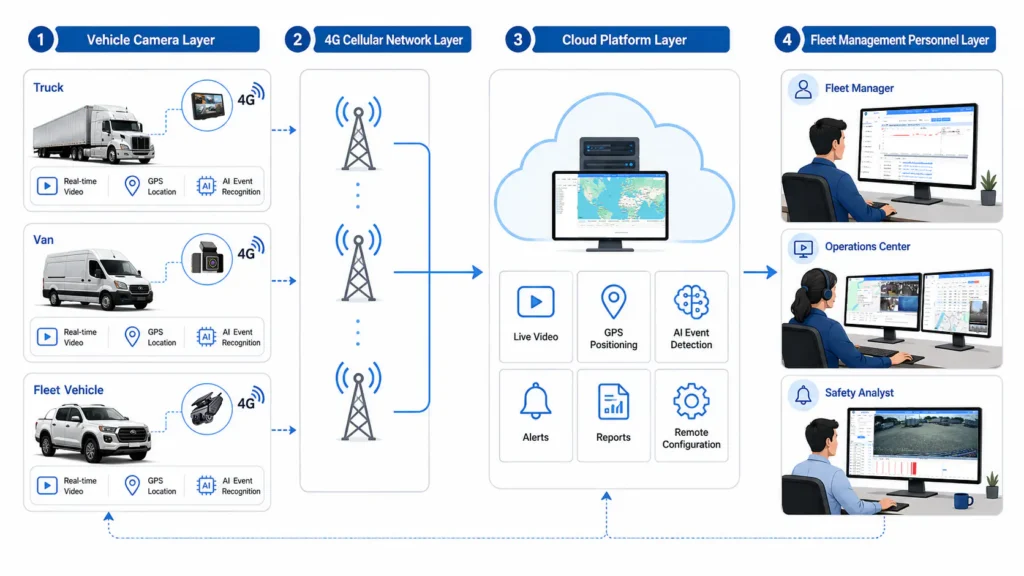
The biggest limitation of traditional dash cams is not image quality, but the data access method—you need to wait for the vehicle to return to the yard and manually remove the SD card to view the footage. 4G cellular connectivity fundamentally changes this process, enabling fleet managers to access live footage and location data the moment an incident occurs. The 4G Dash Cam fleet management solution integrates cellular connectivity, dual-channel video, GPS positioning, and AI event detection, helping fleet operators achieve remote visual management and control.
- How 4G connectivity transforms fleet management response speed and data access
- Fleet visibility capabilities brought by integrating GPS positioning with video evidence
- Specific operational strategies for remote fleet camera management and tiered alert design
- Core selection criteria and deployment roadmap for 4G Dash Cam systems
- Solution adaptation strategies for different fleet sizes
The Value of 4G GPS Dash Cams
The value of 4G connectivity for fleet management is reflected in three dimensions. The first is real-time capability: when collisions, harsh braking, or driver fatigue events occur, the device uploads event video and GPS coordinates to the cloud within seconds, and managers receive push notifications immediately without waiting for vehicles to return. The second is coverage: 4G LTE networks provide stable connections across most operational areas, covering remote routes and intercity highways without relying on Wi-Fi hotspots. The third is scalability: whether you manage 10 or 500 vehicles, 4G connectivity allows each device to independently connect to the cloud platform—adding new vehicles only requires installation and activation, without modifying existing IT infrastructure.
When designing the GreatWill 4G Dash Cam product line, multi-band 4G LTE modules were included as standard, supporting major carrier frequencies worldwide. This means that whether your fleet operates in North America, Europe, the Middle East, or Southeast Asia, the same hardware can adapt to local networks. For scenarios requiring live video streaming rather than just event uploads, learn more about the GreatWill 4G live streaming dash cam solution.
Fleet Dash Cam Benefits That Drive Operational Decisions
When fleet operators evaluate 4G Dash Cams, they face not a simple hardware procurement decision, but the selection of a comprehensive management system covering safety, efficiency, compliance, and cost control.
A 4G Dash Cam fleet management system is an in-vehicle terminal that integrates 4G cellular connectivity, dual-channel video, GPS positioning, and AI event detection. Unlike conventional dash cams, it enables fleet-level remote visual management and control through a cloud platform, merging real-time location with video evidence, and supporting automatic event uploads and remote management.
Real-Time Incident Visibility and Evidence
When a collision is detected, the 4G Dash Cam automatically locks 30-60 seconds of video footage before and after the event, along with precise GPS coordinates, timestamps, and G-sensor data, and uploads them to the cloud.
Effect: The impact in insurance claims and liability disputes is very direct—in cases with video evidence, innocent drivers are exonerated in over 80% of cases.
Applicable scenarios: Logistics and Delivery Fleets.
Recommended solution: Multi-channel dash cam + software platform + Nano SIM IoT Card (high data plan)
Driver Behavior Data for Safety Culture
AI-driven driver monitoring systems detect fatigue driving, phone usage, unfastened seatbelts, and distracted behavior in real time, prompting drivers to self-correct immediately through voice alerts.
Effect: The first 90 days after deployment are the most critical adaptation period. Fleet harsh braking and harsh acceleration events decrease by an average of 40-60% within 90 days.
Applicable scenarios: Long-haul Transport Fleets
Recommended solution: AI-enabled dash cam + software platform + Nano SIM IoT Card (high data plan)
Compliance Documentation Without Manual Work
Fleets operating in regulated environments—whether under North America’s ELD regulations, the EU’s tachograph rules, or China’s GB/T 28181 standard—require auditable vehicle activity records. The 4G Dash Cam automatically generates event logs with timestamps and location information, eliminating the need for compliance teams to manually compile reports.
For specific ROI calculations on how 4G Dash Cams impact fleet operating costs and insurance premiums, including quantified models for insurance rate reductions, fuel savings, and accident cost reductions, GreatWill has published an in-depth analysis on fleet operations.
GPS Tracking Dash Cam for Fleet: When Location Meets Video
GPS positioning and video recording each have limitations when used independently: GPS only tells you “where,” and video only tells you “what happened.” When combined, they create a complete fleet visibility capability—you can see not only the vehicle’s location but also what is happening at that location.
Geofencing with Automated Video Capture
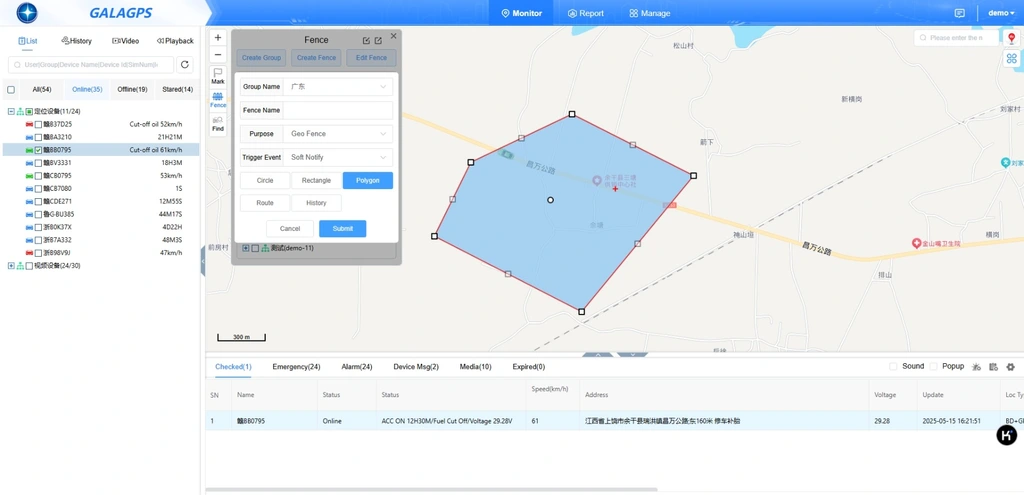
You draw virtual boundaries around customer warehouses, delivery sites, or restricted areas on the cloud map. When a vehicle enters or exits, the system automatically logs the event and triggers video recording.
Effect: Delivery arrival confirmation—when a vehicle enters the customer geofence, the system automatically captures unloading footage with timestamps and GPS coordinates, retrievable with one click during delivery disputes; unauthorized use detection—if a vehicle leaves the designated parking area outside of working hours, the system immediately pushes an alert and starts recording; route deviation monitoring—when a vehicle deviates from the preset route, the system records the deviation location and road conditions at that moment.
Route Replay for Dispute Resolution
Every trip becomes traceable. You select a date and vehicle on the cloud platform, and the system displays the GPS trajectory and corresponding video on a synchronized timeline. Click any point on the trajectory to instantly jump to the road conditions at that moment. Retention period: 90 days.
The 4G Dash Cam product line integrates a multi-constellation GPS module (GPS + BeiDou + GLONASS + LBS) with dual-channel video recording in a single device, achieving positioning accuracy of 1-5 meters. For operators requiring more comprehensive fleet coverage, GreatWill’s 4G fleet dash cam solution supports multi-channel recording and expanded sensor integration.
Managing Fleet Cameras Remotely: Beyond SD Card Retrieval
Remote management is the most intuitive experiential difference between 4G Dash Cams and traditional dash cams. When your fleet has 50+ vehicles distributed across different cities and routes, individually removing SD cards to view footage is extremely inefficient, and critical event videos may have been overwritten by loop recording before the card is retrieved.
Live Video Access and OTA Configuration
- Live video access: Retrieve real-time road view or cabin footage from any vehicle directly from the cloud platform, without the vehicle needing to return to the yard.
- Remote parameter configuration: Adjust recording resolution, alert sensitivity, audio recording toggle, and other parameters—individually or in batch—without dispatching technicians on-site.
- Firmware OTA updates: Push the latest AI algorithms and security patches to all devices without taking vehicles out of service for individual upgrades.
- Real-time event alerts: Upon collisions, harsh braking, fatigue driving, geofence violations, or camera obstruction, the system instantly notifies designated personnel via push notifications, email, or SMS.
Tiered Alert Strategy for Fleet Operations
The effectiveness of remote management depends largely on alert event design. If all events trigger instant notifications, managers become overwhelmed by information overload, and genuinely urgent events get buried.
Alert threshold settings should be based on your operational scenarios—the harsh braking threshold for urban delivery fleets differs from that of long-haul freight fleets. We recommend spending 2-4 weeks calibrating parameters during the initial deployment phase.
| Alert Level | Trigger Event Type | Notification Method | Response Time Requirement |
|---|---|---|---|
| Emergency | Collision, severe impact, SOS button, camera disconnection | Instant push + SMS | Respond within 5 minutes |
| High Priority | Harsh braking/acceleration, speeding, geofence violation, fatigue driving | Email + platform flag | Review within 1 hour |
| Routine | Idling events, route deviation, daily driving event summary | Platform dashboard | Daily/weekly batch review |
How to Choose a 4G Dash Cam System for Your Fleet
The core of selection is not comparing numbers on a spec sheet, but determining whether the system can genuinely solve problems in your operational scenarios.
Hardware and Connectivity Evaluation
Hardware quality directly determines system reliability under extreme conditions. Commercial vehicle operating environments feature large temperature variations, strong vibrations, and high humidity. Consumer-grade dash cams typically last no more than 6 months in such environments. When evaluating hardware, focus on verifying the following metrics:
| Evaluation Dimension | Key Metric | Procurement Verification Method |
|---|---|---|
| Operating Temperature | -20°C to 70°C continuous operation | Request thermal chamber test report |
| Power Supply | Supercapacitor (non-lithium battery) | Lithium batteries pose safety risks at high temperatures; supercapacitors have longer lifespan |
| Voltage Input | 9-36V or 12-48V wide voltage | Confirm coverage of both light and heavy vehicle voltage specifications in your fleet |
| Protection Rating | IP65 or above dust resistance | Request protection certification documents |
| 4G Frequency Bands | Covers major carrier bands in operational areas | Provide operational area list and request frequency band compatibility confirmation |
| Mounting Method | Screw fixation or industrial-grade adhesive | Request vibration test data |
AI capability is another critical evaluation dimension. The on-device AI processor determines the real-time performance and accuracy of event detection. Two aspects need to be verified: whether ADAS (Advanced Driver Assistance Systems) covers forward collision, lane departure, following distance, and pedestrian detection; and whether DMS (Driver Monitoring Systems) covers fatigue, phone usage, unfastened seatbelts, and distracted behavior. More importantly, require suppliers to provide measured false positive rate data—the target is to keep the false positive rate below 5%. High false positive rates lead to driver resistance, rendering the system effectively useless.
Cloud Platform and API Integration
The cloud platform is the primary interface for fleet teams’ daily work, and its usability directly determines system adoption rates.
- Role-based permission management—whether different access permissions and data visibility scopes can be set for fleet managers, safety officers, drivers, and senior management.
- API integration capability—whether an open REST API is provided to integrate with existing Transportation Management Systems (TMS), fleet dispatch systems, or ERP, avoiding data silos.
- Mobile support—whether iOS and Android apps are available, enabling both managers and drivers to view key information on mobile devices.
- Data storage policy—the default retention period for event videos in days, whether different retention strategies can be set by event type, and whether the billing model for expanded storage is transparent.
Deployment Roadmap: From Pilot to Fleet Wide Rollout
Deploying a 4G Dash Cam system is not a one-time installation—it requires a phased approach, allowing devices, processes, and teams to adapt gradually. (Reference plan, develop different plans based on your fleet’s specific conditions.)
- Phase 1 (Weeks 1-4): Select 5-10 vehicles representing different routes and vehicle types for pilot installation. Configure initial alert thresholds and collect driver feedback on AI alert frequency and accuracy. Establish baseline data: pre-deployment accident rate, harsh braking event count, average idle time, and fuel consumption.
- Phase 2 (Weeks 5-8): Calibrate AI sensitivity based on pilot data, reducing the false positive rate to below 5%. Launch a driver communication plan—explaining the system’s safety purpose and coaching orientation, rather than monitoring and punishment. Introduce driver safety scoring and weekly coaching processes. Present early results to management: the first exonerated claim, the first accident prevented, the first batch of improved driving data.
- Phase 3 (Weeks 9-16): Deploy to all vehicles in batches of 20-50 units. Integrate with existing dispatch and management systems via API. Train operations, safety, and compliance teams on using the cloud platform. Configure automated reports for management, safety managers, and drivers respectively.
- Phase 4 (Continuous optimization): Review KPI dashboards monthly—accident rate, fuel efficiency, driver scores, and alert trends. Conduct quarterly driver coaching based on video data. Update geofences and alert rules based on operational changes. Plan hardware refresh cycles—commercial-grade equipment is typically refreshed every 4-5 years.
Learn about our complete 4G Dash Cam product line, including specifications, solution selection, and OEM/ODM customization capabilities.
FAQ
What makes a 4G Dash Cam for fleet management different?
It is an in-vehicle terminal that integrates 4G cellular connectivity, GPS positioning, AI event detection, and a cloud management platform. Conventional dash cams only record video to a local SD card, requiring manual card removal for viewing. A 4G Dash Cam automatically uploads video and GPS data to the cloud when events occur, enabling managers to remotely view live footage, receive alerts, and manage video data for all vehicles without the vehicle returning to the yard.
What are the most important fleet dash cam benefits?
The core value depends on the fleet’s operational scenarios. For fleets with high safety risks, the most important features are AI driver monitoring and real-time collision alerts, which provide early warnings before accidents occur. For logistics and delivery fleets, GPS + video integrated geofencing and delivery confirmation features deliver the greatest value. For regulated fleets, automatically generated compliance event logs save significant manual effort. We recommend identifying your primary pain points before selection, then matching them to corresponding features.
How does a GPS tracking dash cam for fleets achieve position and video synchronization?
It integrates a multi-constellation GPS module and dual-channel cameras in the same device. While recording video, the device continuously receives satellite positioning signals, with each video frame tagged with precise GPS coordinates and timestamps. When an event is triggered, the system uploads a video clip with a position trajectory—not just a standalone video file or position coordinates. In the cloud platform’s route replay feature, the GPS trajectory and video footage are presented on a synchronized timeline.
What specific operations can be performed when managing fleet cameras remotely?
Four core categories of operations: real-time viewing of any vehicle’s current road conditions or cabin footage; remote modification of device parameters such as recording resolution, alert sensitivity, and audio recording toggle; remote pushing of firmware and AI algorithm updates to all devices; and configuring tiered alert strategies with different notification methods based on event severity. All these operations are completed through the cloud platform without requiring technicians on-site.
How long does it take to deploy a 4G Dash Cam system?
The deployment timeline depends on fleet size and existing infrastructure. A pilot with 5-10 vehicles is typically completed within 1-4 weeks. A full deployment for a 50-vehicle fleet generally takes 9-16 weeks, including batch installation, system integration, team training, and parameter calibration. We recommend reserving a 2-4 week parameter calibration period to allow AI alert thresholds to adapt to your actual operational scenarios.
Recommended Reading
- In-depth analysis of 4G Dash Cam ROI for fleet operating costs
- Why commercial truck fleets need 4G Dash Cams
- Multi-channel 4G Dash Cams: Why fleets need multi-camera systems



Responses
Discussion
0 responses
No responses yet
Start the discussion with a practical question or field note related to this article.