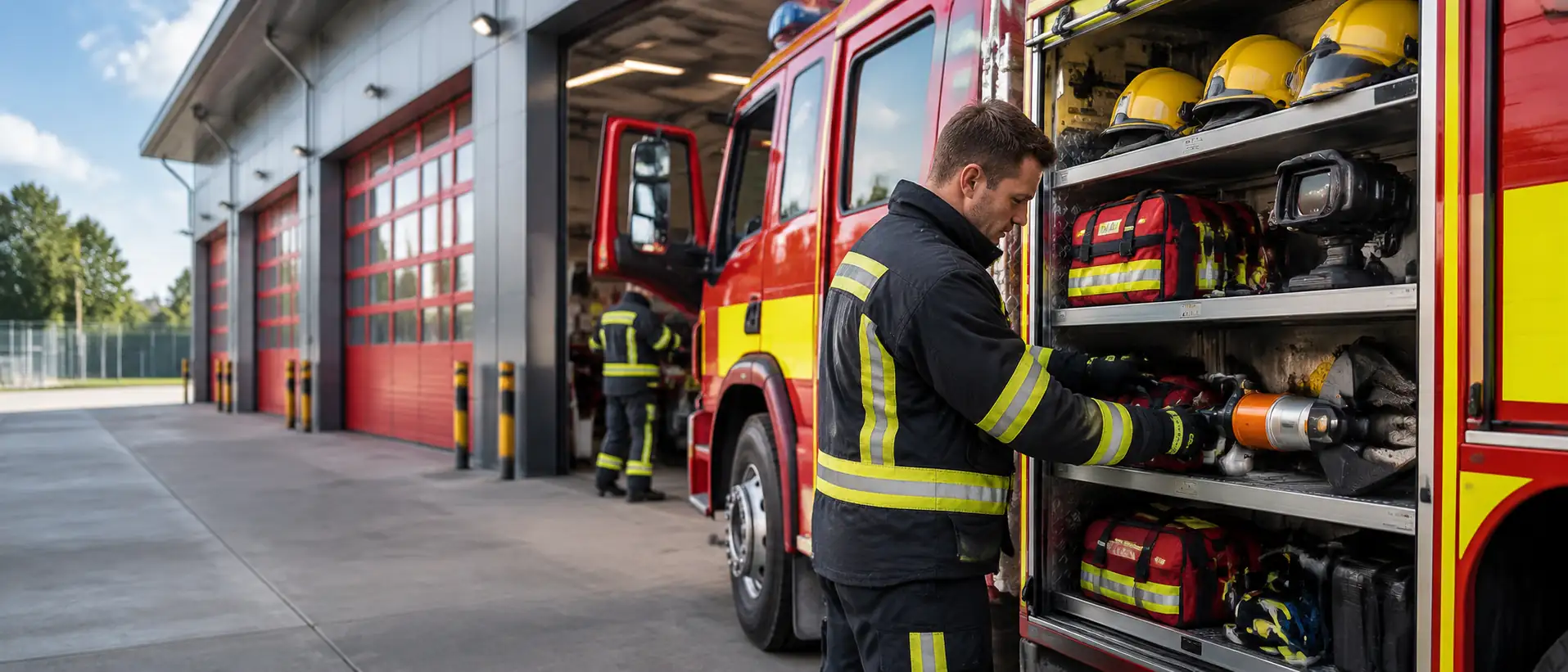
On 5 November 2026, ABAX announced that Lancashire Fire and Rescue Service (LFRS) has fitted its tracking hardware to frontline equipment carried on the brigade’s appliances, with receiving hubs installed inside the vehicles and in the station bays. The system logs what is loaded and where it is, and raises an alert when a tool is left behind or loaded onto the wrong engine.
The interesting part is not the GPS chip. It is the decision to track the equipment inside the vehicle rather than the vehicle alone. For any operator whose vehicles are legally or contractually required to carry a specific kit list, that is a different procurement problem from fleet location, with a different hardware brief and a different failure mode.
What Lancashire Fire and Rescue actually deployed
According to the release, the deployment covers three layers:
- Tagged assets. IP-rated ABAX locators are attached to critical tools, including thermal imaging cameras and hydraulic cutters.
- In-vehicle hubs. Receiving units inside the appliances and the station bays reconcile which tagged items are present, continuously rather than at shift check.
- Exception alerts. If an item is missing or has been loaded onto another appliance, the crew is notified rather than discovering the gap at the incident ground.
The compliance driver is specific to blue-light work. A fire engine cannot legally deploy without a certified inventory of lifesaving equipment on board, so the checklist is not an administrative nicety. The brigade’s previous process relied on manual checks, which consume crew time and depend on human accuracy during multi-agency callouts. ABAX states the deployment has produced 100% appliance compliance; that figure is the supplier’s own reporting on a single customer and should be read as a vendor claim, not an audited outcome.
Vehicle tracking and equipment tracking are separate problems
Most fleets already know where their vehicles are. Far fewer can answer, at 06:00, whether unit 14 has its calibrated gas detector and its second set of fall-arrest harnesses on board. The two questions need different hardware and different data models.
- What is tracked. A vehicle tracker reports the asset that moves itself. Equipment tracking reports items that are removed, swapped between vehicles, sent for calibration or stolen from an open bay.
- Where the reader sits. Vehicle tracking needs sky visibility for GNSS. Equipment reconciliation needs a short-range read zone inside the vehicle or the bay, which is a radio-coverage design problem, not a satellite one.
- What counts as an exception. For vehicle tracking, an exception is unauthorised movement, geofence breach, harsh driving or idling. For equipment tracking, the exception is absence: the item is expected on this vehicle at this time and is not detected.
- Who acts on the alert. Vehicle alerts route to a transport office or a duty manager. Equipment alerts have to reach the crew who is about to leave, which usually means a cab display, a station screen or a phone notification, not a monthly report.
This is why a fleet that already runs GPS tracking often cannot extend the same device to equipment. The existing unit answers where is the truck. It does not answer what is inside it. GreatWill’s asset and equipment GPS trackers cover the second case for high-value tools that leave the yard, while fleet GPS trackers handle the vehicle layer.
Why the compliance requirement changes the hardware brief
When the kit list is a legal condition of deployment, the tracking system inherits the reliability standard of the equipment it monitors. Three consequences follow, and they are the same whether the fleet is fire appliances, utility response vans or plant hire lorries.
1. Detection has to happen without the crew doing anything
A system that requires a crew member to scan each item at the bay door will be bypassed on a busy night shift. The design principle in the LFRS deployment is that the vehicle itself becomes the checkpoint: the hub reads what is loaded as the appliance is made ready. When specifying, ask how the read is triggered, whether it requires a driver action, and what happens if the appliance leaves before a reconciliation completes.
2. The read zone has to survive the vehicle
A steel-bodied appliance, a ladder stowage and a crowded equipment locker are hostile to short-range radio. Ask for the read range in metres, the number of tags a single hub can handle per cycle, and whether the hub needs line of sight. Then test it on your own vehicle, loaded, with the doors shut — not on a bench at the supplier’s office.
3. Absence alerts need a defined grace period
An alert that fires every time a tool is briefly taken out for inspection teaches the crew to ignore alerts. The useful parameter is the grace window: how long an item can be undetected before the system escalates, and whether that window can be set per item class. A thermal imaging camera and a consumable should not share the same rule.
What to specify before you copy the model
- Tag form factor and mounting. Confirm how the tag attaches to the asset without compromising it — adhesive, bracket, or a housing that survives being dropped. For assets that are themselves safety-certified, check that the tag does not interfere with calibration or the manufacturer’s warranty.
- Power and service interval. Battery-powered tags set the maintenance burden. Ask for the stated battery life under your expected read frequency, and whether the tag reports its own low battery before it stops answering.
- Hub installation cost per vehicle. This line is usually underestimated: wiring, mounting and the labour to fit a hub into an existing appliance can exceed the cost of the tags themselves.
- Identification method. Short-range radio tags and RFID are both used for equipment identity. If your yard already issues RFID-tagged tooling, an RFID-reading tracker such as the GT903K 4G RFID fleet tracker lets one device report vehicle position and tag reads together; if not, a dedicated hub plus battery tags is the more common build.
- Where the data lands and who owns it. Confirm whether reconciliation records are exportable, how long they are retained, and whether the records can be produced as evidence for an internal investigation or an insurer.
- Integration with the dispatch or maintenance system. The alert is only as useful as the list it is checked against. If the expected kit list lives in a spreadsheet, the system will drift out of date within a quarter.
Special-category vehicles add a further constraint: the equipment is often mounted in compartments that are opened only at the scene, so the reconciliation logic has to distinguish not loaded from loaded and currently out of the vehicle. Emergency and utility fleets can review the vehicle-side options on our special vehicle GPS tracking page.
What the case study does not tell you
Three questions are unresolved by the release, and a buyer should ask them directly.
- False-alert rate. No figure is given for how often the system reports a missing item that is in fact present. In a live fire station, that number determines whether crews trust the alerts.
- Effect on turnout time. Automating the check should shorten the pre-departure routine, but no before-and-after timing is published. Ask for it in a pilot.
- Cost per vehicle versus cost per tagged item. The release describes hardware and outcomes, not pricing. With 30 to 60 tagged items per appliance, the tag count — not the hub count — usually drives the total.
A pilot design that answers those questions in 90 days
Pick five vehicles and roughly 40 high-value items, and run the system alongside the existing manual check rather than replacing it. Record three numbers weekly: reconciliation completeness at departure, false-alert count per vehicle per shift, and minutes spent on the pre-departure check. A deployment that improves the first two without worsening the third is worth scaling; one that shortens the check by creating alert fatigue is not.
For fleets where the tracked items are themselves mobile and rarely inside a vehicle — plant, generators, towed equipment — a battery-powered asset tracker is the cheaper starting point than a hub-based build, for example the GAT27 4G LTE asset GPS tracker. The two approaches are complementary rather than competing, and most mixed fleets end up running both.
GreatWill supplies the device layer for both builds: wired 4G trackers for vehicles, magnetic and battery-powered units for equipment, and RFID-reading models where tagged tooling already exists. The specification conversation is more useful when it starts from your kit list and your vehicle layout than from a catalogue.
Frequently asked questions
Does a fleet GPS tracker tell you whether equipment is on board?
No. A vehicle tracker reports the position and movement of the vehicle itself. Confirming that a specific tool is loaded requires a tag on the item and a reader inside the vehicle or the bay, plus a rule for how long an absent item may go undetected before an alert is raised.
What did Lancashire Fire and Rescue actually change?
According to ABAX’s 5 November 2026 release, the brigade tagged critical equipment with IP-rated locators and fitted receiving hubs in its appliances and station bays, so that inventory reconciliation happens automatically instead of through manual checklists. The supplier reports 100% appliance compliance; that figure has not been independently audited.
How accurate is equipment-level tracking inside a steel vehicle body?
It depends on the radio technology, hub placement and how densely the locker is packed. Ask the supplier for the read range and tag capacity per cycle, then test on a loaded vehicle with doors closed. Bench demonstrations overstate real-world read performance.
What is a realistic false-alert rate to accept?
There is no universal figure, but the operating test is whether crews keep responding to alerts after the first month. If a station learns to ignore the notification, the system has failed regardless of its detection accuracy. Track false alerts per vehicle per shift during the pilot.
Can equipment tracking replace the manual pre-departure check?
Not on day one. Run both in parallel until reconciliation completeness and false-alert rates are stable, and until the expected kit list in the system matches the real one. For regulated fleets, confirm with your compliance lead whether an automated record is acceptable evidence of the check.
Source
ABAX, “Technology drives operational readiness: Lancashire Fire and Rescue Service optimises fleet compliance with ABAX”, Cision News, published 5 November 2026: read the original release.