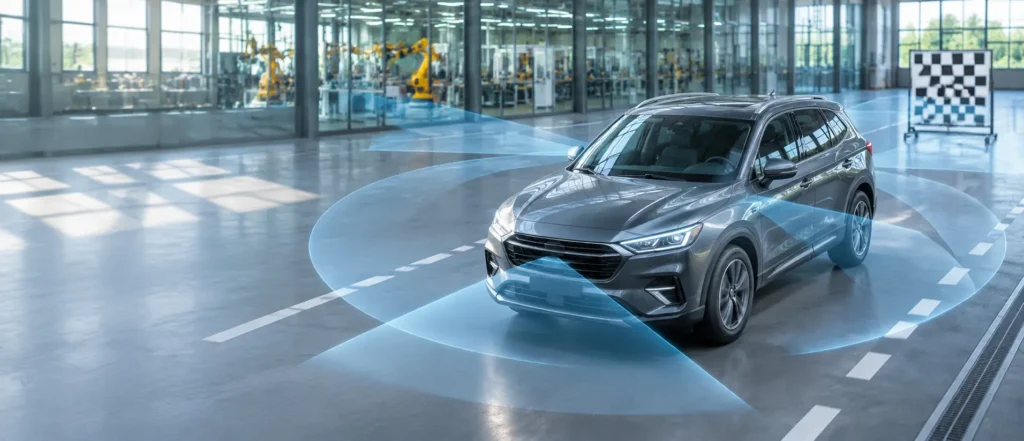

On 27 October 2026, GlobalData published a forecast that puts Asia-Pacific 360-view camera systems at 7.2 million units in 2026 and 10.1 million units in 2033, a 4.9% compound annual growth rate. For anyone specifying vehicle camera hardware, the percentage is the least interesting part. The volume is what matters: about 2.9 million additional fitted systems across seven years, roughly 414,000 units of new demand per year, which is the kind of run rate that moves lens, sensor and SoC pricing.
What the forecast actually covers
Three details determine how far the number can be stretched:
- Scope: factory-fitted 360-view camera systems on passenger vehicles in Asia-Pacific, not retrofit kits.
- Volume: 7.2 million units (2026) rising to 10.1 million units (2033), a 4.9% CAGR over 2026-2033, equal to about 40% cumulative growth.
- Source report: GlobalData, Global Sector Overview & Forecast: Automotive Cameras Q3 2026.
GlobalData analyst Madhuchhanda Palit framed the technology as a packaging decision rather than a luxury feature. Manufacturers position 360-view inside wider parking-assistance and ADAS bundles, use it as a trim-level differentiator, and can push it into higher-volume segments as camera hardware and processing become more cost-effective. Consumer acceptance, in her reading, depends on whether the feature is intuitive to use and reliable across different lighting, weather and traffic conditions.
One caution before the figure goes into a business case: this is factory fitment on passenger cars. It is not an aftermarket dashcam shipment forecast and it does not count retrofit multi-camera systems on vans, trucks or buses. Both markets draw on the same lens, sensor and SoC supply, but their demand drivers are unrelated.
Why dense cities, not premium buyers, set the requirement
GlobalData attributes the APAC relevance to urban geometry: constrained parking, narrow residential streets, mixed road use, and constant low-speed proximity to motorcycles, bicycles, pedestrians and roadside objects. That describes the operating environment of most delivery, service and utility fleets in the region, where the expensive incidents are rarely high-speed crashes. They are car-park contact, mirror and corner swipes, and side impacts in dense traffic: low severity, high frequency, frequently disputed.
That distinction decides what the hardware is for. On a passenger car, a surround-view system is a driver aid: four fisheye views stitched into one top-down image on a dashboard screen. On a commercial vehicle, the same four views carry a second job, producing usable evidence after an incident and moving it off the vehicle before the loop overwrites it. A system that only displays is a parking aid. A system that records, timestamps and uploads is a claims tool. Buyers should be explicit about which of the two is being quoted, because the second one changes the specification, as set out in our fleet dashcam solutions notes.
What rising factory fitment means for aftermarket buyers
The cost curve moves in your favour, on a delay
Volume of this shape usually produces two effects: lens and sensor prices fall as Tier 1 programmes scale, and stitching moves onto cheaper SoCs because surround-view becomes a standard block rather than a custom design. That is the same mechanism GlobalData describes when it expects the feature to migrate from premium to higher-volume segments.
The timing is the catch. Automotive programmes are specified long before volume arrives, so any module cost benefit reaches aftermarket and fleet buyers after the design cycle, not during it. A procurement plan that assumes immediate price relief from a 2026 forecast will be disappointed; one that assumes gradual multi-source supply over three to five years is closer to how this normally plays out.
Differentiation shifts to retention and telematics
If 360-view becomes standard on mid-trim passenger cars, “we have 360 view” stops being a selling point for a retrofit device. What stays scarce is what a carmaker does not sell with the vehicle: multi-day loop retention at a usable bitrate, per-channel metadata, remote retrieval over 4G, and correlation with driver-behaviour or ADAS event data. That is the space a multi-channel lens dash cam with a cellular uplink still occupies in a fleet specification, and it is why four recording channels and four display views are not interchangeable purchases.
Questions that decide the hardware quote
- Coverage against claims data. Full surround coverage, or two or three channels aimed at the blind spots that appear repeatedly in your incident reports? A three-channel installation often resolves more disputes per unit cost than a four-camera display system that stores nothing.
- Resolution with its bitrate. A channel quoted at 2K means little on its own. The same scene at 4 Mbps and at 8 Mbps differs by roughly a factor of two in storage per hour, so ask for the bitrate that applies to the resolution quoted.
- Retention in days. For a four-channel configuration, require storage consumed per vehicle per day at the quoted settings, then check card or SSD capacity against your retention target of 7, 14 or 30 days.
- Uplink budget. Live viewing of four channels at main-stream bitrates saturates a 4G uplink quickly. Most fleets run a substream for routine monitoring and pull the main stream only for evidence export, which keeps monthly data cost predictable.
- Thermal and ingress behaviour. A windshield-mounted unit in a parked vehicle in South or Southeast Asia sees cabin temperatures well above ambient. Ask for the operating range and for the recorder’s behaviour at the top of that range, not just at 25 degrees C.
- Platform and access. Confirm which platform the device streams to, whether owner, dispatcher and insurer roles can view the same vehicle, and whether exported footage keeps its timestamp and channel labels.
- Installation path. Retrofitting four cameras into a van or light truck means routing harnesses through existing apertures. Get cable lengths and connector types before approving the install, or the labour estimate will be wrong.
What to watch over the next two to three years
Three signals will show whether the forecast is being met: the attach rate of 360-view in mid-trim APAC models rather than top trims, whether ADAS bundles absorb the feature as standard equipment, and module cost per camera. If fitment stays a top-trim feature, the retrofit window stays open longer. If it moves down-market as GlobalData expects, retrofit value shifts decisively to recording, retention and telematics, and buyers should specify accordingly instead of paying for a display function the vehicle already has.
FAQ
Does the GlobalData forecast include aftermarket dashcams?
No. It covers factory-fitted 360-view camera systems on passenger vehicles in Asia-Pacific, 7.2 million units in 2026 rising to 10.1 million in 2033 at a 4.9% CAGR. Retrofit multi-camera systems for vans, trucks and buses are a separate market with different buyers and different specifications.
Is 4.9% growth enough to change hardware prices?
On its own, 4.9% is a moderate rate. The relevant figure is the increment: about 2.9 million additional units across the forecast period, roughly 414,000 units of new demand per year. That volume supports multi-source lens and sensor supply and gradual cost reduction, not a price collapse.
Should a fleet buy a 360-view system or a multi-channel dashcam?
If the requirement is parking and manoeuvring assistance for the driver, a surround-view display system fits. If the requirement is evidence, retention and remote retrieval after an incident, specify a multi-channel recorder with 4G, a stated per-channel bitrate and a defined retention period. Many fleets end up needing both, purchased separately.
What bitrate should we require per channel?
Require a stated bitrate at the stated resolution and frame rate, then test retention against it. A practical check is to record a full day at the exact settings and firmware you will deploy and measure the storage consumed, rather than relying on a card-capacity claim.
Why does APAC density matter to a buyer outside APAC?
It matters for pricing and supply rather than for demand. The same camera modules and SoCs serve factory surround-view programmes and aftermarket recorders, so volume growth in APAC affects module availability and cost in other regions too.
Source
GlobalData, “APAC automotive 360-view camera market to record 4.9% CAGR over 2026-33, forecasts GlobalData”, published by Just Auto on 27 October 2026. Original article: just-auto.com. Report cited: Global Sector Overview & Forecast: Automotive Cameras Q3 2026.